
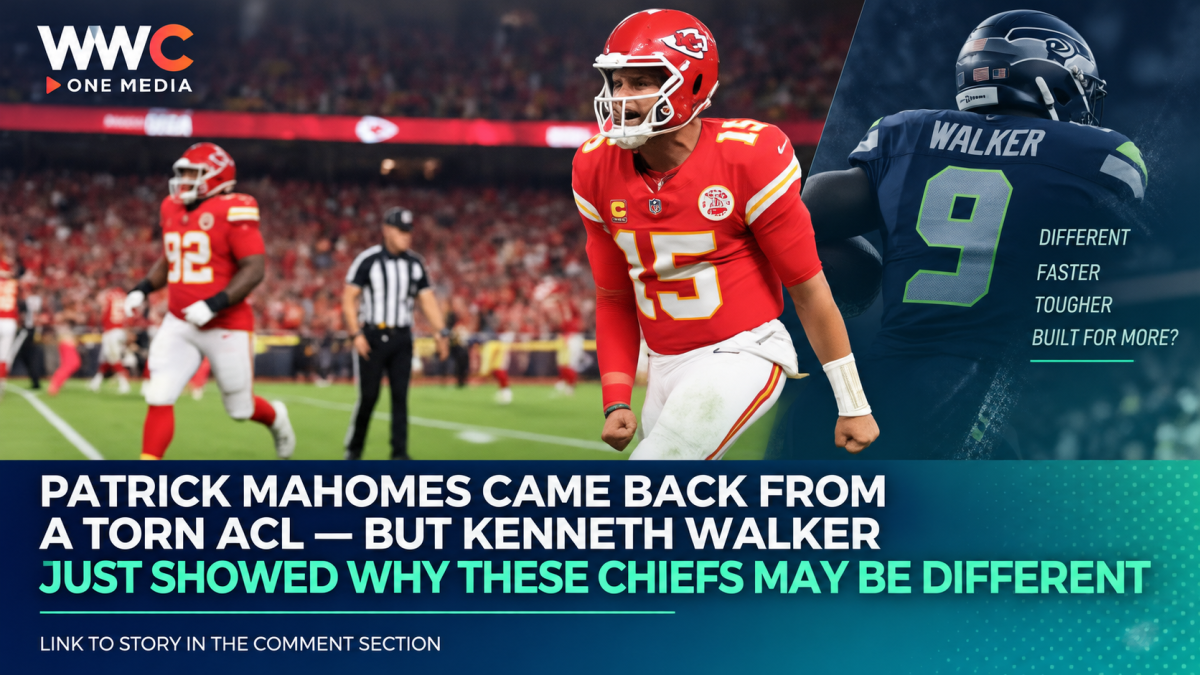
KANSAS CITY, Missouri — Patrick Mahomes waited nine months to answer the question hanging over the Kansas City Chiefs.
Could his surgically repaired left knee still handle an NFL game?
By the end of Monday night, the answer looked encouraging.
But something unexpected happened while Mahomes was proving he could run, scramble and absorb contact again.
For perhaps the first time in years, Kansas City did not need him to be Superman.
That job belonged to Kenneth Walker III.
Walker shredded the reigning AFC West champion Denver Broncos for a career-high 173 rushing yards, added 18 yards receiving and scored twice as Kansas City opened its 2026 season with a statement 31-10 victory at Arrowhead Stadium.
The former Seattle Seahawks star produced 191 yards from scrimmage, more than Denver’s entire offense managed collectively.
The Broncos finished with just 176 total yards.
And that may be the statistic that should worry the rest of the AFC.
For most of the Mahomes era, opponents entered games believing that if they could somehow contain Kansas City’s quarterback, they could contain Kansas City.
Walker’s debut suggested that equation may have changed.
Walker needed one game to justify the hype
Kansas City made one of the NFL offseason’s boldest moves when it signed Walker to a reported three-year, $43 million contract.
That was a significant investment at a position where many NFL clubs have become reluctant to spend heavily.
But Walker did not arrive as an ordinary free agent.
He came to Kansas City after winning Super Bowl LX MVP honors with Seattle in February, then immediately became the centerpiece of the Chiefs’ attempt to rebuild an offense coming off a disastrous season.
His first regular-season game could hardly have gone better.
Kansas City handed him the ball on each of its first four offensive plays. He received seven carries on the opening touchdown drive alone.
The message from coach Andy Reid was unmistakable:
The Chiefs did not pay Walker to become another complementary weapon. They paid him to reshape the offense.
Walker responded with 23 carries for 173 yards — an average of roughly 7.5 yards every time he ran the football.
Then came the play that turned an impressive debut into a national headline.
Fourth-and-1 became 60 yards
Kansas City led 14-7 early in the third quarter when it faced fourth-and-1.
That normally calls for a simple objective: move the chains.
Walker did considerably more.
He bounced the run outside, escaped Denver cornerback Riley Moss and accelerated down the left side for a 60-yard touchdown.
Kansas City suddenly led 21-7.
By the time Walker crossed the goal line, Reuters noted that he alone had accumulated 165 yards while the entire Broncos offense had 113.
He later scored again on a two-yard reception from Mahomes early in the fourth quarter, pushing the lead to 31-10 and effectively ending the game.
NFL Research put the performance into perspective.
Walker’s 191 scrimmage yards were the most ever by a reigning Super Bowl MVP in a Week 1 game, surpassing Jerry Rice’s 180 in 1989.
His 173 rushing yards were also the second-most by a veteran player making his debut for a new team, behind Michael Turner’s 220-yard Atlanta debut in 2008.
Not bad for a first night at Arrowhead.
And Kansas City has been waiting years for this
Walker’s arrival matters because one statistic has quietly followed the Chiefs throughout Mahomes’ championship era.
Kansas City has not had a 1,000-yard rusher since Kareem Hunt in 2017.
That was the year before Mahomes became the full-time starting quarterback.
Since then, Kansas City’s offensive identity has revolved overwhelmingly around Mahomes.
At its best, that produced spectacular football.
At its worst, particularly when offensive-line protection or receiving options deteriorated, the Chiefs became overly dependent on Mahomes improvising solutions.
Walker gives Reid another possibility.
A defense can no longer automatically devote everything to preventing Mahomes from throwing deep or escaping the pocket.
If opponents lighten the box, Walker can run.
If they load defenders near the line of scrimmage, Mahomes gets better passing looks.
And if Kansas City is protecting a lead, it may finally possess a running back capable of controlling the game without requiring Mahomes to throw 40 times.
Monday offered the first glimpse of that formula.
Mahomes’ comeback was still remarkable
Walker stole the night, but Mahomes’ presence was arguably the bigger preseason question.
Nine months earlier, Kansas City’s franchise quarterback tore the ACL and LCL in his left knee during a December loss to the Los Angeles Chargers.
He underwent surgery the following day and immediately began an aggressive rehabilitation programme.
The timing made a Week 1 return far from guaranteed.
Mahomes nevertheless progressed quickly enough to participate fully in training camp, although Kansas City kept him out of all three preseason games.
By September 12, he carried no injury designation and was officially cleared to start against Denver.
Then, in the first quarter Monday, he provided an answer far more convincing than anything a medical report could show.
He ran directly into the defense.
The 15-yard run mattered more than six points
Mahomes initially scrambled for a touchdown that was erased by a penalty.
On the very next play, he did it again.
This time the 15-yard run counted.
Mahomes accelerated up the middle, crossed the goal line and celebrated a touchdown that gave Kansas City its first points of the season.
For a quarterback returning from two torn knee ligaments, it was an unusually aggressive way to announce that rehabilitation was over.
Mahomes later admitted that one of his biggest concerns was simply discovering how the repaired knee would respond when he was hit.
After months of rehabilitation, he said he wanted to get back to playing football.
He did not deliver one of his statistical masterpieces.
Mahomes completed 15 of 27 passes for 184 yards, two touchdowns and one interception, while adding 23 rushing yards and the touchdown.
There was rust.
There were inaccurate throws.
And he made one particularly costly-looking mistake.
But that mistake also revealed how different these Chiefs could be.
Denver was handed the ball at the Kansas City 5 — and got three points
Mahomes threw an interception to Denver safety Brandon Jones in the third quarter.
Jones returned it all the way to the Chiefs’ 5-yard line.
For most teams, that is the kind of turnover that changes a game.
Denver went backwards.
The Broncos lost eight yards in three plays before settling for a 31-yard Wil Lutz field goal.
Instead of slicing Kansas City’s lead to one score with a touchdown, Denver made it 21-10.
Kansas City responded with a field goal.
Walker scored again shortly afterward.
Game over.
That sequence illustrated another major reason the Chiefs looked so comfortable Monday.
Their defense overwhelmed Denver.
Bo Nix had nowhere to go
Denver quarterback Bo Nix finished 17 of 28 for only 131 passing yards, with one touchdown and one interception.
He was sacked four times.
Denver rushed only 15 times as a team.
Its leading rusher, J.K. Dobbins, produced just 36 yards.
The Broncos managed only nine first downs, including one created by penalty, and converted just two of 12 third-down attempts.
Nix did produce one strong early moment, finding Evan Engram for a 19-yard touchdown that tied the game 7-7.
After that, Denver scored only three more points.
That was hardly the debut new offensive play-caller Davis Webb wanted.
Webb took over play-calling duties from head coach Sean Payton this season, but his first game produced only 176 total yards.
The contrast was brutal:
Kenneth Walker: 191 scrimmage yards.
Denver Broncos: 176 total yards.
Denver’s defense also suffered an ugly tackling collapse
Denver entered the season with expectations of fielding one of football’s better defenses.
Monday did not look anything like that.
According to NFL Next Gen Stats cited by NFL.com, the Broncos missed 28 tackles.
Those missed tackles produced 247 additional yards, the most surrendered by any defense through missed tackles since at least 2018.
Walker obviously accounted for much of the damage.
But Kansas City also received an encouraging performance from an offensive line that entered the game with serious questions.
Undrafted rookie Kahlil Benson was forced to start at left tackle in place of injured Josh Simmons.
Against a Denver defense that recorded a franchise-record 68 sacks last season, Benson allowed only one pressure over 32 pass-blocking snaps, according to NFL.com.
For a Chiefs team trying to protect a quarterback returning from reconstructive knee surgery, that mattered enormously.
Travis Kelce quietly made history too
Amid Walker’s breakout and Mahomes’ comeback, another Chiefs star reached a major milestone.
Travis Kelce caught three passes for 71 yards.
One went for 59 yards in the third quarter.
That reception pushed Kelce past Hall of Famer Jason Witten for second place on the NFL’s all-time list for receiving yards by a tight end.
Kelce ended the night with 13,073 career receiving yards.
Only Tony Gonzalez remains ahead of him at 15,127.
Kelce may need considerable time to catch Gonzalez, but reaching second place adds another milestone to one of the most productive tight-end careers in league history.
And perhaps even more tellingly, Kansas City scored 31 points without needing Kelce to dominate the passing game.
Think about how different that is from last season
The 2025 Chiefs were almost unrecognizable compared with the dynasty that preceded them.
Kansas City finished 6-11.
It lost its final six games.
It missed the playoffs for the first time since 2014.
And Denver snapped the Chiefs’ remarkable streak of nine consecutive AFC West championships, winning the division with a 14-3 record.
Mahomes also endured the weakest statistical season of his career as a full-time starter.
In 14 games, he completed about 62.8% of his passes for 3,587 yards, 22 touchdowns and 11 interceptions.
Then came the knee injury.
For the first time in years, Kansas City entered an offseason looking less like the team everyone was chasing and more like one that needed substantial repair.
Monday night does not prove those problems have vanished.
It was one game.
But beating the team that replaced you atop the division by three touchdowns is about as effective a response as Kansas City could have produced.
Walker may be the key to extending the Mahomes era
The obvious temptation after Monday is to declare that Mahomes is completely back.
That would be premature.
He was inaccurate on several throws.
The interception was poor.
He is still only nine months removed from reconstructive knee surgery.
The more consequential takeaway may be that Kansas City finally looks capable of allowing Mahomes to work his way back gradually.
The Chiefs rushed 38 times for 220 yards against Denver.
Walker alone handled 23 carries.
Mahomes attempted only 27 passes.
That is a dramatically more balanced workload than the offense Kansas City has often relied upon during the quarterback’s career.
It also gives Reid another tool for keeping Mahomes healthy.
Every successful Walker run is potentially one fewer snap on which Mahomes has to drop back behind the offensive line, wait for a receiver to separate and expose himself to a pass rush.
For a 31-year-old quarterback coming off a serious knee injury, those saved hits could matter in December far more than they do in September.
Walker changes the math for defenses
For years, opposing coordinators have built game plans around one core principle:
Do not let Mahomes beat you deep.
Force Kansas City to be patient.
Take away explosive throws.
Pressure the quarterback without allowing him to escape.
Walker complicates every part of that strategy.
Kansas City now has a running back capable of punishing lighter defensive fronts.
He can create explosive plays without the quarterback throwing the ball.
He can convert short-yardage situations.
He can catch passes.
And, at least Monday, he demonstrated the ability to turn one missed tackle into a 60-yard touchdown.
Denver discovered that problem immediately.
The Broncos were supposed to be testing Mahomes’ reconstructed knee.
Instead, they spent much of the night trying — and frequently failing — to tackle No. 9.
There is still one reason not to overreact
Week 1 is notorious for producing misleading conclusions.
Teams are installing new schemes.
Players are adjusting to new teammates.
Coaches have limited regular-season film on opponents.
And one exceptional performance does not guarantee another 16 games of the same thing.
Walker has also dealt with injuries during his NFL career, and a workload of 23 carries per game over a full season would create its own physical demands.
Mahomes still needs to prove his knee responds well week after week.
Denver will almost certainly tackle better than this in future games.
And Kansas City has played exactly one meaningful game since finishing 6-11.
Mahomes himself made that point after the victory, stressing that this was merely the beginning of a long season.
That caution is justified.
But the Chiefs did not need Monday night to prove they are already Super Bowl contenders.
They needed to prove last season’s collapse had not become their new identity.
They did that emphatically.
The most important comeback may not have been Mahomes’
Patrick Mahomes walking onto the field nine months after tearing two knee ligaments was supposed to be the defining image of Kansas City’s season opener.
And it was remarkable.
But the Chiefs may have discovered something even more important.
Mahomes can come back without having to bring the entire franchise back by himself.
Walker gave Kansas City 173 rushing yards.
The defense allowed Denver 176 total yards.
The offensive line protected Mahomes.
Kelce made history.
And Kansas City beat the reigning division champion by 21 points despite Mahomes openly acknowledging that he did not play his best football.
That is the part of Monday night that should get the AFC’s attention.
Kansas City spent most of the Mahomes era terrifying opponents because of what its quarterback could do.
After Kenneth Walker’s first game, the scarier possibility is that Patrick Mahomes may no longer have to do nearly as much.




Leave a Reply