
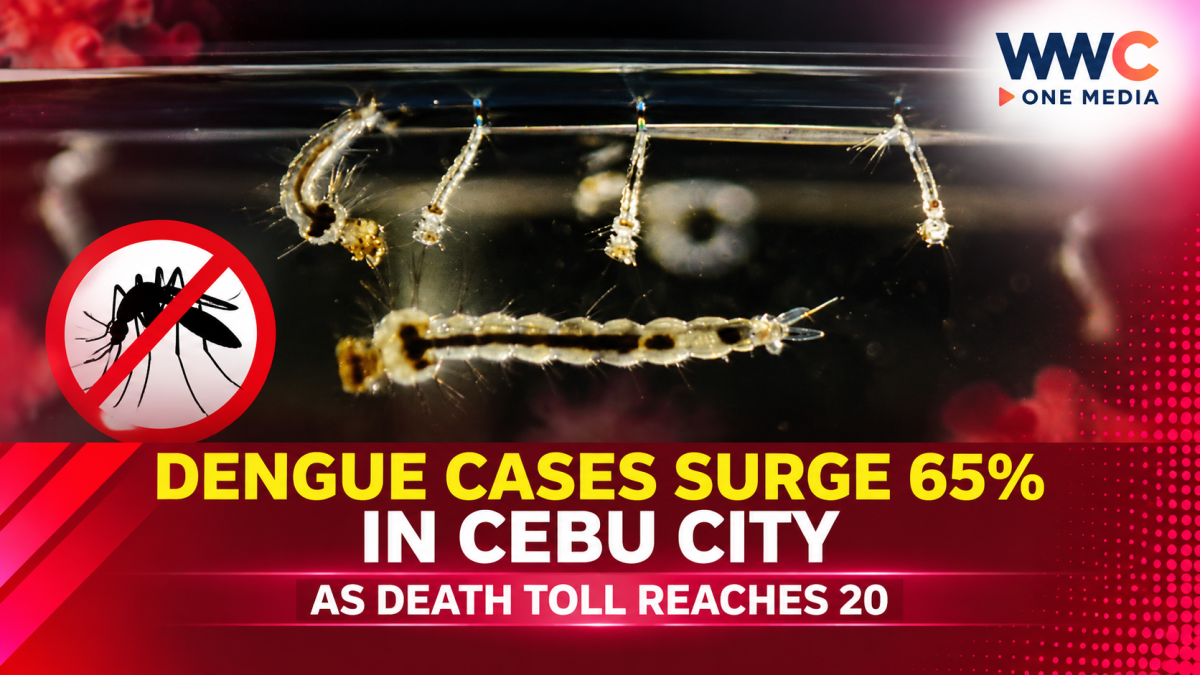
Cebu City has recorded a sharp increase in dengue cases this year, with 20 people dying from the mosquito-borne disease from January through early September 2026.
Data from the Cebu City Health Department showed 2,456 dengue cases between January 1 and September 5, compared with 1,484 cases recorded during the same period in 2025.
That represents an increase of 972 cases, or about 65.5 percent.
The death toll has also more than tripled, rising from six dengue-related deaths in 2025 to 20 this year.
Cebu City sees major rise in dengue infections
The increase has prompted the city government to strengthen its dengue prevention efforts, particularly in communities where cases are highest.
Kenneth Siasar, chief of staff of Cebu City Mayor Nestor Archival, said stagnant water remains one of the biggest contributors to mosquito breeding.
Dengue-carrying mosquitoes can reproduce not only in outdoor areas but also inside homes.
Containers such as uncovered buckets, barrels and drums can collect enough water to become breeding sites. Flower vases that are not regularly cleaned and blocked or stagnant drainage areas can also create conditions where mosquitoes multiply.
City officials are therefore urging residents to make dengue prevention part of their regular household cleaning routines.
Cebu City Medical Center records 16 deaths
Separate figures from the Cebu City Medical Center show the extent of the problem within the city’s public healthcare system.
The hospital recorded 844 dengue patients from January 1 to September 13.
Of those patients, 297 were admitted for treatment while 547 were handled as consultations.
The medical centre recorded 16 dengue-related deaths during the same period.
Officials explained that the figures from the City Health Department and Cebu City Medical Center are different because the CHD also receives reports from private hospitals across the city.
The broader CHD figures therefore provide a more comprehensive picture of dengue cases in Cebu City.
Ten barangays identified as high-risk areas
The city government has identified several barangays with particularly high numbers of dengue cases.
They include Guadalupe, Lahug, Basak San Nicolas, Tisa, Labangon, Talamban, Mambaling, Kalunasan, Punta Princesa and Apas.
Authorities plan to prioritise these areas for mosquito-control activities instead of waiting for individual barangays to request assistance.
The city government has also ordered misting operations in areas where dengue transmission is considered a concern.
Cleanup efforts expanded
The city government is strengthening information campaigns and encouraging barangay health workers to remind residents that dengue prevention cannot focus only on public spaces.
Households also need to regularly inspect their surroundings for containers and other areas where water can accumulate.
Officials are also carrying out cleanup activities in public areas while encouraging families to maintain cleanliness inside their homes.
At Cebu City Hall, officials ordered additional cleaning after at least one employee was confirmed to have contracted dengue.
The city government has not yet determined how many other City Hall employees may have been infected.
Children remain particularly vulnerable
Children remain among those considered more vulnerable to dengue because they may spend more time outdoors, where they can be exposed to mosquito bites.
Adults can also become infected, particularly in workplaces where stagnant water may not be immediately noticed.
Health officials are therefore urging residents, schools, workplaces and communities to maintain regular mosquito-control measures rather than relying solely on occasional cleanup drives.
Is Cebu City facing a dengue outbreak?
Despite the sharp increase in infections and deaths, city officials have not yet declared the situation an outbreak.
Siasar said he was not aware of the specific threshold used by the City Health Department to make such a declaration.
The city government and CHD are expected to continue assessing the latest dengue data as cases rise.
For now, the increase in infections and deaths is prompting stronger prevention efforts, with authorities placing greater emphasis on eliminating stagnant water and targeting communities where dengue cases are highest.
With more than 2,400 cases and 20 deaths already recorded this year, Cebu City’s latest dengue figures underline the importance of sustained mosquito-control efforts inside homes as well as throughout public areas.




Leave a Reply