
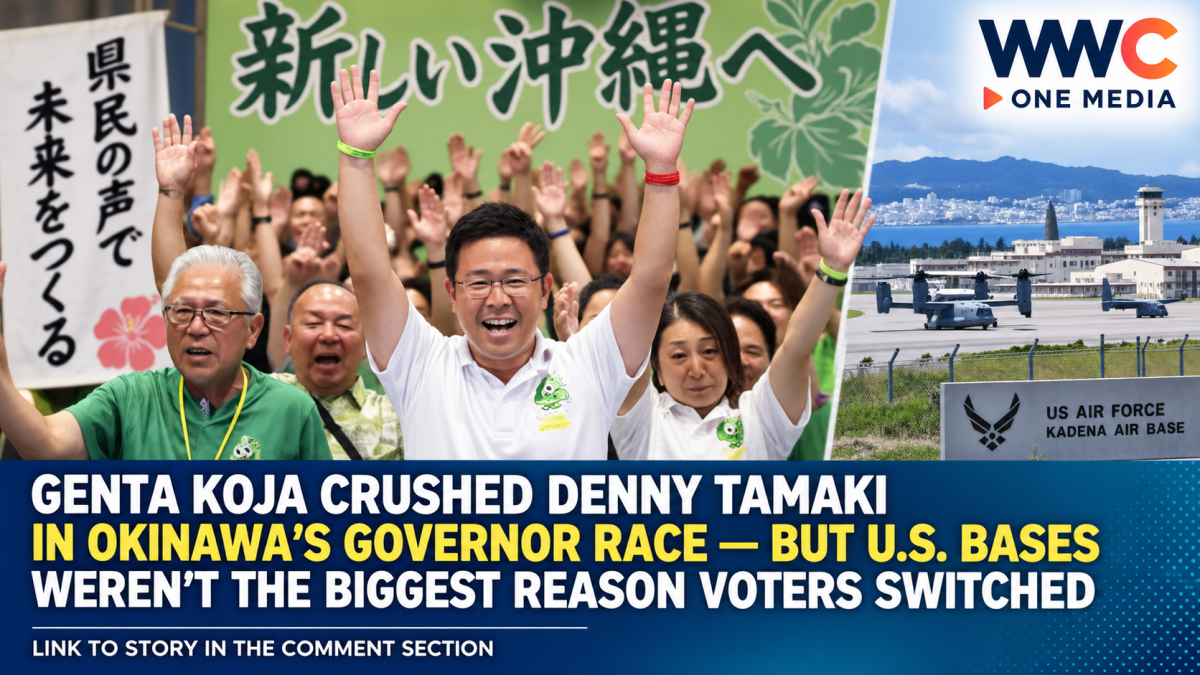
NAHA, Japan — Okinawa has delivered one of its most dramatic political reversals in more than a decade.
Genta Koja, a 42-year-old former deputy mayor of Naha backed by Prime Minister Sanae Takaichi’s ruling Liberal Democratic Party and a broad coalition of conservative and centrist parties, has decisively defeated two-term Governor Denny Tamaki.
This was not close.
The final count gave Koja 423,124 votes, compared with 276,060 for Tamaki, according to Okinawa’s official election tally. Four minor candidates shared only a small fraction of the remaining vote.
Koja’s victory ends 12 consecutive years in which Okinawa was governed by leaders opposed to relocating U.S. Marine Corps Air Station Futenma to Henoko, and it gives Tokyo something successive national governments have wanted for years:
An Okinawa governor who does not intend to fight the Henoko project at every available political and administrative turn.
But interpreting the result simply as “Okinawa votes for U.S. bases” would miss the most important thing that happened.
The electorate changed the question.
Koja didn’t just win. He won almost everywhere.
The scale of Koja’s victory is striking when the official municipal results are examined.
He beat Tamaki comfortably in Naha, Okinawa’s capital and largest city, by 86,336 votes to 60,161.
He also won Ginowan, home to the controversial Futenma air station, by 31,585 to 17,592.
And he carried Nago, where the replacement facility is being constructed at Henoko, by 19,914 to 12,358.
Across the prefecture’s 41 municipalities, the official tally shows Tamaki finishing ahead of Koja only in Ogimi village, where the incumbent narrowly won 939 to 885.
Everywhere else, Koja led.
That geographic sweep makes it difficult to dismiss the result as a narrow conservative breakthrough concentrated in one region.
It was broad.
And it was achieved despite pre-election reporting suggesting the race could be close. The Japan Times had described Koja as holding only a slight lead days before the vote.
Okinawa now gets its youngest elected governor ever
Koja will also make history in another way.
He will become the first Okinawa governor born after the prefecture was returned to Japanese sovereignty in 1972, following 27 years of postwar U.S. administration.
At 42, he will be the youngest elected governor in Okinawa’s history.
His four-year term is scheduled to begin on September 30.
That generational change is more than biographical trivia.
Okinawa’s politics has for decades been shaped by memories of World War II, U.S. occupation, land seizures, military accidents, crimes involving U.S. personnel and a belief among many residents that the prefecture carries an unfair share of Japan’s security burden.
Koja belongs to the first gubernatorial generation with no personal memory of Okinawa existing outside Japanese administration.
That does not erase history.
But it may help explain why a growing share of voters—especially younger residents—appears to be judging prefectural politics through a different set of priorities.
The number that explains the election: 49.5%
Kyodo News conducted an exit poll of 2,909 voters at 60 polling locations and asked what mattered most when they decided whom to support.
The largest answer was not Henoko.
It was not China.
It was not the U.S.-Japan alliance.
Economic revitalization came first, at 49.5%.
Only 20.9% said the U.S. military base issue was their most important consideration.
And the voting split within those groups was dramatic.
Among people who put the economy first, 78.7% voted for Koja.
Among those who said the military-base issue mattered most, 72.9% backed Tamaki.
That may be the cleanest explanation of the result.
Tamaki continued to dominate among voters who wanted Okinawa’s confrontation with Tokyo over military bases to remain at the center of prefectural politics.
There simply were not enough of them.
Nearly one-third of Tamaki’s old voters switched sides
Koja’s victory also cannot be explained solely by conservative voters turning out in greater numbers.
According to Kyodo’s exit poll, 30.8% of respondents who said they voted for Tamaki in the 2022 gubernatorial election switched to Koja this time.
That is a huge amount of electoral leakage for an incumbent seeking a third term.
Koja also beat Tamaki among every age category up through voters in their 60s.
Among voters in their teens through 30s, more than 70% supported Koja.
Tamaki did retain an advantage among unaffiliated voters: Kyodo found him leading Koja 56.2% to 40.9% among those without a party affiliation.
But Koja’s strength among younger residents and voters focused on the economy proved overwhelming.
Even Tamaki had already realized Henoko was no longer enough
The shift was visible before election day.
During previous campaigns, Tamaki made opposition to the Futenma relocation one of his defining themes.
This time, even he increasingly emphasized healthcare, welfare, wages and economic issues.
Japan Times reporting during the campaign noted that the Henoko dispute had faded into the background as the candidates debated Okinawa’s relationship with Tokyo and how best to improve the prefecture’s economy.
A Ryukyu Shimpo/JX Press poll conducted before the vote similarly found nearly 47% of respondents identifying the economy, jobs and measures against rising prices as their biggest concern, versus 16.6% focused on U.S. bases and security.
The election result therefore did not suddenly invent a new political priority.
It confirmed a trend already visible during the campaign.
Koja made the economy his central promise
Koja argued that a less confrontational relationship with Japan’s central government could produce stronger investment, higher incomes and better opportunities.
One of his boldest campaign targets was to raise Okinawa’s per-capita prefectural income from roughly ¥2.3 million to ¥5 million by around 2036, while developing new industries in healthcare, pharmaceuticals, beauty products and advanced sectors alongside the tourism industry.
There is an important technical caveat.
“Per-capita prefectural income” is not the same as the average worker’s take-home pay. The measure includes employee compensation as well as corporate and property income and divides the total across the population.
So describing Koja’s ¥5 million target as literally promising every Okinawan worker ¥5 million in annual take-home pay would be inaccurate.
The political message, however, was unmistakable:
Okinawa should become significantly richer.
And voters clearly wanted to hear it.
Tamaki lost more than 63,000 votes from 2022
The shift becomes even clearer when compared with the last gubernatorial election.
Tamaki won reelection in 2022 with 339,767 votes.
This year he received 276,060.
That is a drop of more than 63,000 votes, despite overall voter turnout rising from the previous contest.
Koja, meanwhile, surpassed 423,000 votes.
Kyodo reporting described his tally as a record for an Okinawa gubernatorial candidate.
The loss therefore represents much more than Tamaki narrowly failing to mobilize his base.
A substantial segment of Okinawa’s electorate moved.
But something else changed: Henoko itself is less unpopular than it once was
The same Kyodo exit poll produced another extraordinary finding.
Asked specifically about relocating Futenma to Henoko, 50.2% said they supported the relocation, while 43.8% opposed it.
That is not the same as saying 50.2% of all Okinawans permanently support every element of the current plan.
Exit polls have methodological limits, and results can differ substantially depending on how the question is phrased and who responds.
But it is still noteworthy because opposition to Henoko once dominated Okinawan electoral politics.
In a 2019 prefectural referendum, more than 70% of participating voters opposed the landfill work needed for the new facility.
The political environment seven years later is clearly different.
That does not mean Okinawa suddenly loves U.S. bases
The distinction is important.
A voter can simultaneously believe that Okinawa hosts too many American military facilities and conclude that completing Henoko is now the most practical route toward closing Futenma.
Those are not contradictory positions.
Japan’s Defense Ministry itself acknowledges the disproportionate burden.
Okinawa represents only a tiny share of Japan’s national territory, yet approximately 70% of the land occupied by U.S. military facilities for exclusive use in Japan is concentrated in the prefecture.
Those facilities occupy around 8% of Okinawa Prefecture’s total land area and about 14% of Okinawa’s main island.
The Japanese government argues that Okinawa’s location near the Taiwan Strait, Korean Peninsula and major sea lanes makes the American military presence important for deterrence.
At the same time, Tokyo officially says the concentration of facilities imposes a burden that must be reduced.
Koja inherits both realities.
Futenma remains the issue that refuses to disappear
The United States and Japan agreed in 1996 that Marine Corps Air Station Futenma should eventually be returned.
Three decades later, the base remains in operation.
Tokyo says construction of its replacement in Henoko is the only viable way to eliminate the dangers posed by Futenma’s location in densely populated Ginowan. Japan and the United States reaffirmed that position in defense talks this year.
Tamaki and his predecessor Takeshi Onaga fought the relocation through administrative decisions, lawsuits and political pressure.
But the project continued.
Koja takes the opposite approach.
He accepts Henoko, but says Tokyo should clarify when Futenma will actually be returned.
The day after his victory, he said he wanted the return date clarified as soon as possible.
That could become a politically dangerous promise.
Henoko does not automatically mean Futenma closes tomorrow
Construction remains difficult.
The replacement facility is being built partly on reclaimed coastal land near Camp Schwab in Nago.
One major complication is extraordinarily soft seabed in parts of the construction zone, requiring extensive ground-improvement work.
The timeline has stretched far beyond the original expectations surrounding the 1996 agreement.
Recent reporting says actual return of Futenma is not expected before the mid-2030s at the earliest.
There is also a dispute over runway capabilities.
Futenma’s existing runway is about 2,700 meters long, while Henoko’s planned runways are approximately 1,800 meters.
A U.S. Defense Department response cited this year said Futenma would not be returned until an alternative long-runway capability had been identified, although Tokyo insists there is no fundamental disagreement with Washington over the eventual return.
That means Koja could find himself supporting Henoko while simultaneously demanding answers from the same central government that backed him.
And Tokyo has reasons to be delighted by his victory
Prime Minister Takaichi’s administration is pushing a major expansion of Japanese defense capability, particularly across the southwestern islands.
Okinawa occupies an extraordinarily important geographic position.
Yonaguni, Japan’s westernmost inhabited island, lies only about 110 kilometers from Taiwan.
Japan has been strengthening missile, surveillance and electronic-warfare capabilities throughout the southwestern island chain as concern grows over the possibility of a Taiwan contingency and wider competition with China.
Reuters reported that Koja’s election could also make it easier for Tokyo to obtain prefectural cooperation for military use of civilian ports and airports during emergencies.
That is why the result has national-security implications far beyond Henoko.
But Tokyo could badly misread the mandate
The central government’s biggest mistake would be interpreting Koja’s 59% vote share as permission to treat Okinawa simply as a military platform.
The exit-poll numbers point somewhere else.
Nearly half of voters said economic revitalization mattered most.
About one-fifth put the base issue first.
Koja therefore received a mandate to cooperate with Tokyo, but he also received a much clearer mandate to improve living standards.
His political future will be judged on whether he can actually produce better jobs, higher household incomes, stronger industries, affordable child-rearing and economic opportunity.
If all Okinawans see from improved relations with Tokyo is more military construction, that bargain could unravel quickly.
Tamaki’s defeat is a much bigger problem for “All Okinawa”
The election also represents a strategic crisis for the All Okinawa movement.
The coalition grew around opposition to Henoko and helped elect Takeshi Onaga in 2014.
After Onaga’s death, Tamaki carried the movement forward, winning in 2018 and again in 2022.
That means opponents of Henoko controlled Okinawa’s governorship for 12 straight years.
Koja has now broken that streak with a margin too large to explain away as bad luck.
If anti-Henoko forces want to regain power, the lesson is increasingly clear:
Opposition to military-base policy may remain important, but it is no longer sufficient as the central organizing principle of a winning prefecture-wide campaign.
Young Okinawans may be changing what the governorship is supposed to do
This may eventually prove to be the most consequential part of the election.
Older generations lived through or grew up much closer to the period when Okinawa was under American administration.
Younger voters did not.
For them, military-base politics competes with much more immediate questions:
Can I find a high-paying job without leaving Okinawa?
Can I afford a home?
Can I raise children here?
Will tourism produce better wages?
Can the islands develop high-value industries instead of remaining heavily dependent on services and outside government spending?
New York Times reporting before and during the election highlighted low wages, rising prices, unemployment concerns and child poverty as major pressures facing the prefecture.
Koja appears to have successfully turned those concerns into votes.
There is still a security component, however
The economy explains much of Koja’s victory.
It does not explain everything.
Koja also campaigned on the argument that Okinawa’s security environment has deteriorated and that the U.S.-Japan alliance and Japan’s Self-Defense Forces remain necessary for deterrence.
Concerns about China’s military activity around Taiwan and the East China Sea are more visible today than during earlier Okinawa elections.
Reuters notes that Tokyo sees Okinawa and the wider southwestern island chain as strategically essential to preventing a hostile force from gaining easier access into the western Pacific.
Younger Okinawans can therefore be economically frustrated and more accepting of deterrence at the same time.
Politics rarely fits into one neat explanation.
Koja’s political advantage now becomes his biggest risk
For years, Okinawa governors could blame difficult relations with Tokyo for part of what they could not achieve.
Koja has promised the opposite model.
He argues that cooperation with the central government will help Okinawa.
The government in Tokyo backed his campaign.
The LDP wanted his victory.
That means expectations will now be enormous.
If Koja secures infrastructure investment, economic-development funding, more support for families and progress on Futenma’s eventual closure, he can argue that pragmatism worked.
If he fails, voters may conclude that Okinawa gave up confrontation without receiving enough in return.
His first term could redefine Okinawan politics
Koja takes office on September 30 as the youngest governor in the prefecture’s electoral history.
He arrives with something his predecessors rarely had:
a governor’s office that is politically aligned with the national government on Henoko.
That could dramatically change relations between Naha and Tokyo.
But the most important change may have already happened before Koja signs a single document.
Okinawa’s electorate has demonstrated that the military-base question no longer automatically decides who governs the prefecture.
A candidate who accepts Henoko just defeated one of Japan’s best-known anti-base politicians by 147,064 votes.
Yet the strongest evidence suggests voters were not primarily rushing toward Henoko.
They were rushing toward something they believed might improve their economic future.
That distinction is what Tokyo, Washington and Okinawa’s new governor cannot afford to miss.
Because Koja may have won the election partly by accepting Japan’s security strategy.
He appears to have won the landslide by promising Okinawans something much more immediate: a better life.



Leave a Reply