
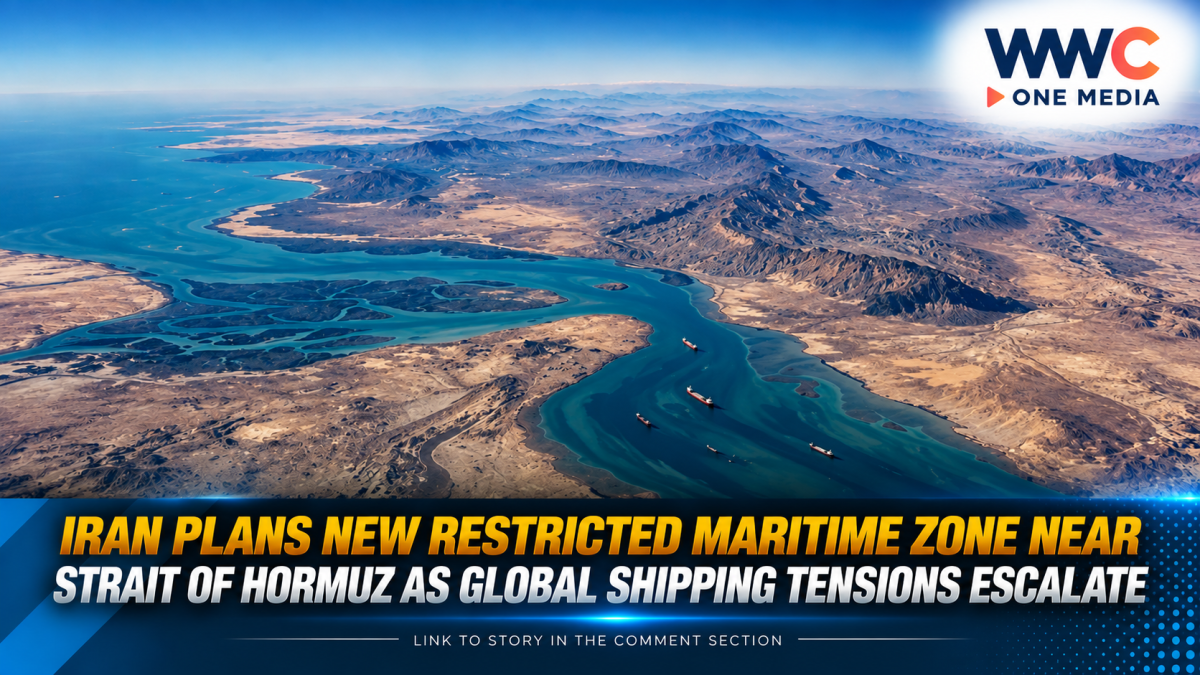
TEHRAN — Iran is preparing to declare a new “restricted” maritime zone outside the Strait of Hormuz, adding another layer of uncertainty to one of the world’s most strategically important shipping routes as military tensions with the United States continue to escalate.
Mohsen Rezaei, secretary of Iran’s Supreme National Security Council, said the new zone would be announced in the coming days and would cover areas in the Gulf, according to Iranian state media.
Rezaei said ships entering the newly designated area could be placed on a sanctions list. However, Iranian authorities have yet to publicly provide full details on the zone’s exact boundaries, enforcement procedures or how it would affect commercial shipping.
The announcement comes at a particularly sensitive moment for global energy markets. The Strait of Hormuz remains a critical route for oil and gas shipments, and recent attacks and restrictions have already sharply reduced maritime traffic through the waterway.
Why the New Iranian Move Matters
The Strait of Hormuz is one of the world’s most important energy chokepoints.
Before the current conflict, roughly one-fifth of global oil supplies passed through the waterway, making any prolonged disruption capable of sending shockwaves through energy markets, shipping companies and fuel prices worldwide.
Iran’s latest announcement does not necessarily mean the entire strait is being formally closed.
Instead, Tehran appears to be expanding its system of restrictions and sanctions around maritime traffic while maintaining pressure on vessels it considers unauthorized or non-compliant.
That distinction is important.
The announcement concerns a new restricted zone outside the Strait of Hormuz, rather than an immediate declaration that every commercial vessel will be prevented from transiting the strait.
Shipping Traffic Is Already Falling
The announcement follows weeks of increasingly severe disruption.
Reuters reported that shipping activity through the Strait of Hormuz had fallen to an average of about 10 commodity vessels a day, the lowest level recorded since May.
The decline reflects the growing security risks facing commercial operators following attacks involving U.S. and Iranian forces.
Iran has also been expanding its blacklist of vessels.
On Sept. 2, Reuters reported that Iran had added 11 more ships to a list of vessels it considers non-compliant, bringing the total to 56. The affected vessels included crude-oil tankers, LNG carriers, LPG carriers and clean-product vessels.
That means the latest restricted-zone announcement is not occurring in isolation.
It is part of a broader tightening of Iranian controls over shipping in and around the waterway.
Oil Prices Are Already Feeling the Pressure
Energy markets reacted quickly to the latest escalation.
Brent crude rose to around $96.80 a barrel on Monday, while U.S. West Texas Intermediate reached approximately $92.14, according to Reuters.
Brent had already gained 7.8% the previous week, while WTI climbed almost 10%, as investors assessed the risk of prolonged disruptions to oil shipments.
The market’s concern is straightforward: even without a total closure of Hormuz, fewer ships willing or able to pass through the waterway can reduce available supply and increase transportation costs.
That can eventually feed into gasoline, diesel, aviation fuel and other energy prices.
The U.S.-Iran Confrontation Is Getting More Dangerous
The new maritime restriction comes after a sharp escalation at sea.
U.S. forces have targeted three Iranian oil tankers, according to Reuters, following Iranian attacks involving U.S. naval vessels.
Iran’s Islamic Revolutionary Guard Corps has also claimed attacks against U.S. ships, although Washington has disputed some of Tehran’s claims. The U.S. military, for example, denied an Iranian claim that an American unmanned military vessel had been successfully struck.
The conflicting claims make the situation especially difficult for commercial shipping operators, who must assess not only the physical threat from attacks but also rapidly changing rules governing which vessels can safely transit the region.
Iran Has Already Been Using Shipping Restrictions
The planned zone represents an expansion of measures Tehran has already taken.
Iran’s Persian Gulf Strait Authority has been maintaining a blacklist of vessels that it says violated its navigation rules.
Reuters reported that the list had grown to 56 vessels by early September and that Iranian authorities had warned against cooperation with blacklisted ships, including through ship-to-ship transfers.
The restrictions have already begun influencing commercial decisions.
Some shipping and energy companies have reportedly avoided vessels appearing on the Iranian blacklist because of the risk of detention, confiscation, sanctions or other penalties.
What Happens If Iran Enforces the New Zone?
That remains one of the biggest unanswered questions.
Iran has not yet provided enough public detail to determine whether the new zone would primarily function as a warning area, a sanctions mechanism, a military exclusion area or some combination of those measures.
Its practical effect could therefore depend heavily on how aggressively Iranian forces attempt to enforce it.
If commercial vessels begin avoiding the affected area altogether, shipping routes could become longer and more expensive.
If ships continue entering the zone despite Iranian warnings, the risk of confrontation could rise significantly.
And if a major tanker were detained or attacked, the impact on already nervous oil markets could be immediate.
Global Economy Faces a Bigger Risk
The stakes extend far beyond the Middle East.
Hormuz connects the Persian Gulf with the Gulf of Oman and the Arabian Sea, making it a critical gateway for energy exports from major producers.
A prolonged disruption could increase crude prices, raise transportation and insurance costs and intensify inflationary pressure in countries that depend heavily on imported energy.
Reuters reported Monday that higher oil prices were already contributing to concerns about renewed inflation and the potential implications for global interest-rate policy.
That means the next move in the Hormuz crisis could be felt not only by shipping companies and oil traders, but also by consumers thousands of kilometres away.
The Big Question Now
Iran’s announcement is still short on operational details.
But the direction is unmistakable.
Tehran is tightening its grip over maritime activity around one of the world’s most important energy corridors at the same time that military confrontation with Washington is intensifying.
For global markets, that creates a dangerous combination: less shipping, higher risk and greater uncertainty over what happens to the next vessel entering the area.
The real test will come when Iran reveals the boundaries of the new restricted zone — and when the first commercial ships have to decide whether to enter it.
That decision could determine whether the latest Hormuz escalation remains a warning shot or becomes the next major shock to global oil supplies.
SEO Package
Primary Keyword:
Iran Strait of Hormuz restricted zone
Secondary Keywords:
- Strait of Hormuz crisis 2026
- Iran restricted maritime zone
- Iran shipping restrictions
- Iran US tensions
- Strait of Hormuz oil prices
- Iran oil tankers
- global oil supply
- Hormuz shipping crisis
- Iran maritime zone
- Strait of Hormuz shipping
- Iran sanctions on ships
- global energy markets
SEO Title:
Iran Plans Restricted Maritime Zone Near Strait of Hormuz as Oil Prices Rise
Meta Description:
Iran plans a new restricted maritime zone near the Strait of Hormuz as U.S.-Iran tensions escalate, threatening global shipping and oil markets.
Facebook Headline:
IRAN’S NEW HORMUZ MOVE: Restricted Maritime Zone Could Put Global Shipping on Edge
Facebook Caption:
A new flashpoint is emerging around the Strait of Hormuz. 🇮🇷🚢 Iran says it will soon declare a restricted maritime zone near the strategic waterway, where shipping activity has already plunged amid escalating U.S.-Iran attacks. Oil prices are rising — and the next move could determine how much worse the crisis becomes.
Accuracy check
- Iran plans to announce a restricted maritime zone: reported by Iran’s state media and independently reported by Reuters and Al Jazeera.
- Exact boundaries and enforcement details: not yet fully disclosed, so this article does not present the zone as an already operational blockade.
- Approximately one-fifth of global oil supplies previously transited Hormuz: reported by Reuters.
- Shipping traffic has fallen sharply: Reuters reported an average of about 10 commodity ships per day, the lowest level since May.
- Iran’s vessel blacklist reached 56: Reuters reported 11 additional vessels were added on Sept. 2.
- Oil-price impact: Brent and WTI rose Monday amid renewed fears of prolonged disruption.
- U.S. denial of an Iranian claim about striking an American unmanned vessel: independently reported by AP.
Bottom line: The strongest accurate viral angle is not “Iran has closed the Strait of Hormuz.” That would overstate the current announcement. The verified development is that Iran is preparing a new restricted zone around the strategic waterway while shipping is already being disrupted and oil prices are climbing.

Leave a Reply