
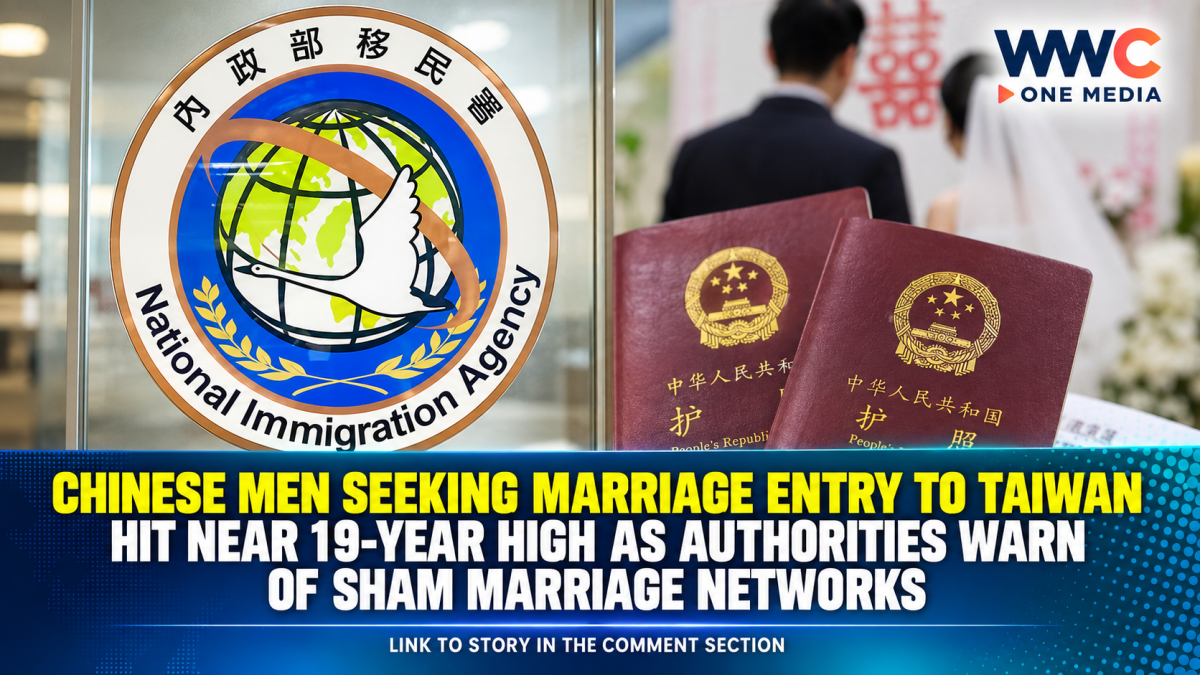
TAIPEI, Taiwan — The number of Chinese men applying to enter Taiwan through marriage has climbed to its highest level in nearly two decades, government data show, as Taiwanese authorities investigate suspected sham marriages and illegal employment networks.
Since 2023, 1,508 Chinese men — excluding applicants from Hong Kong and Macau — have applied to come to Taiwan through marriage, according to government data cited by the Taipei Times.
The figure represents a dramatic increase compared with 256 Chinese men recorded in 2004, highlighting a major shift from previous decades when women from China made up the overwhelming majority of Chinese spouses entering Taiwan.
Taiwan Sees Sharp Rise in Chinese Male Marriage Applicants
The increase comes amid continued economic difficulties in China, including a prolonged property-sector downturn and concerns over employment opportunities.
According to accounts cited by the Taipei Times, some Chinese men have sought to move to Taiwan in search of employment and greater personal freedom. However, authorities and sources also raised concerns that intermediaries may be arranging fraudulent or sham marriages to help some individuals gain entry.
One Chinese man, identified only by a pseudonym, told the newspaper that he paid an intermediary to arrange his move to Taiwan. Another said he paid tens of thousands of yuan and later worked at a construction site.
Their accounts could not independently establish how widespread such arrangements are, but Taiwanese authorities say suspected sham marriages remain a serious concern.
Authorities Investigate Alleged Sham Marriage Networks
Sources cited in the report said some Chinese men entering Taiwan through fraudulent marriages allegedly work in construction or factories, while others are suspected of illegally working as taxi or delivery drivers.
A senior official from Taiwan’s National Immigration Agency said sham marriages can potentially lead to criminal charges related to false information in official documents, as well as violations of Taiwan’s laws governing cross-strait relations.
Authorities said Taiwan has multiple screening procedures designed to detect fraudulent marriages before entry is approved. However, officials acknowledged that some cases can evade detection and said investigations would continue.
The National Immigration Agency has also linked the issue to broader concerns involving public safety and national security.
From Economic Pressure to a Search for Opportunity
The reported increase is also being viewed against the backdrop of China’s economic challenges.
China’s property market has struggled for years, while employment concerns — particularly among younger workers — have remained a major issue.
Some of the Chinese men interviewed by the Taipei Times said financial opportunities in Taiwan were not necessarily dramatically better once living costs, intermediary fees and family obligations were considered.
However, they said they valued what they described as greater personal freedom and the ability to speak openly without fear of political repercussions.
Those statements represent the personal experiences of the individuals interviewed and should not be interpreted as representing all Chinese nationals seeking marriage-based entry to Taiwan.
A Major Shift in Cross-Strait Migration Patterns
For decades, the more common pattern involved Chinese women marrying Taiwanese men and moving to Taiwan.
The latest data suggest that the gender balance among Chinese marriage applicants has changed significantly in recent years.
Taiwan’s immigration authorities now face the challenge of distinguishing legitimate cross-strait marriages from suspected arrangements created primarily to obtain residency or access employment opportunities.
The issue is particularly sensitive because Taiwan generally maintains strict regulations governing immigration and residency for people from mainland China.
China-Taiwan Relations Add Another Layer of Complexity
The immigration issue is emerging at a time of already heightened tensions between Taipei and Beijing.
China claims Taiwan as part of its territory, while Taiwan’s government rejects Beijing’s sovereignty claims and maintains that Taiwan’s future should be decided by its people.
Recent weeks have seen continued disputes over Chinese activity near Taiwan. Taiwan has criticized Chinese maritime operations east of the island, while Beijing continues to assert its claims over Taiwan and surrounding waters.
Taiwan is also expanding its defense capabilities amid increasing military and political pressure from China. President Lai Ching-te recently said Taiwan’s defense budget would exceed NT$1 trillion for the first time, while Beijing criticized the move.
Why This Story Matters
The surge in Chinese male marriage applicants is more than an immigration story.
It touches on several major issues facing Taiwan:
- Immigration and residency policy
- Suspected marriage fraud
- Illegal employment
- Cross-strait migration
- China’s economic difficulties
- Taiwan’s national security concerns
- Growing tensions between Taipei and Beijing
Authorities now face the difficult task of protecting legitimate couples while identifying fraudulent arrangements that may be used to bypass Taiwan’s immigration and employment rules.
What Happens Next?
Taiwan’s National Immigration Agency says it will continue investigating suspected sham marriages and strengthening efforts to prevent fraudulent entry.
The nearly 19-year high in Chinese male marriage applicants could also increase pressure on policymakers to review how Taiwan screens marriage-based immigration applications involving mainland Chinese nationals.
For now, the figures reveal a striking shift in cross-strait migration — and a new challenge for Taiwan as economic pressures, immigration rules and national security increasingly intersect.
As Chinese men increasingly seek entry to Taiwan through marriage, the question for authorities is becoming harder: How many are genuine couples — and how many are using marriage as a gateway to residency and work?
WWC ONE MEDIA J.M.D




Leave a Reply