
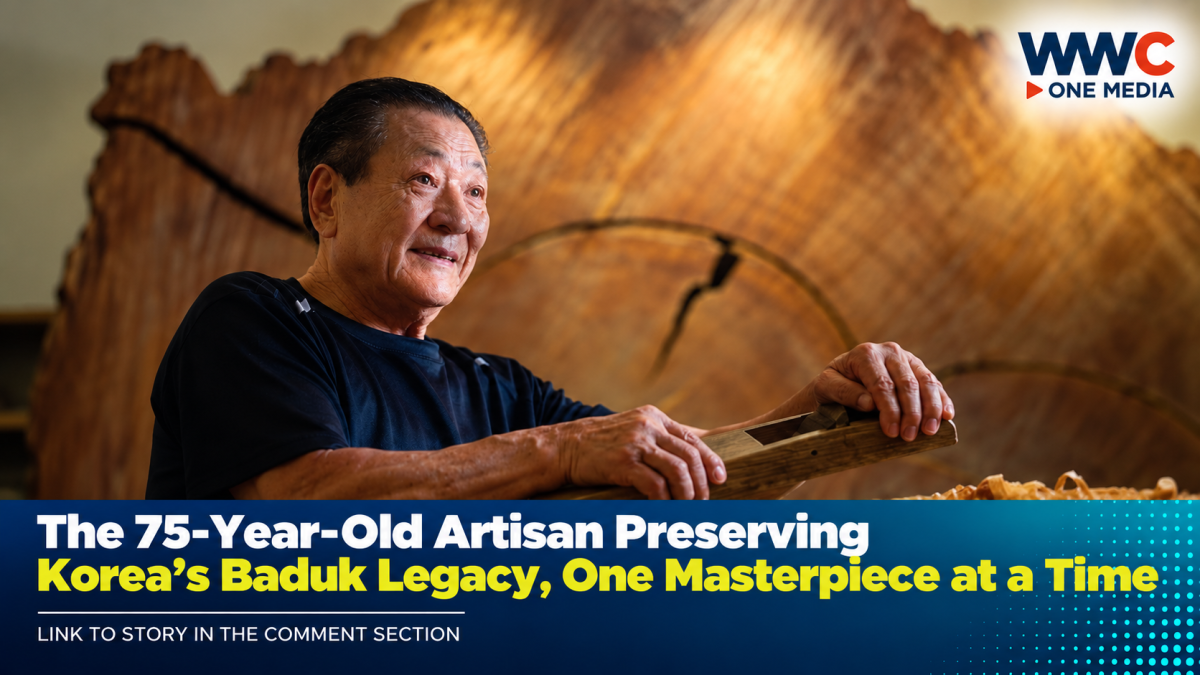
At 75, Shin Wan-sik has spent six decades turning carefully selected timber into some of Korea’s most celebrated baduk boards — connecting an ancient board game with moments in modern Korean history.
Based in Namyangju, Gyeonggi Province, Shin is the president of Six Brothers Baduk, a company he established with his five brothers and their wives in 1989. The company has grown into what The Korea Times describes as Korea’s largest baduk-board manufacturer, accounting for about 70 percent of the domestic market.
But Shin’s story is about far more than manufacturing.
His boards have been part of some of the most memorable moments in modern baduk. Six Brothers Baduk produced the board used for Lee Se-dol’s historic 2016 match against Google DeepMind’s AlphaGo, while boards made by the company have also been associated with legendary Korean players such as Cho Hun-hyun and Lee Chang-ho.
In 2025, one of Shin’s custom-made boards took on an even more diplomatic role when a similar masterpiece was presented by South Korean President Lee Jae Myung to Chinese President Xi Jinping during the APEC summit in Gyeongju. The board was made from timber estimated to have come from a 700-to-800-year-old tree and had been naturally dried for about two decades before undergoing further painstaking preparation.
From hardship to mastery
Shin entered the world of baduk and woodworking as a teenager after leaving rural Gokseong in South Jeolla Province. At 14, he became an errand boy at a baduk club connected to the late master Cho Nam-chul, a relative of Shin’s. A year later, he began working at a woodworking factory and learned to use the hand plane that would eventually define his career.
The physical demands of that work have stayed with him. His right index finger has become permanently misshapen after decades of repeatedly pressing down on hand planes — a striking reminder of the craftsmanship required to make traditional boards by hand.
Why the finest baduk boards can cost tens of thousands of dollars
For Shin, making a premium baduk board begins long before the first grid line is drawn.
The process includes seasoning the timber, cutting and planing it precisely, carving a resonance cavity underneath, applying traditional lacquer lines and attaching individually crafted wooden legs.
The most prestigious boards use bija wood, or Torreya nucifera, prized for its pale golden appearance and distinctive sound when a stone strikes the surface.
According to Shin, master-grade boards require timber from exceptionally old trees, sometimes at least five centuries old. Even then, only a small portion of the wood may have the straight, fine grain needed for an elite board. Because Korea’s ancient trees are protected, sourcing suitable material has increasingly required imported timber.
The prices reflect that rarity. Six Brothers Baduk produces everything from relatively inexpensive folding boards to museum-quality pieces costing more than 100 million won, or roughly $75,000.
From AlphaGo to a new digital generation
Baduk, also known internationally as Go, originated in China and developed into a major intellectual tradition across East Asia. Korea eventually became one of the world’s strongest baduk nations, producing generations of internationally renowned players.
The game received another global spotlight in 2016 when Lee Se-dol faced AlphaGo in Seoul. The five-game match became a landmark moment in the public discussion surrounding artificial intelligence and human strategic thinking.
Ironically, the technology that helped introduce baduk to a worldwide audience also contributed to a shift away from physical boards. Online play became increasingly important, particularly during the COVID-19 pandemic.
That change has forced traditional manufacturers to adapt.
After two of Shin’s brothers died, his three sons joined the family business. Their English, Chinese and Japanese-language skills have helped Six Brothers Baduk pursue customers beyond Korea, including markets in Taiwan, the Philippines, Germany and the United States.
The company’s international reach is not entirely new. A 2014 Korea JoongAng Daily report documented foreign baduk enthusiasts playing at a Six Brothers Baduk center in Seoul, highlighting the company’s connection with Korea’s growing international baduk community.
A craft that refuses to disappear
For Shin, the value of a baduk board cannot be measured simply by its price.
After six decades of working with timber, he still sees the material itself as the heart of his craft. His workshop is filled with carefully accumulated wood — much of it collected over a lifetime in pursuit of the perfect board.
And despite the rise of online baduk, Shin believes the physical experience still matters: the feel of the wood, the presence of another player and the distinctive sound of a stone striking the board.
That may be the most important part of his legacy.
In an era when a game can be played instantly on a screen anywhere in the world, Shin Wan-sik is preserving something that technology cannot easily reproduce: the human hands, natural materials and generations of craftsmanship behind the board itself.
His boards may be designed for a game, but their story is much larger — one of patience, Korean craftsmanship and a tradition determined to survive the digital age.




Leave a Reply