
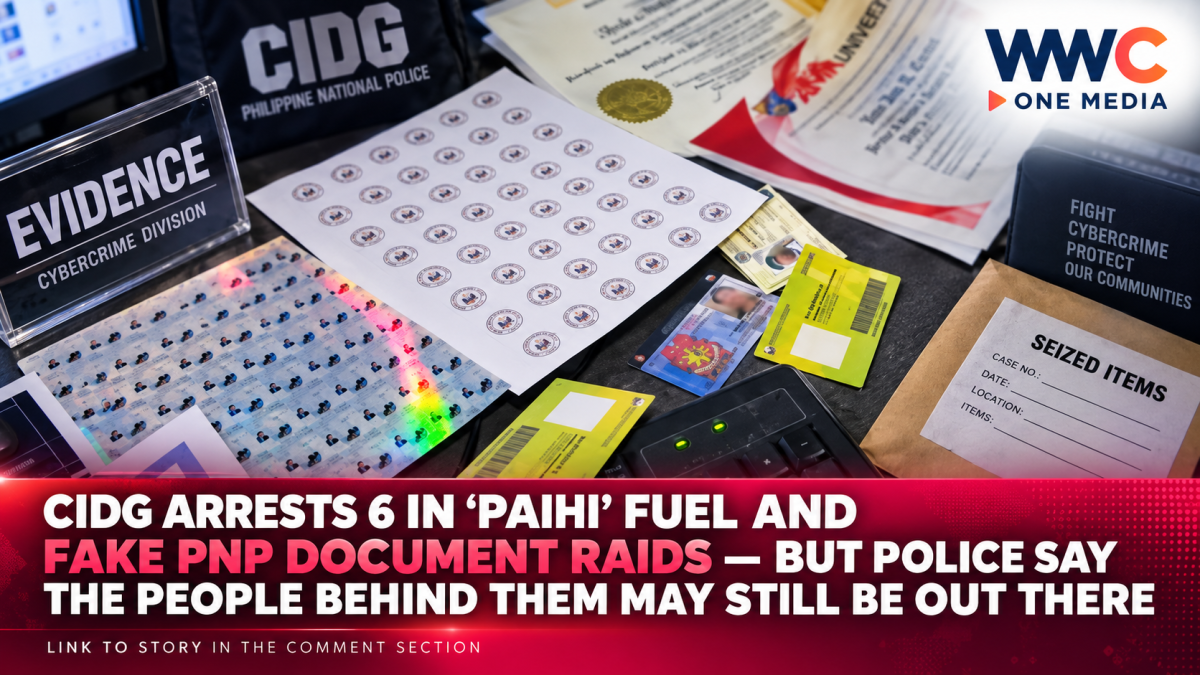
MANILA, Philippines — Six people have been arrested in two separate Metro Manila operations that exposed what police describe as two very different underground businesses: an alleged multimillion-peso illegal petroleum operation in Navotas and a suspected document-forging operation in Recto capable of producing fake police papers—including permits connected to carrying firearms.
The Criminal Investigation and Detection Group-National Capital Region said three suspects were arrested in Navotas late Saturday in connection with an alleged “paihi” operation, while another three were arrested in Manila for allegedly manufacturing and selling counterfeit Philippine National Police documents.
And the more troubling part of both cases may be what investigators are now trying to uncover.
Police say they are still pursuing people believed to be behind the fuel operation.
In the Manila case, meanwhile, investigators are examining seized computer storage devices to identify potential customers who may already be carrying fake police documents.
First raid: alleged ‘paihi’ operation in Navotas
CIDG-NCR chief Police Colonel John Guiagui said the Navotas operation was carried out at around 11:45 p.m. Saturday along Honorio Lopez Boulevard in Barangay NBBS Kaunlaran.
Three suspects were allegedly caught engaged in the transfer, storage and distribution of petroleum products without the necessary authorization from the Department of Energy.
Police seized equipment and petroleum-related items they valued at approximately P6.66 million.
Among the items reported seized were:
- containers containing diesel;
- three steel storage tanks;
- a 20,000-liter tanker;
- a 40,000-liter tanker;
- a smaller tanker;
- a diesel pump; and
- delivery receipts.
CIDG officials said improvised containers and facilities were allegedly being used in transferring fuel for resale or distribution.
The arrested men have been subjected to inquest proceedings for alleged violations of Batas Pambansa Blg. 33, as amended by Presidential Decree No. 1865, the Philippine law covering prohibited activities involving petroleum products.
What exactly is a ‘paihi’ operation?
The Filipino term “paihi” literally translates to “urinating,” but in the petroleum trade it has become slang for the unauthorized siphoning, transfer or diversion of fuel from tankers, vessels or other sources.
In some operations, fuel is allegedly siphoned directly from trucks.
In others, authorities have found petroleum being transferred from boats or larger storage systems into drums, tanks or smaller vehicles for resale outside authorized distribution channels.
Philippine petroleum law specifically identifies the unauthorized sale or distribution of petroleum products as illegal trading.
Presidential Decree No. 1865, which amended BP 33, also addresses adulteration, underdelivery, hoarding and other prohibited practices involving petroleum products.
The law defines illegal trading to include the sale or distribution of petroleum products without the required government license or authority.
Upon conviction, violations can carry fines, imprisonment and forfeiture of petroleum products involved in the illegal transaction.
Police say the fuel may have originated from vessels
Guiagui said investigators believe the fuel involved in the latest Navotas operation was being obtained from vessels offshore before being transported into Malabon and Navotas for resale.
According to the CIDG official, the suspects arrested at the site were allegedly workers rather than the people ultimately directing the operation.
Police say cases have also been prepared against suspected organizers who were not present during the raid.
Once warrants are issued, Guiagui said authorities intend to arrest them as well.
That distinction matters.
The three people currently under arrest have not been proven to be the masterminds of any larger operation, and the CIDG’s allegation that other organizers exist remains part of the ongoing investigation.
This wasn’t CIDG’s first ‘paihi’ raid in the area
The latest operation is part of a broader crackdown on illegal petroleum trading across Metro Manila and nearby provinces.
Guiagui said the Navotas raid was already the third CIDG-NCR operation against alleged “paihi” activities in the Camanava area, which includes Caloocan, Malabon, Navotas and Valenzuela.
The scale of some earlier seizures has been considerably larger.
In June, CIDG officers arrested 10 men in Barangay Tanza II, Navotas, in an operation where police said about P12 million worth of fuel and equipment was seized.
Authorities reported recovering around 80 drums of diesel, a fuel tanker, a truck and two motorboats. Police alleged fuel was being siphoned from the boats and transferred to the tanker.
Then in July, another CIDG operation in Malabon resulted in four arrests and the seizure of petroleum products and equipment valued at roughly P20 million, according to the Philippine News Agency.
The repeated operations suggest authorities are dealing with more than isolated roadside fuel theft.
Earlier this year, the PNP said it was investigating whether illegal fuel operations in places including Navotas and Laguna could be linked to wider organized networks.
PNP chief Gen. Jose Melencio Nartatez Jr. said in April that intelligence monitoring was continuing to determine whether some operations were connected to larger syndicates.
Police have not publicly established that the suspects in the latest Navotas case belong to such a network.
Why authorities are particularly worried about illegal fuel now
The crackdown has also come during a period when authorities have been paying closer attention to the petroleum supply chain.
In March, the Department of Energy announced intensified monitoring after receiving reports of possible hoarding and profiteering in petroleum sales.
The DOE said it was coordinating with the Department of the Interior and Local Government and the PNP as part of efforts to enforce petroleum and price laws.
Illegal fuel trading carries another danger beyond lost revenue or unauthorized sales.
Police have repeatedly warned that improvised fuel-transfer operations can pose serious fire and explosion risks, particularly when petroleum is stored or transferred in unsuitable containers or in residential areas.
That makes a “paihi” site potentially both a criminal-enforcement issue and a public-safety hazard.
But the second operation may be even more alarming
While investigators were pursuing alleged illegal fuel traders in Navotas, CIDG officers were dealing with a completely different problem in Manila.
Three people were arrested Friday along Recto Avenue for allegedly producing and selling fake PNP documents.
Police said the arrests followed a buy-bust operation in which investigators commissioned fake documents and paid the suspects to produce them.
According to Guiagui, the suspects were able to provide counterfeit police-related documents after receiving payment.
Police say charges involving falsification of public documents have been filed.
Among the alleged fakes: permits connected to carrying firearms
The suspected operation did not involve only ordinary identification cards.
CIDG said documents allegedly being counterfeited included:
Permit to Carry Firearms Outside of Residence documents, or PTCFORs;
police clearances;
and identification or documentation associated with the PNP’s Civil Security Group and Supervisory Office for Security and Investigation Agencies.
Authorities said customers were allegedly charged around P2,000 or more for individual documents or identification cards.
It is the alleged fake firearm-related documentation that has particularly concerned investigators.
A legitimate permit process includes screening and qualification requirements.
Guiagui told local media that genuine PTCFOR documents issued through PNP headquarters contain security features that fake-document manufacturers in Recto should not be able to reproduce accurately.
Police also stressed that applicants for legitimate firearm-related authorization undergo requirements intended to determine whether they are legally and psychologically qualified.
The concern is therefore not merely that someone might possess a fake piece of paper.
It is that a counterfeit document could be used in an attempt to bypass screening connected with carrying a firearm outside a residence.
A P2,000 document could create a much bigger security problem
Police say counterfeit permits are particularly serious because an individual presenting a sophisticated fake may appear, at least initially, to have undergone procedures that never actually occurred.
That creates potential problems during checkpoints, inspections or security encounters.
It could also undermine trust in legitimate documentation.
However, authorities have not disclosed evidence that any particular fake produced by the arrested suspects was successfully used to evade a police checkpoint or commit another crime.
The investigation is still determining who bought the alleged counterfeit papers and how they were used.
Investigators may now have the customer list
That may be where the most significant development in the Manila case lies.
CIDG personnel confiscated an external storage drive and computer hard drive during the operation.
Investigators are now examining the devices for records, templates and information that could identify people who allegedly purchased counterfeit PNP documents.
Guiagui said individuals found to have commissioned fake documents could be subpoenaed and asked to surrender them.
Investigators will also determine whether additional criminal complaints should be filed.
That means the three arrests in Recto may represent only the beginning of the case.
If investigators recover customer records, police could potentially reconstruct how long the operation had been running, what kinds of documents were being ordered and how many counterfeit papers had entered circulation.
Recto’s fake-document problem has a long history
Recto Avenue has for years been associated with illicit document production.
Previous investigative reporting has demonstrated how counterfeit diplomas, civil-registry records and other government-looking documents could be commissioned from operators in the area.
In one earlier investigation, journalists were able to obtain a fake marriage certificate designed to imitate official civil-registry documents.
The latest CIDG case is different because police allege that counterfeit documents connected directly to law enforcement and firearms regulation were being produced.
That potentially raises the security stakes considerably.
Two raids, two very different underground economies
At first glance, illegal diesel trading and counterfeit police permits have little in common.
One involves fuel.
The other involves documents.
But the two operations expose a similar enforcement problem: legitimate systems can be undermined when people create an unauthorized route around them.
In Navotas, police allege petroleum was being moved and sold outside the legal distribution and permitting system.
In Manila, they allege police documents were being manufactured outside official PNP processes.
Both cases remain allegations, and the guilt of those arrested must ultimately be determined through legal proceedings.
But the investigations are no longer focused only on the six people already in custody.
In Navotas, CIDG officers say they are pursuing alleged operators who were absent when the raid occurred.
In Manila, investigators are opening seized digital storage devices looking for the people who may have ordered the fake documents.
That means the most important number in this story may ultimately be far bigger than six arrests.


Leave a Reply