
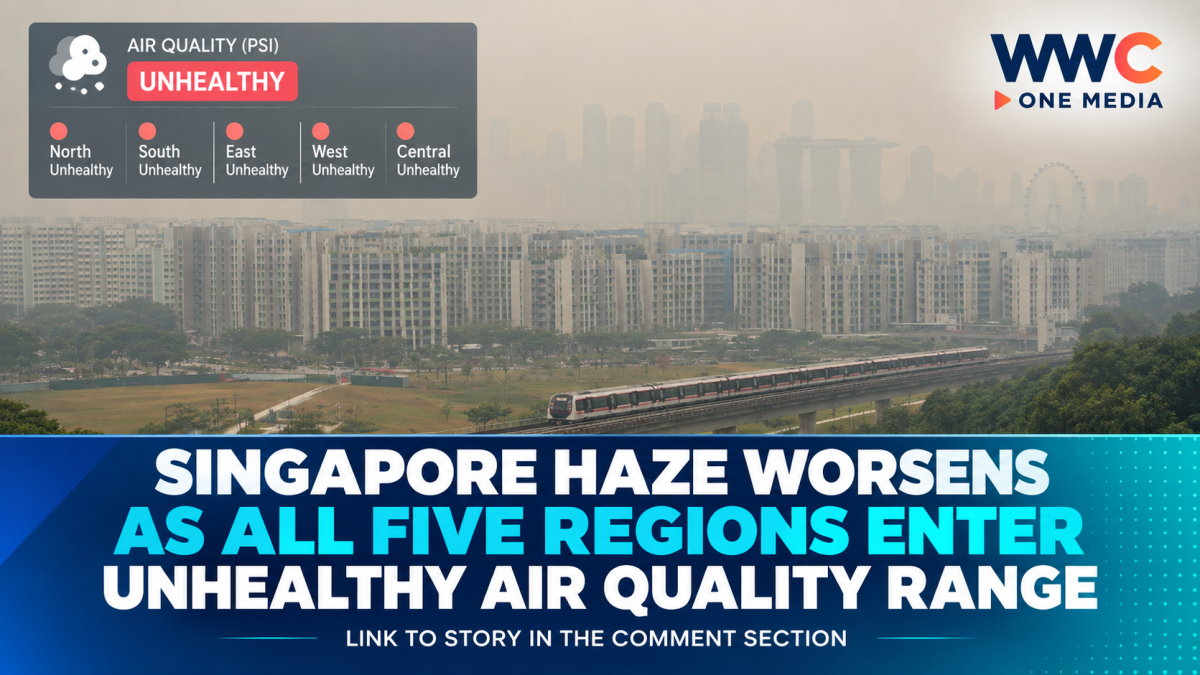
Singapore’s air quality deteriorated sharply on Tuesday (Sept 15), with all five regions recording unhealthy 24-hour Pollutant Standards Index (PSI) readings as haze from regional fires continued to affect the city-state.
The deterioration marks the first time since September 2019 that all five regions of Singapore have simultaneously entered the unhealthy range.
At 6am, the PSI reached 154 in central Singapore, the highest reading recorded among the five regions. The north registered 104, the south 111, while the east and west both recorded 128.
By 7am, readings ranged from 104 to 153, with the central region remaining the worst affected.
Under Singapore’s PSI scale, readings between 101 and 200 are classified as unhealthy.
Haze spreads across Singapore
The latest deterioration followed a worsening trend on Monday, when the central, eastern and western regions first entered the unhealthy range.
Southern Singapore slipped into the unhealthy range at around 10pm on Monday, followed by the northern region at about 1am on Tuesday.
The worsening conditions came despite signs that one-hour PM2.5 concentrations had begun improving overnight.
Authorities have continued to monitor smoke haze drifting towards Singapore from fires in parts of Indonesia, particularly southern Sumatra and Kalimantan.
Dry conditions in those areas, combined with prevailing southeasterly and southerly winds, have increased the risk of smoke being carried towards Singapore.
Central Singapore records PSI above 150
Central Singapore experienced the most severe deterioration, with its 24-hour PSI climbing to 154 at 6am before easing slightly.
The reading is significant because the unhealthy threshold begins at 101, meaning the central region was more than 50 points above the level at which authorities advise residents to reduce prolonged or strenuous outdoor activity.
The National Environment Agency has repeatedly warned that the health impact of haze depends on the individual’s health, the pollution level and the duration and intensity of outdoor activity.
Healthy people are advised to reduce prolonged or strenuous outdoor physical exertion when the PSI reaches the unhealthy range.
Children, older people and pregnant women are advised to minimise prolonged or strenuous outdoor exertion, while people with chronic heart or lung conditions should avoid such activities.
PM2.5 levels remain an important warning sign
While the 24-hour PSI provides a broader picture of air quality, authorities also monitor one-hour PM2.5 concentrations when assessing immediate outdoor conditions.
PM2.5 refers to fine particulate matter small enough to penetrate deep into the respiratory system.
On Monday, central Singapore’s one-hour PM2.5 concentration reached 132, its highest recent level, before easing later in the day.
The improvement overnight does not necessarily mean the haze situation has ended, as changing wind conditions and continuing fires in the region can quickly alter Singapore’s air quality.
Indonesia fires continue to drive regional haze
The latest haze episode is part of a wider regional pollution problem linked to fires in Indonesia.
Smoke from fires in southern and central Sumatra and Kalimantan has repeatedly been detected drifting towards Singapore in recent days.
Indonesia is experiencing an especially severe fire season this year amid prolonged dry conditions and intense heat. Authorities have reported large areas affected by fires across Sumatra and Borneo, with the resulting smoke also affecting neighbouring countries.
The haze has already caused significant disruption in parts of Indonesia, including school closures in areas where air pollution has become hazardous.
Regional authorities are continuing firefighting and monitoring operations as dry weather persists.
Residents urged to reduce strenuous outdoor activity
With all five Singapore regions now in the unhealthy PSI range, residents are being urged to take precautions, particularly if they need to spend extended periods outdoors.
People planning outdoor exercise should check both the latest PSI and one-hour PM2.5 readings before heading outside.
Those in vulnerable groups may need to take additional precautions if unhealthy conditions persist.
The latest deterioration also highlights how quickly Singapore’s air quality can change during the regional fire season.
After several days in the moderate range, Singapore’s air quality moved back into unhealthy territory on Monday before spreading across the entire country by Tuesday morning.
For now, the combination of persistent fires, dry weather and winds favourable to smoke movement means haze remains a concern for Singapore, with conditions likely to remain closely watched in the coming days.




Leave a Reply