
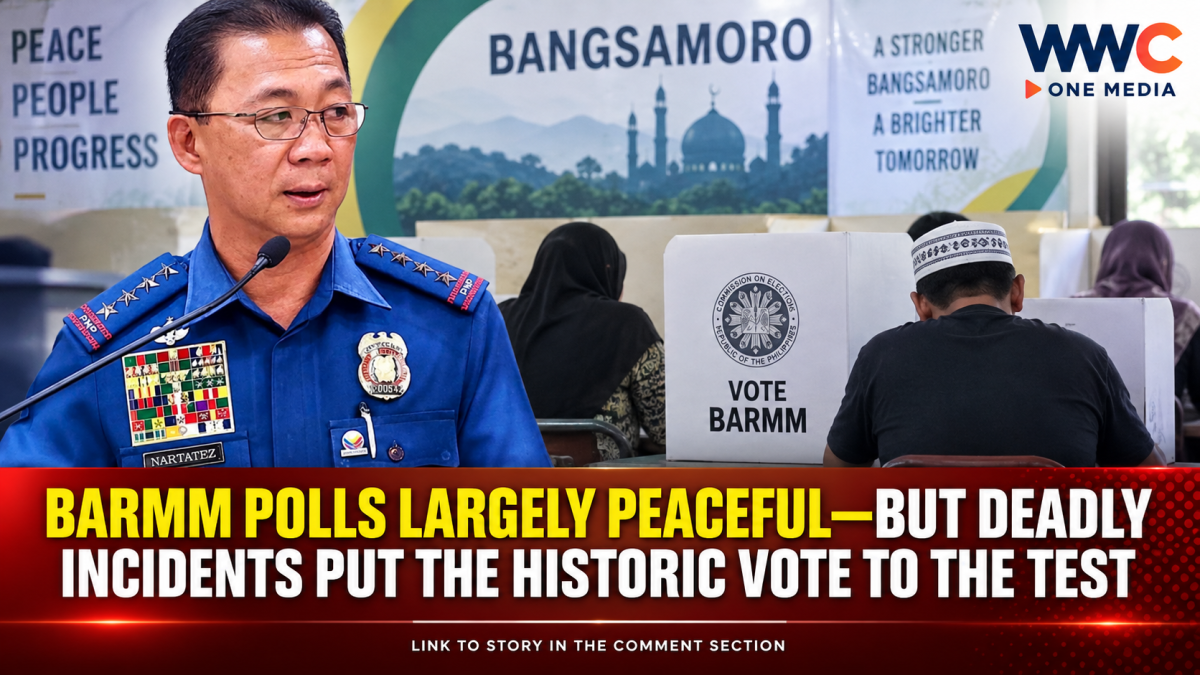
COTABATO CITY — The Bangsamoro Autonomous Region in Muslim Mindanao (BARMM) held its historic first parliamentary elections on Monday, September 14, with the Philippine National Police (PNP) describing voting in most areas as generally peaceful and under control despite pockets of violence, delays and other challenges.
The assessment came as nearly 2.4 million registered voters across BARMM went to the polls to elect members of the region’s first parliament—a crucial step in the decades-long transition from armed conflict toward autonomous democratic governance.
PNP information officer Col. Allen Rae Co said authorities were investigating seven suspected election-related incidents, including shootings, explosions and the recovery of a homemade explosive device.
The incidents included shootings reported in Basilan, Cotabato and Maguindanao del Sur, while explosions were reported in Cotabato. Three people were killed and 15 others wounded in the violence, according to police and media reports.
Despite the incidents, police maintained that voting proceeded peacefully in the majority of monitored areas.
“It is still under control. This is generally peaceful,” Co said, emphasizing that most areas within BARMM were able to conduct the electoral process without major disruption.
Historic election under heightened security
The September 14 vote was the first parliamentary election in BARMM, making it a major test of the region’s peace process and its transition to self-government.
The election involved 80 parliamentary seats: 40 party representatives, 32 district representatives and eight sectoral representatives. The eventual parliament will play a central role in determining the region’s political leadership, including the selection of the Bangsamoro chief minister.
Authorities had mounted a massive security operation ahead of the polls. The PNP had identified 108 election areas of concern, with varying levels of risk. Lanao del Sur had the largest number of red-category areas, while other provinces were classified according to their histories of election-related violence, political rivalry and other security threats.
More than 9,000 police personnel had been deployed for election security, with the Armed Forces of the Philippines and other government agencies supporting the operation.
Violence erupts despite security measures
The largely peaceful assessment did not mean the elections were without serious incidents.
According to BusinessMirror, seven suspected election-related incidents were under investigation, involving shootings, explosions and the discovery of an improvised explosive device in Basilan. Three people were reported killed and 15 wounded in shooting incidents.
In Al-Barka, Basilan, voting was delayed after a confrontation involving members and supporters linked to the Moro Islamic Liberation Front (MILF). Election officials eventually allowed voting to proceed and extended polling hours to accommodate the delay.
In Cotabato City, violence also prompted heightened concern, with the Commission on Elections taking additional measures after an incident at a polling location.
Reuters reported that authorities had placed Cotabato City under Comelec control following violence that erupted at a polling site. Despite the disruption, Comelec Chairman George Erwin Garcia said the elections continued and remained generally peaceful across the region.
Concerns had been building before election day
The violence did not come entirely without warning.
Before election day, security and peace monitors had raised concerns over political rivalries, clan conflicts, land disputes, armed groups and extremist threats in parts of BARMM.
The Climate Conflict Action Asia and Early Response Network had previously warned about the region’s security environment, including an August 15 ambush involving Bangsamoro Interim Chief Minister Abdulraof Macacua.
A separate pre-election assessment by the Asia Network for Free Elections and the National Democratic Institute also identified voter intimidation, vote buying, flying voters, misinformation and political patronage networks as potential threats, particularly in remote communities.
These concerns underscored the difficulty of holding a credible election in a region still emerging from decades of armed conflict and political instability.
A major test for the Bangsamoro peace process
The significance of the election extends beyond the selection of lawmakers.
BARMM was established following the 2014 peace agreement between the Philippine government and the MILF, which abandoned its long-standing goal of creating an independent state in favor of greater regional autonomy.
The parliamentary elections are therefore being viewed as a major milestone in transforming the peace agreement into functioning democratic institutions. The region’s first parliament is expected to shape policies on governance, development, public services and the continued implementation of the peace process.
The stakes are particularly high in a region whose recent history includes decades of armed conflict and the 2017 Marawi siege.
Peaceful majority, but challenges remain
For the PNP and Comelec, the immediate priority was ensuring that isolated incidents did not derail the broader electoral process.
Police reported that voting had started as scheduled in the majority of monitored locations, including areas in Basilan, Lanao del Sur, Maguindanao del Sur, Maguindanao del Norte, Tawi-Tawi and the Special Geographic Area.
But the incidents also served as a reminder that the transition to peace remains unfinished.
The success of BARMM’s first parliamentary election will ultimately depend not only on whether voters were able to cast their ballots, but also on whether the region’s new political institutions can withstand longstanding rivalries, clan conflicts, armed violence and public distrust.
For now, authorities are emphasizing the same message: the elections continued, most voting areas remained peaceful, and the democratic process moved forward despite the challenges.
But the violence reported in several areas means the real test for Bangsamoro may begin after the ballots are counted.



Leave a Reply