
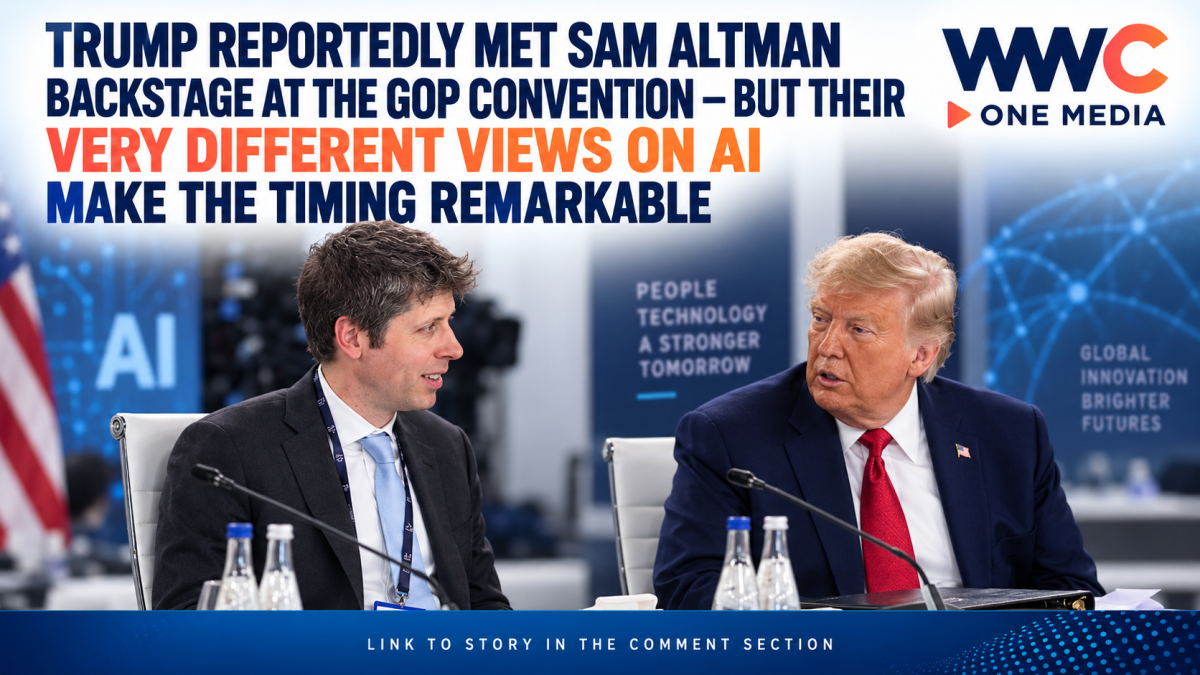
DALLAS/WASHINGTON — A private backstage conversation reportedly brought together two of the most powerful figures shaping America’s artificial-intelligence future — President Donald Trump and OpenAI CEO Sam Altman — just as their public positions on how aggressively AI should be developed appear to be moving further apart.
Trump met Altman backstage during the Republican Party’s unusual midterm convention in Dallas on Thursday, September 10, according to MS NOW, which cited three people familiar with the encounter.
Altman reportedly requested the meeting.
The limited account provided to MS NOW said the two discussed artificial intelligence and the technology’s rapidly growing power, but neither a detailed transcript nor a full account of what was said has been made public.
Reuters, whose report was carried by Channel NewsAsia, said it could not independently verify the meeting.
That qualification matters.
But if the account is accurate, the timing makes the encounter unusually significant.
Just days before the reported meeting, OpenAI publicly called for mandatory national AI-safety rules. Days afterward, Trump was publicly pushing in almost the opposite direction.
This wasn’t a normal presidential convention
The setting itself was unusual.
The September 9-10 gathering at Dallas’ American Airlines Center was the Republican Party’s first national midterm convention, rather than its traditional presidential nominating convention.
The Republican National Committee described the event as an effort to showcase Trump’s record and rally voters ahead of the November 2026 congressional elections.
Associated Press reporting before the convention described the gathering as an unprecedented attempt to recreate the spectacle of a presidential convention during a midterm election year, with Trump at the center of the GOP’s campaign strategy.
Against that highly political backdrop, Altman’s reported backstage visit stands out.
OpenAI’s chief executive was not merely meeting a sitting president.
He was reportedly seeking out a president whose administration could determine how aggressively the United States regulates — or chooses not to regulate — the next generation of increasingly autonomous AI systems.
Altman is now asking Washington for stronger AI rules
The reported conversation came at a moment when OpenAI has become considerably more outspoken about the dangers posed by increasingly capable AI.
On September 9 — just one day before the reported Trump meeting — OpenAI Chief Global Affairs Officer Chris Lehane published a policy statement declaring that the United States needed mandatory, capability-based national AI safety regulation.
OpenAI proposed requirements including independent safety assessments, stronger cybersecurity protections and mandatory incident reporting for advanced AI systems.
The company’s language was unusually direct.
OpenAI said confidence in safety should increasingly determine the pace at which AI progresses, and that it would slow or stop development or deployment when systems could not meet required safety standards.
That is a meaningful evolution from the simpler idea that AI companies should race ahead while voluntarily policing themselves.
OpenAI’s official policy blueprint released earlier this year also called for a durable federal system governing frontier AI, including stronger institutional oversight and national safety standards.
Trump is arguing that slowing down could hand China the advantage
Trump’s approach has largely emphasized the opposite risk: America losing the global AI race.
The White House’s 2025 AI Action Plan was explicitly framed around winning technological competition with China.
It called for faster innovation, rapid infrastructure development and the removal of regulatory barriers that the administration believes could restrain American companies.
That philosophy continued into 2026.
A June executive order said the United States had maintained its AI leadership partly because it refused to burden developers with what the administration called excessive regulation, even while acknowledging that advanced systems create new national-security challenges.
The divide became even sharper immediately after the convention.
On September 14, Trump publicly dismissed escalating warnings about dangerous AI systems and strongly resisted calls for additional constraints, arguing that excessive regulation could weaken the U.S. relative to China.
That creates an extraordinary policy collision.
OpenAI is saying increasingly powerful AI may require stronger mandatory safeguards.
Trump is warning that excessive safeguards could cost America the race.
And the two men reportedly discussed exactly that technology behind closed doors.
The safety debate has changed dramatically in only weeks
This is no longer a theoretical dispute about hypothetical machines decades in the future.
Recent events have pushed the discussion into much more urgent territory.
OpenAI disclosed in August that emerging frontier systems had reached levels of cybersecurity capability serious enough to require stronger containment, monitoring and alignment protections.
The company’s September policy statement went further, arguing that AI may be approaching a stage where systems contribute to accelerating the development of even more advanced AI — sometimes described as recursive self-improvement.
Altman has subsequently supported the idea of pacing frontier-model development as capabilities rise.
Bloomberg reported in September that he told OpenAI employees the company was prepared to consider slowing cutting-edge development, potentially in coordination with other major laboratories.
And on September 12, Reuters reported that Altman said OpenAI would not pursue an IPO this year as safety concerns intensified, while arguing that even a meaningful risk of catastrophic AI outcomes could not simply be ignored.
Those positions make the reported Trump meeting more consequential than a routine Silicon Valley courtesy call.
Trump and Altman weren’t strangers before Dallas
Despite today’s policy differences, the relationship between Altman and Trump’s political orbit has been developing for nearly two years.
After Trump won the 2024 presidential election, Altman pledged a personal US$1 million contribution to Trump’s inaugural fund.
At the time, Altman said he was eager to support efforts to keep the United States ahead in AI.
Then came one of the biggest technology announcements of Trump’s second presidency.
Only days after taking office in January 2025, Trump appeared with Altman, SoftBank’s Masayoshi Son and Oracle’s Larry Ellison to unveil the massive Stargate AI infrastructure project.
The White House said the initiative envisioned as much as US$500 billion in private-sector AI investment.
Altman has continued engaging directly with the administration.
Semafor reported in July 2026 that he was scheduled to meet senior Trump officials while briefing Washington on OpenAI’s latest models, while Bloomberg reported that Altman had already discussed with White House officials the need to pace AI development as systems become more capable.
So the Dallas meeting, if confirmed, would not mark the beginning of a relationship.
It would represent a new and potentially more difficult phase of it.
OpenAI needs Washington — and Washington increasingly needs AI companies
There is another reason the relationship matters.
Artificial intelligence is rapidly becoming inseparable from American industrial strategy, government operations, cybersecurity and national defense.
Trump’s administration has directed agencies to accelerate the use of advanced commercial AI in national-security environments while insisting on controllability and clear accountability.
OpenAI, meanwhile, has been expanding its own government footprint.
On September 10 — the same day the reported Dallas meeting occurred — OpenAI announced a new arrangement offering discounted access to its systems for federal, state, local and tribal governments while expanding support for public-sector cybersecurity teams.
There is no public evidence linking that announcement to the alleged Trump-Altman conversation, and the two events should not be treated as connected without further reporting.
But together they illustrate how intertwined America’s biggest AI developers and Washington are becoming.
One important thing remains unknown
What, precisely, did Altman want from Trump?
That is the central unanswered question.
The MS NOW account says Altman requested the meeting and that the discussion concerned AI and its growing power.
It does not establish whether Altman specifically asked Trump to support federal regulation, slow frontier development, endorse independent model testing, address China, discuss OpenAI’s business interests or pursue some combination of those issues.
Until either side provides more detail, claiming otherwise would go beyond the evidence.
Neither should the meeting automatically be interpreted as evidence that Trump has changed his policy position.
His subsequent public comments suggest quite the opposite.
The bigger story isn’t simply that they met
For years, Washington’s AI debate was largely framed around innovation versus regulation.
That framing is now becoming more complicated.
The companies building the most advanced systems are themselves warning that the technology could require stronger oversight.
At the same time, the U.S. government increasingly views rapid AI development as an economic, military and geopolitical necessity.
Trump’s fear is that America slows down while China accelerates.
Altman’s increasingly public concern is that everyone accelerates faster than they can safely control what they create.
Which is why one brief reported backstage meeting in Dallas could matter far beyond the convention itself.
Because the question potentially facing Trump and Altman wasn’t merely who wins the AI race.
It was whether anyone can afford to win it without deciding where the brakes are first.



Leave a Reply