
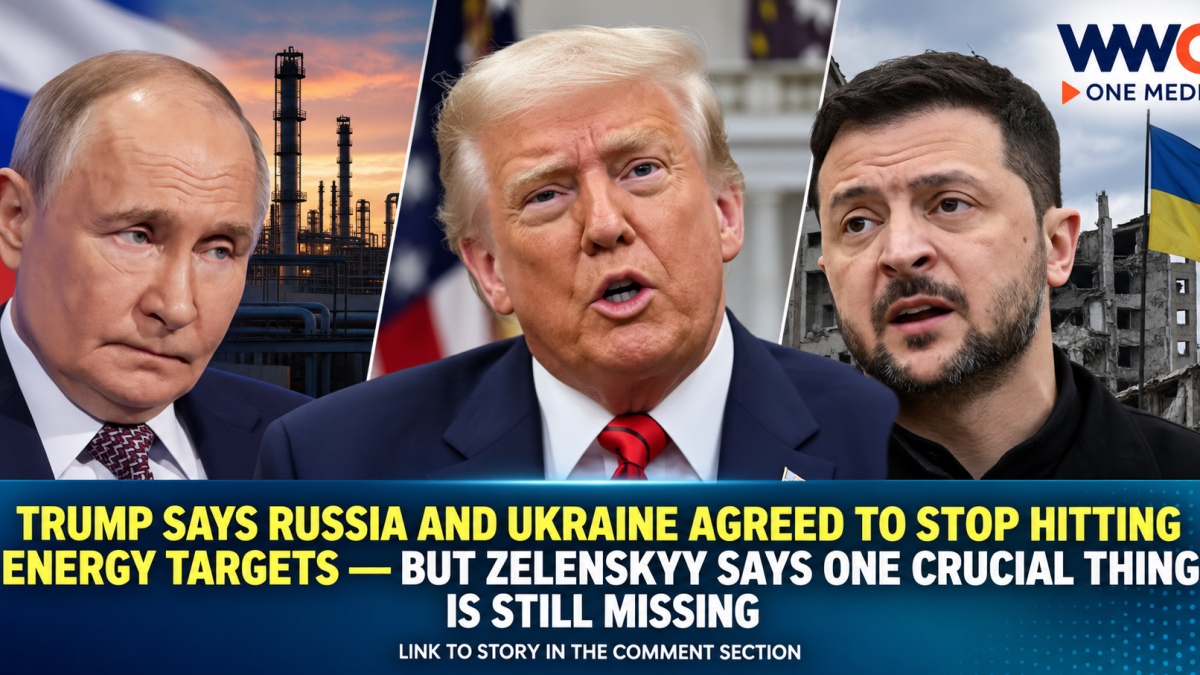
WASHINGTON/KYIV — September 15, 2026 — U.S. President Donald Trump says Russia and Ukraine have agreed to stop attacking each other’s energy infrastructure, potentially opening a new path toward de-escalation in a war now more than four years old.
But within hours, Ukrainian President Volodymyr Zelenskyy added a critical qualification.
Kyiv, he said, is willing to halt strikes on Russian territory only if the United States can secure a genuine Russian commitment to stop attacking Ukraine’s critical infrastructure and demonstrate that Moscow is serious about ending the war.
That distinction turns what initially sounded like a breakthrough into something much more uncertain.
Trump announced the purported understanding on social media, saying both Ukraine and Russia had agreed not to attack energy targets.
But Reuters reported that Zelenskyy’s subsequent remarks amounted to a denial that Ukraine had already formally endorsed such an agreement. He instead described a possible halt in energy attacks as a potential first step toward de-escalation, provided it was reliable and reciprocal.
And as of the latest public statements, Russia has welcomed Washington’s push to stop Ukrainian attacks on its fuel industry — but has not offered the same clear public confirmation of Trump’s claimed bilateral agreement.
That leaves one major question hanging over Washington’s newest peace initiative:
Is this actually an agreement — or the beginning of negotiations toward one?
TRUMP’S ANNOUNCEMENT CAME ONE DAY AFTER HE PUBLICLY PRESSURED ZELENSKYY
The sudden ceasefire claim followed an unusually direct intervention by Trump.
Speaking in Ireland on Sunday, the U.S. president called on Zelenskyy to stop Ukraine’s attacks on Russian oil refineries and other infrastructure involved in producing diesel.
Trump argued that the strikes were contributing to a global diesel shortage and driving prices higher.
Ukraine has been carrying out long-range drone attacks against Russian refineries for months, reducing fuel production and contributing to petrol shortages inside Russia.
Kyiv argues that the facilities are legitimate wartime targets.
Russia’s oil sector is crucial not only to the civilian economy but also to government revenues and military logistics, and Ukraine says attacking that infrastructure raises the financial and operational cost of Moscow’s invasion.
The impact has become increasingly difficult for Russia to absorb.
The International Energy Agency recently lowered its Russian oil-production forecasts again, citing damage and disruption from Ukrainian strikes. Reuters reported that Russian crude production fell sharply in August, while Moscow’s own draft economic projections point to 2026 production reaching a 17-year low.
That means Trump is asking Kyiv to scale back one of its increasingly effective forms of economic pressure on Moscow.
And that is precisely why Zelenskyy wants something substantial in return.
ZELENSKYY: UKRAINE WILL DE-ESCALATE — IF RUSSIA DOES TOO
Zelenskyy said Ukraine could support a halt to attacks on energy facilities if it becomes part of a credible reciprocal arrangement.
The Ukrainian leader emphasized that Russia has repeatedly attacked his country’s electricity network, heating systems, ports and other critical civilian infrastructure throughout the war.
Those attacks have damaged power generation, disrupted industry and left civilians facing outages and heating problems.
Ukraine’s strikes against Russian energy installations, Zelenskyy said, have largely been carried out in response.
His position therefore amounts to a straightforward exchange:
Russia stops attacking Ukrainian critical infrastructure.
Ukraine stops its retaliatory attacks on Russian energy and industrial targets.
But Zelenskyy says Washington must first demonstrate that Moscow actually intends to honor such an arrangement.
Previous attempts at limited ceasefires have collapsed quickly, with Moscow and Kyiv accusing one another of violations. AP noted that past efforts to establish even partial ceasefires have sometimes unravelled within hours.
That history helps explain Kyiv’s caution.
MOSCOW LIKES PART OF TRUMP’S IDEA — BUT HASN’T CONFIRMED THE WHOLE DEAL
Russia reacted positively when Trump initially urged Zelenskyy to stop attacking Russian diesel facilities.
Kremlin spokesman Dmitry Peskov said calls for Ukraine to stop striking what Moscow describes as civilian economic infrastructure were welcome.
Yet Moscow’s broader military posture has not visibly changed.
On the same day the potential energy ceasefire was being discussed, Peskov said Russian forces were continuing operations across Ukraine and would continue doing so.
That creates a significant gap between Trump’s announcement and events on the battlefield.
Russia wants Ukrainian strikes on its refineries stopped.
Ukraine wants Russian attacks on its power and infrastructure stopped.
Washington wants both sides to treat an energy ceasefire as a possible opening toward ending the wider war.
The unresolved issue is enforcement.
Who determines whether an attack violates the deal?
Which facilities count as protected energy infrastructure?
Do oil refineries serving military operations qualify?
Would power grids supplying defense factories be protected?
And what happens after the first alleged violation?
Those questions could determine whether the proposal lasts for months — or collapses almost immediately.
WHY RUSSIAN REFINERIES HAVE BECOME SUCH IMPORTANT TARGETS
Ukraine’s refinery campaign represents a significant change in the economics of the war.
Long-range Ukrainian drones are increasingly capable of reaching facilities hundreds or even thousands of kilometres inside Russian territory.
One particularly dramatic example came in July, when an attack forced operations to halt at the Omsk refinery, Russia’s largest oil refinery and its leading gasoline producer.
Reuters reported that damage affected a processing unit accounting for a substantial portion of the plant’s capacity, potentially aggravating shortages.
Such attacks create several problems for Moscow simultaneously.
Refineries must be repaired.
Domestic fuel becomes scarcer.
Exports can decline.
Military logistics become more complicated.
And Russia earns less from a sector central to its economy.
Reuters reported this week that Russian regions have experienced serious petrol shortages following months of strikes.
For Kyiv, that makes the campaign one of the few ways it can impose economic pain deep inside Russia even while Russian forces continue pressing Ukrainian positions on the battlefield.
Giving it up would therefore be a meaningful concession.
TRUMP SAYS UKRAINE’S STRIKES ARE HURTING GLOBAL DIESEL SUPPLY
Trump’s immediate concern is not only battlefield diplomacy.
It is also fuel prices.
The U.S. national average price for diesel passed $6 per gallon for the first time on record in September, according to GasBuddy data cited by Reuters.
Diesel matters well beyond motorists.
It powers trucks moving food and consumer goods, trains, ships, construction equipment and agricultural machinery.
Higher diesel prices can therefore spread through the broader economy, increasing freight costs and potentially pushing consumer prices higher.
That is particularly politically sensitive in the United States ahead of the November midterm elections.
Trump said the global diesel surge was largely the result of the Russia-Ukraine war rather than the conflict involving Iran.
The broader energy-market evidence, however, shows the price shock has multiple causes.
THE ENERGY CRISIS IS BIGGER THAN UKRAINE’S REFINERY STRIKES
Ukraine’s attacks have unquestionably removed Russian refining capacity and tightened supplies.
But Reuters and AP also point to severe Middle East disruptions.
Traffic through the Strait of Hormuz, one of the world’s most important energy chokepoints, has been sharply reduced amid the Iran conflict.
Middle Eastern refining and shipping disruptions have squeezed supplies of petroleum products.
Attacks have also hit Saudi energy infrastructure.
On Tuesday, Brent crude was trading around $106.93 a barrel, while U.S. West Texas Intermediate was near $102.65, following attacks that disrupted Saudi Arabia’s crucial East-West pipeline.
The International Energy Agency has warned of a widening global oil-supply deficit as normal Gulf flows remain disrupted.
Reuters has separately reported that industry executives expect global diesel supplies to remain tight through winter because the problem extends beyond Russian refineries to limited worldwide refining capacity, disruptions in both Russia and the Middle East, and strong seasonal demand.
That means stopping Ukrainian strikes on Russia could ease one source of pressure.
It would not automatically solve the global energy crisis.
THERE IS A POLITICAL DIMENSION FOR TRUMP
The timing matters.
Expensive fuel has again become a domestic political liability in the United States.
A Reuters/Ipsos poll released this week found Trump’s approval rating at 35 per cent, while voters expressed growing dissatisfaction over economic conditions. Reuters reported that the Iran conflict and its effect on energy prices have weighed on household finances ahead of congressional elections.
That provides another reason the White House wants pressure taken off refined-fuel markets quickly.
A pause in attacks on Russian refineries could increase available diesel supply.
An energy ceasefire might also create momentum for wider Russia-Ukraine negotiations.
And any significant reduction in global energy prices could help ease U.S. inflation pressures.
For Trump, therefore, diplomacy, energy and domestic politics are increasingly intertwined.
A POSSIBLE FIRST STEP TOWARD OCTOBER PEACE TALKS
There is also a wider diplomatic effort underway.
Ukraine is preparing for the possible resumption of trilateral negotiations involving Ukraine, Russia and the United States in October, according to a senior Ukrainian official cited by Reuters.
Those discussions would revive a process that stalled after previous talks in Geneva.
The central dispute remains extraordinarily difficult.
Russia continues to demand territory in the Donbas that it claims but does not entirely control.
Ukraine rejects surrendering sovereign territory to Moscow.
Neither question is solved by an agreement over refineries and power stations.
But limiting attacks on energy infrastructure could create something negotiators currently lack:
a confidence-building measure both sides can test in real time.
If Russia stops striking Ukraine’s grid and Ukraine stops attacking Russian refineries, Washington could argue that both governments have demonstrated the ability to honor a limited agreement.
That, in turn, could create room for negotiations on larger issues.
But if either side quickly accuses the other of cheating, the experiment could instead demonstrate just how far apart Moscow and Kyiv remain.
A “BREAKTHROUGH” THAT STILL NEEDS A DEAL
Trump’s announcement initially sounded definitive.
The reality is more complicated.
Ukraine has not rejected the concept.
In fact, Zelenskyy has explicitly said Kyiv is prepared to participate.
But he wants guarantees of reciprocity and evidence that Russia is serious about a sustainable agreement.
Russia has welcomed pressure on Ukraine to stop attacking its fuel infrastructure, but Moscow has yet to publicly confirm Trump’s broader description of a mutually agreed energy ceasefire.
And strikes elsewhere in Ukraine are continuing.
So for now, the development may be best understood not as a completed ceasefire but as a potentially important diplomatic opening.
After years of missile attacks, drone strikes, blackouts, refinery fires and shattered infrastructure, energy has become one of the war’s most powerful weapons.
Now Washington is trying to turn it into one of its first bargaining chips for peace.
Whether that succeeds may depend on something neither side has been willing to offer easily throughout this war.




Leave a Reply