
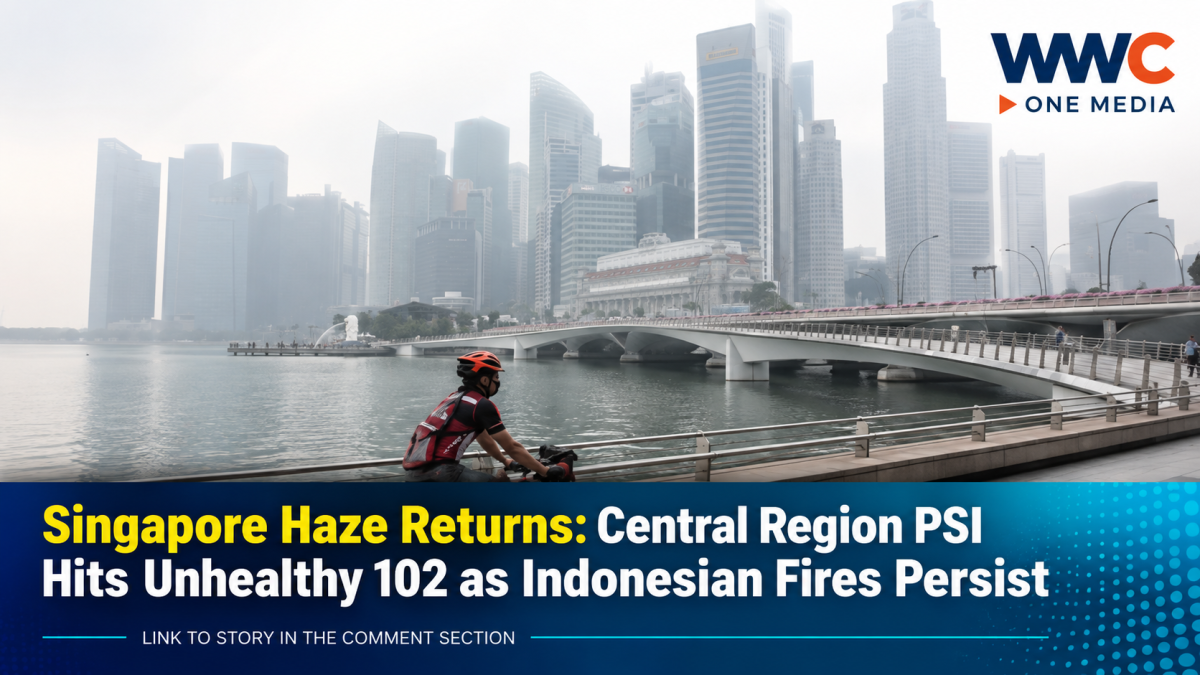
SINGAPORE — Singapore’s air quality has deteriorated again, with the central region entering the unhealthy range after its 24-hour Pollutant Standards Index (PSI) reached 102 at noon on September 14.
The return to unhealthy air comes after four consecutive days of moderate readings and as smoke haze from fires in parts of Indonesia continues to affect the region. The National Environment Agency (NEA) said moderate to dense smoke plumes were being observed over Kalimantan and parts of Sumatra, with some plumes drifting toward Singapore.
PSI climbs beyond 102 as haze worsens
The 102 reading was recorded in Singapore’s central region at noon, crossing the 101 threshold for the unhealthy category.
But conditions continued to deteriorate during the afternoon. According to CNA, Singapore’s central-region PSI climbed to 112 by 3 p.m., while readings in the other four regions ranged from 85 to 98.
At noon, the other regions remained below the unhealthy threshold, with readings of 91 in the east and west, 82 in the south and 79 in the north, according to The Straits Times’ report of NEA readings.
The PSI measures air pollution over a 24-hour period. A reading of 101 to 200 is classified as unhealthy, and authorities advise people to reduce prolonged or strenuous outdoor activity at those levels.
Indonesian fires remain a major concern
The latest deterioration is linked to the wider regional haze situation.
NEA reported moderate to dense smoke plumes from fires in West and Central Kalimantan and central and southern Sumatra, while smoke haze was also observed in other parts of Southeast Asia. Prevailing winds can carry smoke from these areas toward Singapore.
Reuters reported last week that Indonesia was experiencing a severe wildfire season, with authorities recording a sharp increase in respiratory illnesses in affected provinces. The fires have also sent smoke and haze across national borders, affecting neighboring countries including Singapore and Malaysia.
Singapore had only just returned to moderate levels
The latest spike is particularly notable because Singapore’s air quality had remained in the moderate range since September 11.
Earlier this month, the central region repeatedly crossed into unhealthy territory. On September 4, the PSI exceeded 101 for the first time since October 2023, prompting authorities to begin issuing daily haze advisories.
The central region again recorded unhealthy readings on September 9 and 10, reaching 105 on the morning of September 10.
The recurring spikes highlight how quickly Singapore’s air quality can change when regional fires persist and winds become favorable for smoke transport.
What Singapore authorities are warning
NEA said the 24-hour PSI forecast for the next 24 hours is expected to range from moderate to the lower end of the unhealthy category.
The agency advises people to use the 24-hour PSI when planning activities and to check the 1-hour PM2.5 reading when making decisions about immediate outdoor activity.
For healthy people, normal activities can generally continue when conditions remain moderate, but prolonged or strenuous outdoor exercise should be reduced when the PSI enters the unhealthy range. More vulnerable groups, including children, older people and those with chronic heart or lung conditions, are advised to take greater precautions.
Haze risk could persist
Weather conditions across the region could determine whether Singapore’s air quality improves or deteriorates further.
NEA said showers are expected over northern Sumatra and northwestern Borneo, while drier conditions are expected to persist over Kalimantan and central and southern Sumatra, where fires and smoke remain a concern.
For now, Singapore is once again dealing with an air-quality problem that appeared to be easing only days ago.
And with the central PSI already climbing from 102 at noon to 112 by mid-afternoon, the bigger question is whether this latest haze episode will fade quickly—or become another prolonged stretch of unhealthy air.




Leave a Reply