
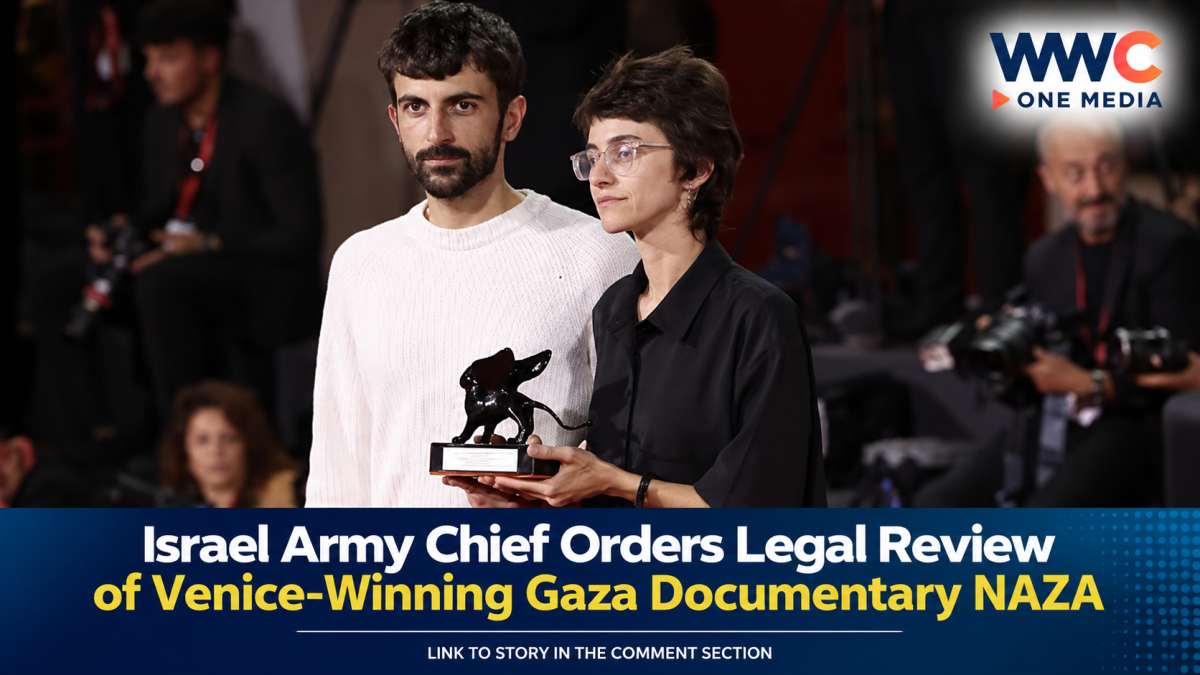
Israel’s military chief has ordered a legal review of the documentary NAZA, escalating a growing confrontation over the film’s allegations about the conduct of Israeli forces during the Gaza war.
Chief of Staff Lt. Gen. Eyal Zamir instructed the military’s top legal officials to examine possible legal measures against the filmmakers and others involved in the production after the documentary won the Special Jury Prize at the Venice Film Festival.
The move comes as Israeli political and military leaders sharply condemn the film, while its creators defend it as an investigation based on testimony from Israeli military and intelligence insiders.
Military weighs action against filmmakers
Zamir ordered the Military Advocate General to examine possible legal steps concerning NAZA and the people involved in making it.
He also ordered a separate investigation into the possible disclosure of classified military material used in the documentary.
The military has accused the film of presenting a distorted picture of its operations in Gaza and putting Israeli soldiers at risk.
The review does not mean that legal proceedings have already been launched against the filmmakers. Instead, military lawyers are being asked to determine whether there are grounds for action and what legal options may be available.
What NAZA alleges
Directed by Israeli filmmakers Yuval Abraham and Rachel Szor, NAZA examines Israel’s military campaign in Gaza through interviews with Israeli intelligence officers and soldiers.
The filmmakers say they interviewed 24 military and intelligence insiders, whose identities have been concealed.
The documentary alleges that Israeli forces used artificial-intelligence systems and other targeting technologies in Gaza and that commanders sometimes approved attacks despite knowing civilians could be killed.
It also examines allegations concerning attacks on residential buildings and the treatment of Palestinian civilians during military operations.
The title refers to a term the filmmakers say is used within the Israeli military to describe expected civilian casualties associated with an attack.
IDF rejects the film’s allegations
The Israel Defense Forces has rejected the central claims presented in the documentary.
Military officials have questioned the credibility and identities of the anonymous sources and disputed the suggestion that artificial intelligence independently determines which people or locations are attacked.
The IDF has said that human personnel remain responsible for approving strikes and that the military operates under procedures intended to reduce civilian casualties.
The military has also accused the documentary of presenting selected testimonies without sufficient context.
The dispute has therefore become a broader battle over how Israel’s conduct in Gaza is documented and scrutinised.
Netanyahu condemns documentary
Prime Minister Benjamin Netanyahu has also attacked NAZA, describing it as incitement and accusing the film of contributing to antisemitism.
The criticism has intensified the controversy surrounding the documentary just days after its Venice premiere.
The filmmakers, however, have defended the project and argued that examining allegations of civilian deaths is a matter of public accountability.
Abraham, who previously co-directed the Oscar-winning documentary No Other Land, used his Venice acceptance speech to stress the importance of confronting allegations of wrongdoing rather than suppressing them.
Venice award puts film in global spotlight
NAZA received the Special Jury Prize at the 2026 Venice Film Festival after its premiere attracted a lengthy standing ovation.
The award has transformed what could have remained a niche investigative documentary into an international political controversy.
The film was produced with the involvement of The Guardian and executive produced by filmmaker Jonathan Glazer.
Its release comes at a time when Israel’s military campaign in Gaza remains the subject of intense international scrutiny, including allegations concerning civilian casualties and possible violations of international law.
Classified information becomes a second issue
The military’s decision to investigate possible leaks adds another dimension to the controversy.
Authorities are examining whether classified material was improperly disclosed to the filmmakers and whether anyone inside the military violated security rules.
That inquiry is separate from the documentary’s substantive allegations about the Gaza war.
Even if investigators conclude that classified information was improperly disclosed, that would not by itself establish whether the claims made by the film’s interviewees are true or false.
Those questions will remain separate from any potential legal case concerning the production of the documentary.
A growing fight over Gaza’s wartime record
The dispute surrounding NAZA reflects a much larger struggle over evidence and accountability surrounding the Gaza war.
Israel says its military operations are directed against Hamas and that its forces take measures to limit civilian harm.
Critics, Palestinian officials and human rights organisations have accused Israel of conducting operations that have caused extensive civilian deaths and destruction.
The documentary adds another potentially powerful source to that debate by featuring Israeli insiders speaking anonymously about military operations.
Its release has therefore created an uncomfortable situation for Israel’s military leadership: allegations coming from individuals presented as people with direct knowledge of the system are now being broadcast to an international audience.
Whether those allegations ultimately withstand further investigation will depend on evidence beyond the documentary itself.
But with Israel’s military now examining possible legal action and investigating the alleged disclosure of classified material, NAZA has moved from a film-festival controversy into a much wider confrontation over the Gaza war, military accountability and freedom of expression.




Leave a Reply