
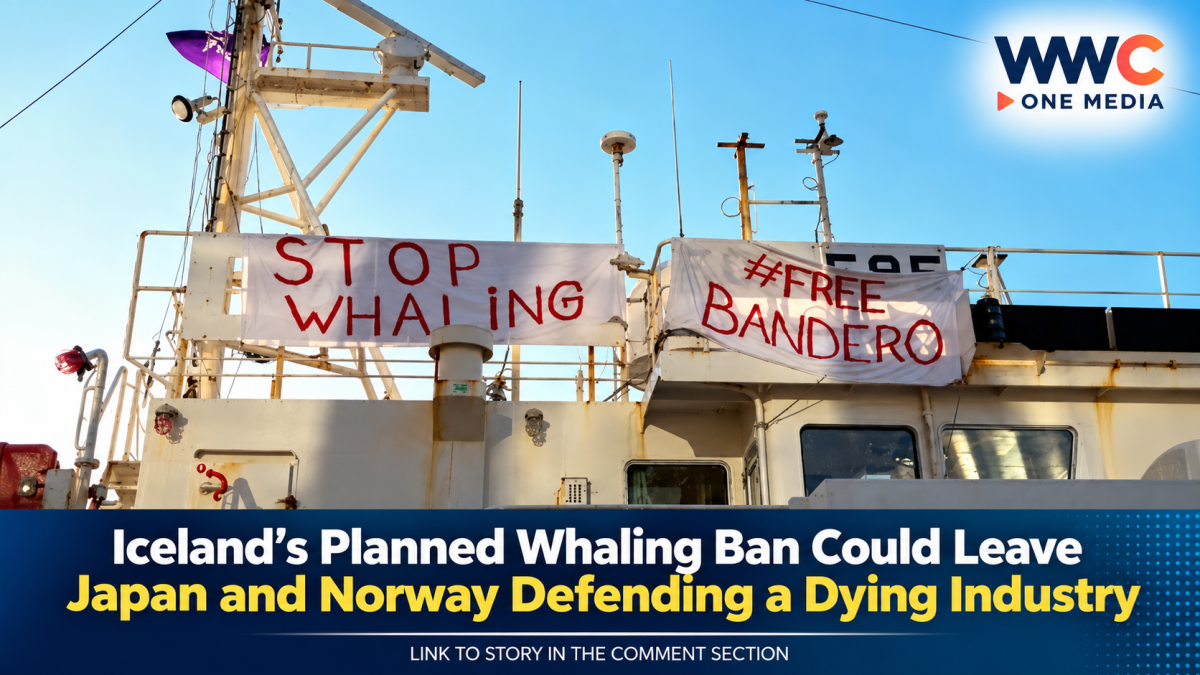
Iceland’s plan to permanently ban commercial whaling could leave Japan and Norway increasingly isolated as the world’s last remaining commercial whaling nations, putting new pressure on an industry already facing declining demand and growing international opposition.
The Icelandic government plans to introduce legislation in February 2027 that would permanently prohibit commercial whaling. If approved, the move would mark a major shift for a country that has continued hunting whales despite the international moratorium adopted in 1986.
For Japan, the development is particularly significant because Iceland’s whale meat industry has long been connected to the Japanese market.
Iceland prepares to walk away from whaling
Iceland resumed commercial whaling in 2006 and has periodically faced fierce domestic and international debate over whether the industry should continue.
Its latest proposal comes after years of pressure from animal-welfare groups and growing questions over whether commercial whaling remains economically or politically sustainable.
Iceland’s sole remaining whaling company, Hvalur, currently operates under a licence that runs through 2029. The company has nevertheless continued hunting during the 2026 season, with a quota allowing up to 150 fin whales.
By early September, around 80 fin whales had reportedly been killed during the season.
Fin whales are classified as vulnerable globally, although their North Atlantic population is considered sufficiently robust by some assessments to support managed harvesting.
Japan could become even more isolated
If Iceland ends commercial whaling, only Japan and Norway would remain as countries openly conducting commercial hunts.
That would leave Tokyo facing an increasingly difficult international environment.
Japan withdrew from the International Whaling Commission in 2019 and resumed commercial whaling that same year. The move freed Japan from the commission’s commercial-whaling moratorium, although the country continues to report its catches to the organisation.
Tokyo has defended whaling as part of Japan’s food culture and maritime tradition, arguing that whale populations should be managed according to scientific assessments rather than blanket prohibitions.
But the political argument becomes more difficult when fewer countries are willing to maintain the industry.
Iceland’s whales are closely tied to Japan
The economic relationship between Icelandic whaling and Japan is particularly important.
Much of Iceland’s fin-whale meat has traditionally been exported to Japan, where whale meat remains available despite its declining popularity compared with the decades when it was a more common source of protein.
That means Iceland’s decision is not simply about ending a domestic industry.
It could also reduce the number of suppliers serving Japan’s shrinking whale-meat market.
The situation highlights one of the central challenges facing commercial whaling: even where governments continue to permit it, consumer demand has become far smaller than it was during the industry’s peak.
A shrinking market and heavy political debate
Whaling supporters argue that the industry can provide jobs, maintain coastal communities and contribute to national food sovereignty.
Critics counter that modern commercial whaling has become economically marginal and increasingly difficult to justify when alternative industries, including fishing and whale watching, can generate greater long-term value.
Iceland’s debate has been particularly complicated because the country also has a major whale-watching tourism industry.
The two activities have existed side by side, but conservation groups have argued that killing whales undermines Iceland’s reputation as a destination for marine tourism.
Public opinion remains divided
Iceland’s proposed ban does not mean the issue has been settled.
The country’s last whaling company has said it believes the industry can survive another attempt to outlaw it.
Hvalur chief executive Kristján Loftsson has pointed to previous efforts that failed to permanently eliminate whaling and remains confident that political opposition could prevent the proposed ban from becoming law.
Public opinion is also not unanimous. A June poll cited by Reuters found that 41 per cent of respondents opposed whaling, while about one-third supported it and 26 per cent were undecided or neutral.
The parliamentary battle could therefore still be contentious.
Norway faces the same dilemma
Norway is likely to become Japan’s only major partner in defending commercial whaling if Iceland exits the industry.
Oslo has long maintained an objection to the international commercial-whaling moratorium and resumed commercial hunting in 1993.
But Norway’s industry also faces questions over demand and economics.
The fact that commercial whaling has survived in only a handful of countries reflects how dramatically the global market has changed since the industry was at its height.
The 1986 moratorium changed the industry
The International Whaling Commission adopted its commercial-whaling moratorium in 1986, sharply reducing legal commercial hunts worldwide.
Indigenous communities in places such as Greenland and Alaska remain permitted to hunt whales for cultural and subsistence purposes under separate provisions.
Japan eventually left the IWC in 2019 and resumed commercial whaling, while Iceland and Norway have continued hunting under their respective positions regarding the moratorium.
The result is an increasingly unusual global situation in which commercial whaling is concentrated in just a few countries.
Iceland’s planned exit could make that concentration even more pronounced.
Japan’s whaling debate is unlikely to disappear
Japan has invested heavily in maintaining its whaling industry despite the relatively small size of the domestic market.
Government support has helped sustain the sector, while politicians and industry advocates continue to frame whaling as an issue of national sovereignty and cultural identity.
But declining consumption presents a fundamental challenge.
Even if Japan can maintain the legal and political infrastructure needed to hunt whales, it must also maintain enough demand to make the industry viable.
That becomes harder when international partners disappear and whale meat becomes increasingly niche.
A symbolic blow to commercial whaling
Iceland’s proposed ban would therefore carry significance beyond the number of whales hunted in its waters.
It would represent another major country deciding that commercial whaling no longer has a long-term place in its economy.
For Japan and Norway, the immediate effect would be greater diplomatic isolation rather than an automatic end to their industries.
But the symbolism would be powerful.
The world’s commercial whaling community could soon shrink to just two countries, leaving Japan and Norway defending a practice that much of the world has already abandoned.
For Japan in particular, Iceland’s decision could serve as a warning: maintaining whaling is becoming less about a broad international industry and increasingly about preserving a small, politically sensitive tradition against a rapidly changing global consensus.




Leave a Reply