
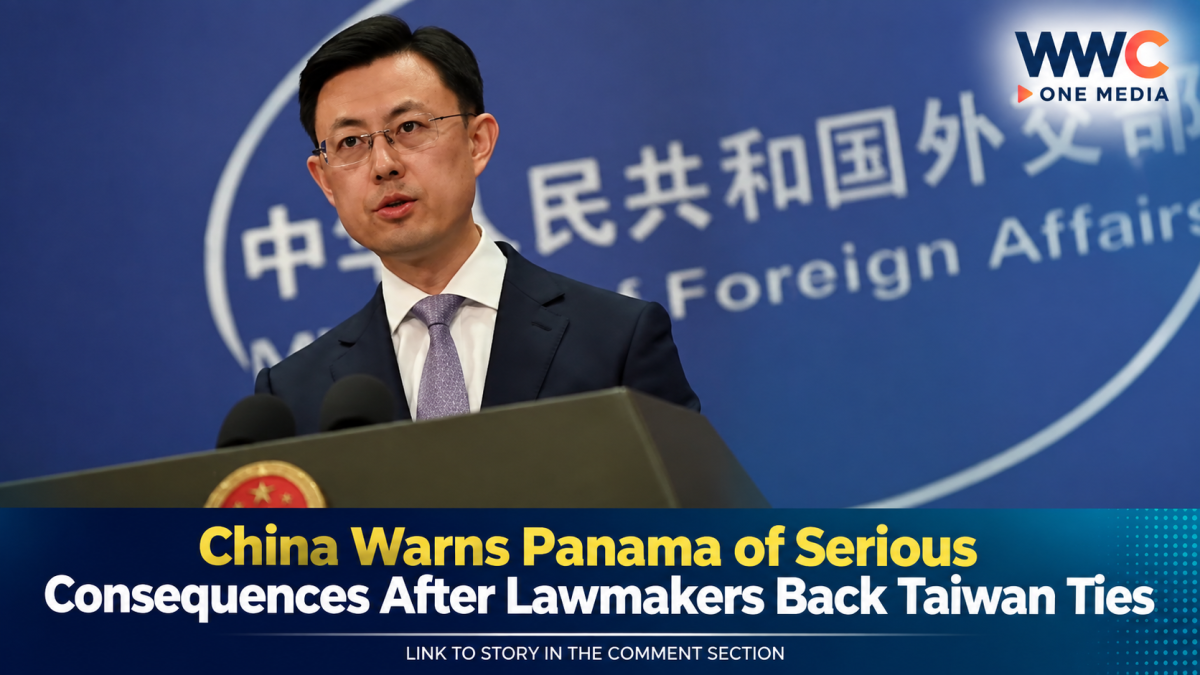
China has warned Panama of “serious consequences” after a majority of Panamanian lawmakers established a parliamentary exchange group with Taiwan, defying pressure from Beijing and putting new strain on diplomatic relations between the two countries.
The move is particularly sensitive because Panama formally switched diplomatic recognition from Taiwan to China in 2017 and has since maintained the one-China principle in its official relations with Beijing.
Beijing demands Panama uphold one-China principle
Chinese Foreign Ministry spokesman Guo Jiakun said the creation of the parliamentary group seriously violated the one-China principle that forms the political basis of China-Panama relations.
He urged the Panamanian politicians involved to understand what Beijing described as the broader consequences of challenging that principle.
China has consistently opposed official or quasi-official exchanges between Taiwan and countries that recognise Beijing, arguing that such contacts undermine its claim that Taiwan is part of China.
The latest warning shows that Beijing is prepared to apply diplomatic pressure even when Taiwan-related initiatives originate from foreign legislatures rather than national governments.
Panama’s president distances himself from lawmakers
The parliamentary initiative has created an unusual split within Panama.
President José Raúl Mulino has publicly distanced his administration from the lawmakers’ move, reaffirming Panama’s commitment to its relationship with China.
That has not stopped members of the country’s legislature from pursuing closer parliamentary contact with Taiwan.
The development therefore does not represent an immediate change in Panama’s diplomatic recognition.
Instead, it highlights growing differences between the executive branch and lawmakers over how far Panama should engage Taiwan while maintaining formal ties with Beijing.
Taiwan gains a new channel for engagement
For Taiwan, the creation of the parliamentary exchange group represents a small but politically significant opening.
Taiwan has lost many of its formal diplomatic allies over the past several decades as Beijing has persuaded countries to recognise the People’s Republic of China instead.
Panama was one of those countries.
Although parliamentary exchanges do not amount to diplomatic recognition, they can provide Taiwan with an additional channel for political engagement and cooperation.
Taiwan has increasingly sought to strengthen relationships with foreign lawmakers, city governments and other institutions as Beijing works to limit the island’s official international space.
Panama switched recognition in 2017
Panama established diplomatic relations with Beijing in June 2017, ending its longstanding diplomatic relationship with Taiwan.
The decision was a major diplomatic setback for Taipei because Panama was one of Taiwan’s most important partners in Central America.
Since then, Panama has maintained formal relations with Beijing and accepted the one-China framework as the basis of its diplomatic relationship with China.
The latest parliamentary move does not formally reverse that decision.
But Beijing is clearly concerned that expanded political exchanges with Taiwan could create momentum for a broader shift in Panama’s approach.
China-Panama relations already face tensions
The dispute comes at a time when relations between Panama and China have already become more complicated.
Panama has taken steps that have challenged some of Beijing’s expectations regarding its economic and strategic engagement with the country.
The Panama Canal is particularly sensitive because of its enormous importance to global trade and China’s commercial interests in the region.
Beijing therefore has strong incentives to prevent political disputes over Taiwan from developing into a broader deterioration in bilateral relations.
Taiwan issue becomes a wider diplomatic contest
China’s reaction also reflects the broader international competition between Beijing and Taipei.
Beijing has intensified efforts to prevent Taiwan from expanding its international relationships, while Taiwan has sought to build unofficial partnerships even with countries that formally recognise China.
Parliamentary diplomacy has become one of the areas where Taiwan can maintain international contacts without requiring governments to establish formal diplomatic relations.
For Beijing, however, even these unofficial exchanges can cross a political red line when they appear to give Taiwan greater international legitimacy.
A warning with wider implications
The dispute demonstrates how the Taiwan issue continues to affect countries far beyond East Asia.
For Panama, maintaining diplomatic and economic ties with China while allowing lawmakers to develop closer relations with Taiwan creates a delicate balancing act.
For Beijing, the priority remains preventing any action that could weaken the one-China principle.
And for Taiwan, every new parliamentary relationship provides an opportunity to expand its international presence despite its lack of formal recognition from most governments.
The immediate dispute may remain limited to parliamentary exchanges.
But China’s warning of “serious consequences” signals that Beijing will be watching closely to ensure that Panama’s growing political contacts with Taiwan do not develop into something more substantial.




Leave a Reply