
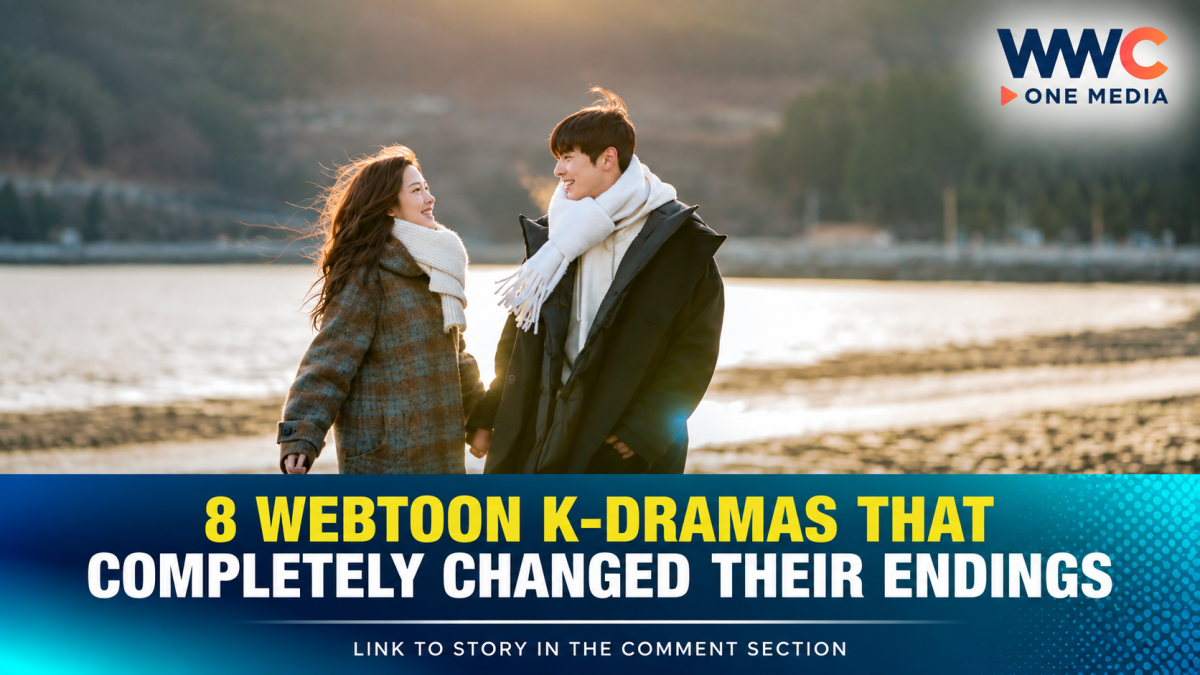
When a beloved webtoon is turned into a K-drama, fans often expect to see their favourite characters and storylines brought to life as faithfully as possible.
But adaptations rarely follow the source material perfectly.
Sometimes production begins before the webtoon has finished, forcing writers to create their own conclusion. In other cases, screenwriters reshape the story to suit a television audience, change a character’s fate or simply decide that the original ending does not work as well in live action.
The result can be anything from a subtle adjustment to a finale that completely changes the meaning of the story.
Here are eight webtoon-based K-dramas that took dramatically different paths from their original endings.
Love Alarm
Starring Kim So-hyun, Song Kang and Jung Ga-ram, Love Alarm revolves around an app that alerts users whenever someone within 10 metres has romantic feelings for them.
The love triangle between Kim Jo-jo, Hwang Sun-oh and Lee Hye-yeong became one of the show’s biggest hooks.
The adaptation faced an unusual problem during its second season because the original webtoon had gone on an indefinite hiatus while its creator dealt with health issues.
That meant the drama had to create its own route to the finish.
Both versions ultimately pair Jo-jo with Hye-yeong, but the journey is very different. The K-drama introduced its own resolution for the Love Alarm 2.0 algorithm, gave Sun-oh a more distinct redemption story and placed greater emphasis on Jo-jo becoming emotionally independent.
Instead of simply reproducing the webtoon’s romantic ambiguity, the drama gave viewers a more definitive television conclusion.
Sweet Home
Sweet Home is one of the clearest examples of an adaptation eventually becoming its own story.
The Netflix series, starring Song Kang, Lee Jin-wook and Lee Si-young, begins with the same central premise as the webtoon: humans are transforming into monsters while residents of an apartment complex struggle to survive.
But the differences grow substantially as the series progresses.
Several characters receive dramatically different storylines, while others meet completely different fates.
Ji-su is one of the most significant examples. In the webtoon, she survives into the post-apocalyptic aftermath, while the television adaptation kills her much earlier.
Eun-hyeok and Eun-yoo also take different paths, and even the final images of the two versions are different.
The webtoon ends with Hyun-su emerging from a cocoon and discovering Ji-su’s phone, followed by an epilogue depicting survivors in a snow-covered world.
The television series instead builds toward its own mythology and conclusion.
At that point, Sweet Home was no longer simply adapting the webtoon. It had effectively become a separate version of the story.
Yumi’s Cells
Yumi’s Cells faced a particularly difficult adaptation challenge.
The original webtoon spans 512 chapters and follows Yumi through multiple relationships and different stages of her life.
The television drama, led by Kim Go-eun, Ahn Bo-hyun and Jinyoung, compressed that enormous story into two seasons.
The biggest difference comes with Yumi’s romantic future.
In the webtoon, Yumi eventually meets Shin Soon-rok, who becomes her true endgame partner. The drama never fully develops that relationship.
Instead, Season 2 ends with Yumi single and focused on her career as a writer.
Viewers are given only a brief glimpse of Soon-rok at an office gathering, leaving the possibility of a future relationship open.
The drama also softened Yoo Babi’s flaws and gave his character a more sympathetic farewell than the webtoon.
Rather than rushing through another major romance, the series chose to end Yumi’s story on a note of independence and personal growth.
Nevertheless
Nevertheless may have one of the most talked-about differences between its webtoon and television ending.
The drama stars Han So-hee as Yoo Na-bi and Song Kang as Park Jae-eon, two art students drawn into a complicated relationship despite Na-bi’s doubts about Jae-eon’s intentions.
The webtoon and drama both explore the same toxic push-and-pull dynamic, but they ultimately reach different conclusions.
In the original story, Na-bi walks away from Jae-eon and moves toward another relationship.
The K-drama takes a more romantic route.
Na-bi and Jae-eon reconcile, giving their relationship another chance and delivering a more conventional romantic ending.
The change significantly alters the message of the story.
The webtoon leans toward the idea that recognising a destructive relationship can mean having the strength to leave it. The drama instead leaves room for the possibility that people can change and that unresolved chemistry deserves another chance.
For viewers who read the webtoon first, the difference was impossible to miss.
Mask Girl
Mask Girl did not simply change the ending of its source material. It changed the fate of its central character.
The Netflix series follows Kim Mo-mi, whose life is portrayed at different stages by Lee Han-byeol, Nana and Go Hyun-jung.
Her journey takes her from an insecure office worker to a masked internet performer, fugitive and prisoner.
But the most significant departure comes in the final confrontation.
In the original webtoon, Mo-mi survives her encounter with Kim Kyung-ja and escapes into an uncertain future.
The Netflix adaptation chooses a far more tragic conclusion.
Mo-mi protects her estranged daughter, Mi-mo, from Kyung-ja’s gunfire and sacrifices herself before the police arrive.
The alteration gives the ending a stronger emotional emphasis on motherhood and redemption.
Instead of leaving Mo-mi as a morally complicated survivor, the drama turns her final act into a sacrifice for her child.
True Beauty
True Beauty is another adaptation where the production team had to create a stopping point before the original story had finished.
Moon Ga-young, Cha Eun-woo and Hwang In-youp starred in the 2020 drama adaptation of Yaongyi’s hugely popular webtoon.
The television series eventually brings Lim Ju-gyeong and Lee Su-ho back together, providing audiences with a neat romantic conclusion.
But the webtoon continued well beyond the point where the K-drama ended.
That meant readers were able to follow the characters into later stages of their relationships and adult lives, while television viewers received a much earlier conclusion.
The difference is therefore less about a completely rewritten fate and more about how much of the characters’ lives each version allows audiences to see.
The drama had to provide an ending.
The webtoon had room to keep going.
Cheese in the Trap
Cheese in the Trap remains one of the most complicated examples of adapting an ongoing webtoon.
The 2016 drama starred Kim Go-eun, Park Hae-jin and Seo Kang-joon and was produced while Soonkki’s original webtoon was still being published.
That created an obvious problem: the television series needed to conclude before the source material had reached its own ending.
The drama leaves Hong Seol and Yoo Jung’s relationship on an intentionally open note, while the completed webtoon eventually gives readers a more definitive resolution.
But the ending was only one source of controversy.
As the drama progressed, viewers also questioned the increasing focus on Baek In-ho and the changing balance between the central characters.
The result was an adaptation that increasingly moved away from the trajectory readers had been following online.
It became an example of how difficult it can be to adapt a popular story while its creator is still developing the original plot.
The Uncanny Counter
Not every adaptation needs to completely rewrite its final scene to change the meaning of the story.
The Uncanny Counter demonstrates how alterations to character motivations and emotional arcs can produce a different ending even when the broad destination remains familiar.
The drama, led by Jo Byeong-gyu and Kim Se-jeong, made substantial changes to Jang Yi’s original webtoon across its two seasons.
The differences became particularly noticeable in the second season through the storyline involving Ma Ju-seok, played by Jin Sun-kyu.
Both versions explore his struggle against the forces consuming him, but the drama places greater emphasis on So Mun’s ability to reach him and bring him back.
Other characters, circumstances and motivations surrounding the confrontation were also reshaped.
The result is an ending that is less about simply asking who survives and more about who gets the chance to save another person.
Why K-Dramas Keep Changing Webtoon Endings
Changing a webtoon ending can be risky.
Fans often arrive with years of attachment to the original characters and already know where the story is supposed to go. Even a seemingly small alteration can therefore generate strong reactions.
But adaptation is not necessarily about copying every panel.
A webtoon and a television series operate differently. A long-running digital comic can spend hundreds of chapters developing relationships, while a K-drama may have only 12 or 16 episodes to reach its conclusion.
Sometimes the source material is unfinished. Sometimes a storyline works better on the page than it does with live actors. And sometimes writers want the television version to stand on its own.
That is why Love Alarm, Sweet Home, Yumi’s Cells, Nevertheless, Mask Girl, True Beauty, Cheese in the Trap and The Uncanny Counter can all tell versions of the same stories while arriving at noticeably different destinations.
For viewers, that can be frustrating when the original ending was a favourite.
But it can also make the adaptation worth watching even after reading the webtoon—because knowing how the original story ends does not necessarily mean knowing how the K-drama will end.

Leave a Reply