
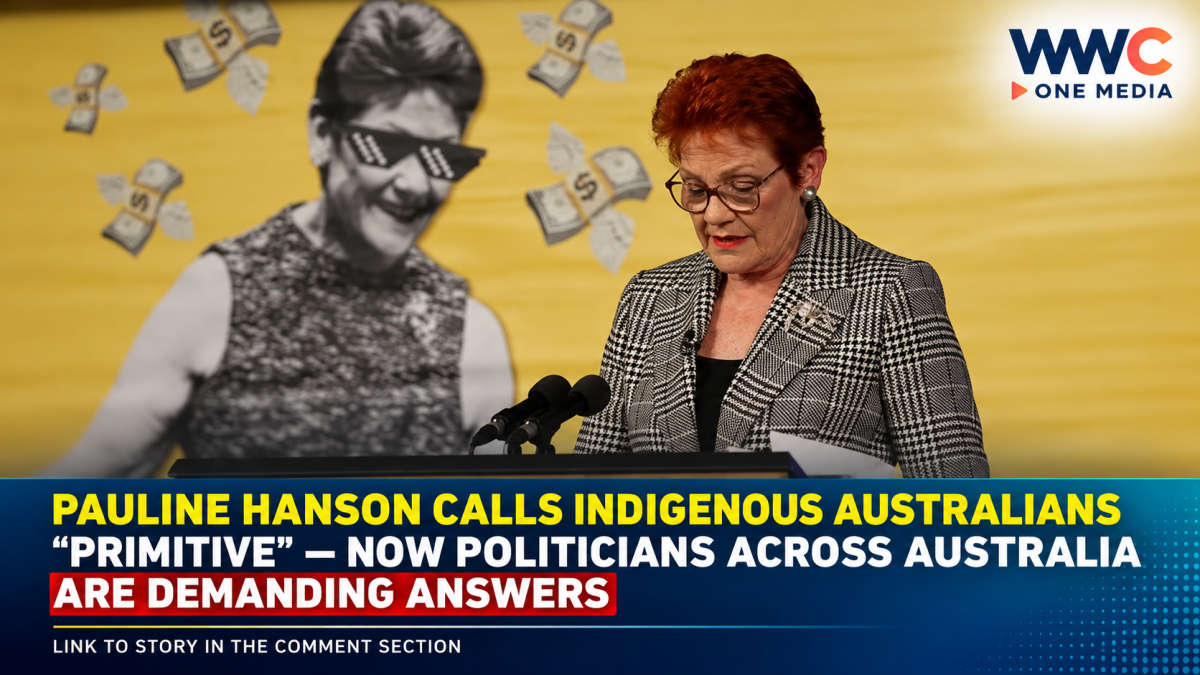
SYDNEY — One Nation leader Pauline Hanson is facing renewed condemnation across Australia after resurfaced comments in which she described Indigenous Australians as the “most primitive race on Earth” and questioned what they had contributed to the country over thousands of years.
The remarks were made during a podcast interview in 2025 but resurfaced publicly on September 14, 2026, prompting an immediate political backlash from Indigenous leaders, government ministers and politicians across the political spectrum.
Hanson was discussing the teaching of Indigenous Australian history and culture in schools when she questioned why such subjects were being emphasized.
She argued that Indigenous Australians had not invented technologies such as the wheel and dismissed examples of Indigenous cultural heritage, before saying they had “achieved nothing.”
The comments have been condemned as racist and deeply offensive, with Indigenous Australians Minister Malarndirri McCarthy describing them as “totally outrageous” and calling for Hanson to apologize.
Liberal Senator Jacinta Nampijinpa Price, who is herself Indigenous, also criticized Hanson, describing the remarks as “appalling” and reflecting what she called “wilful ignorance.” Other opposition and crossbench politicians have similarly rejected the comments.
Australia’s Indigenous history tells a very different story
The controversy has also renewed scrutiny of claims about the achievements and history of Aboriginal and Torres Strait Islander peoples.
Australia’s National Indigenous Australians Agency says Aboriginal and Torres Strait Islander cultures represent one of the oldest continuous civilizations on Earth, with histories extending back more than 65,000 years.
The Australian Institute of Aboriginal and Torres Strait Islander Studies (AIATSIS) documents extensive Indigenous knowledge and technologies, including sophisticated fishing systems, stone fish traps, woven nets, spears, hooks and other methods developed and adapted across different environments.
AIATSIS notes that large-scale stone fish traps and weirs demonstrate technological capability developed by Aboriginal communities, while archaeological evidence also records innovations such as bone-tipped spears and shell fish hooks.
The history is therefore considerably more complex than a comparison based simply on whether a particular technology—such as the wheel—was developed.
Indigenous Australian societies developed knowledge systems adapted to the continent’s diverse environments, including sophisticated practices involving land management, fishing, food gathering, navigation, language, law, ceremony and intergenerational transmission of knowledge.
Backlash comes as One Nation gains political momentum
The controversy comes at a politically significant moment for Hanson and One Nation.
Once largely viewed as a fringe political movement, One Nation has experienced a major resurgence in 2026. Reuters reported in August that the party had won its first lower-house seat in Western Australia’s state parliament, adding to its growing electoral momentum. The party had also previously overtaken Labor in a national opinion poll.
Hanson has increasingly placed immigration, multiculturalism and national identity at the center of her political platform.
In June, she told the National Press Club that Australia should be “monocultural” rather than multicultural, while in July she faced criticism after appearing on the podcast of British far-right activist Tommy Robinson.
Those controversies have intensified debate over how far-right and nationalist politics are influencing Australia’s political mainstream.
The renewed backlash over her Indigenous comments therefore comes at a time when One Nation is seeking to convert growing public dissatisfaction over immigration, housing and the cost of living into broader electoral support.
Hanson faces calls to apologize
Despite the growing criticism, Hanson has not offered the apology demanded by some of her political opponents. Reports indicate she has instead pushed back against the renewed media attention surrounding remarks made a year earlier.
For Indigenous Australians and their advocates, however, the controversy goes beyond one political statement.
It has reopened a longstanding debate over how Australia’s First Peoples are represented in politics, schools and national discussions about identity.
Government sources describe Aboriginal and Torres Strait Islander cultures as fundamental to Australia’s national identity and emphasize their continuity across more than 65,000 years.
The political question now is whether the controversy will merely generate another cycle of outrage—or become a broader test of how Australians respond to racial rhetoric as One Nation’s influence continues to grow.
And with the party gaining electoral ground, the answer could extend well beyond Hanson herself.




Leave a Reply