
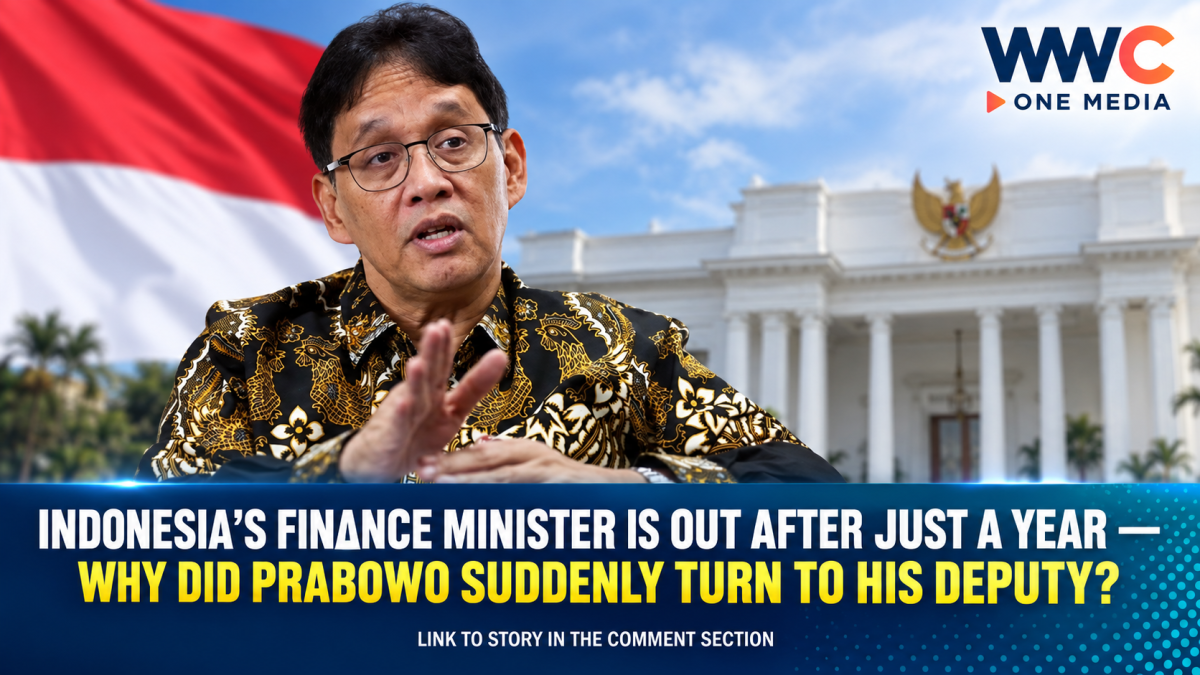
JAKARTA, Indonesia — Indonesian President Prabowo Subianto has replaced Finance Minister Purbaya Yudhi Sadewa with his deputy, Suahasil Nazara, in a dramatic Cabinet shake-up that puts one of Southeast Asia’s most closely watched economies under a new financial chief.
The decision, announced on Monday, September 14, makes Suahasil the third person to serve as Indonesia’s finance minister since Prabowo took office in October 2024.
Purbaya had held the powerful position for only about a year after being appointed on September 8, 2025, to replace longtime finance minister Sri Mulyani Indrawati. Sri Mulyani had served under three Indonesian presidents and was widely regarded as one of the country’s most influential economic policymakers.
PURBAYA OUT, SUAHAASIL IN
President Prabowo officially appointed Suahasil Nazara as Indonesia’s new finance minister during a ceremony at the State Palace in Jakarta.
According to Indonesia’s ANTARA news agency, Suahasil’s appointment was formalized through Presidential Decree No. 97/P of 2026, which covers the dismissal and appointment of the finance minister for the remainder of the 2024-2029 presidential term.
The change came after a dramatic day in Jakarta. Channel NewsAsia reported that Purbaya had left a parliamentary hearing before the announcement, while senior government officials, including Suahasil, arrived at the State Palace for the swearing-in ceremony.
The government did not immediately provide a detailed public explanation for Purbaya’s removal.
WHO IS INDONESIA’S NEW FINANCE MINISTER?
Suahasil is far from an unknown figure within Indonesia’s economic establishment.
He has served as deputy finance minister since 2019 and previously led the Finance Ministry’s Fiscal Policy Agency. Before entering government, he built a career in academia and economic policy.
His long experience inside the Finance Ministry could make his appointment particularly important at a time when investors are closely watching Indonesia’s fiscal direction.
Reuters reported that Suahasil takes over amid concerns about fiscal management and investor confidence, while other reports have pointed to market unease over policy uncertainty and the government’s ambitious spending agenda.
WHY THE CHANGE MATTERS FOR INDONESIA’S ECONOMY
The finance minister is one of the most powerful positions in Indonesia’s government, overseeing the state budget, taxation, government spending and broader fiscal policy.
Under President Prabowo, Indonesia has pursued ambitious economic and social programmes, including major spending initiatives and efforts to accelerate economic growth.
But those ambitions have also intensified questions over how the government will maintain fiscal discipline while funding expensive programmes.
The Financial Times reported that investor concerns during Purbaya’s tenure included his support for looser fiscal policies and disagreements over economic management, while analysts have continued to focus on Indonesia’s legally mandated fiscal deficit ceiling of 3 per cent of gross domestic product.
Suahasil now faces the difficult challenge of supporting Prabowo’s economic agenda while convincing investors that Indonesia’s public finances remain credible and predictable.
PURBAYA’S SHORT AND HIGH-PROFILE TENURE
Purbaya entered the Finance Ministry after previously leading Indonesia’s Deposit Insurance Corporation.
Once in office, however, the previously low-profile technocrat quickly became one of the government’s most recognisable and outspoken economic figures.
Channel NewsAsia noted that observers viewed Purbaya as having a brash and unfiltered style, which helped raise his public profile but also drew attention to his often unconventional approach to economic policy.
Among his more notable proposals was the idea of imposing a levy on ships passing through the strategically vital Malacca Strait, one of the world’s busiest trade and energy routes.
Purbaya had also been involved in major discussions surrounding Indonesia’s infrastructure and financial commitments, including the restructuring of ownership connected to the China-funded Jakarta-Bandung high-speed railway project known as Whoosh. Reuters reported earlier this month that Indonesia was preparing to shift control of the project to a government entity as authorities dealt with its significant debt obligations.
THIRD FINANCE MINISTER UNDER PRABOWO
The latest reshuffle is significant because of the speed of turnover at the Finance Ministry.
Suahasil is now the third finance minister to serve under Prabowo since the president began his term less than two years ago.
Sri Mulyani left the position in September 2025 and was replaced by Purbaya. Now, just over a year later, Purbaya himself has been replaced by Suahasil.
That rapid succession could make investors and businesses particularly sensitive to Suahasil’s first policy decisions.
The Straits Times reported that speculation over Purbaya’s position had grown amid concerns surrounding Indonesia’s fiscal policy, while Reuters described Suahasil’s appointment as another major shift in Prabowo’s economic leadership team.
CAN SUAHAASIL NAZARA RESTORE CONFIDENCE?
For markets, the biggest question is not simply why Purbaya was removed.
It is what comes next.
Suahasil inherits an economy with enormous potential, a massive domestic market and ambitious growth plans. But he must also manage the expectations of investors who want reassurance that Indonesia will maintain fiscal discipline despite pressure for higher spending and faster growth.
His extensive experience inside the Finance Ministry could help provide continuity.
But with Indonesia now on its third finance minister under President Prabowo, the new minister’s first major decisions will be watched closely in Jakarta, across Southeast Asia and by global investors.
The sudden removal of Purbaya may have closed one chapter in Indonesia’s economic leadership.
But for Suahasil Nazara, the real test is only beginning: Can he balance Prabowo’s ambitious economic agenda with the fiscal credibility needed to keep markets on Indonesia’s side?




Leave a Reply