
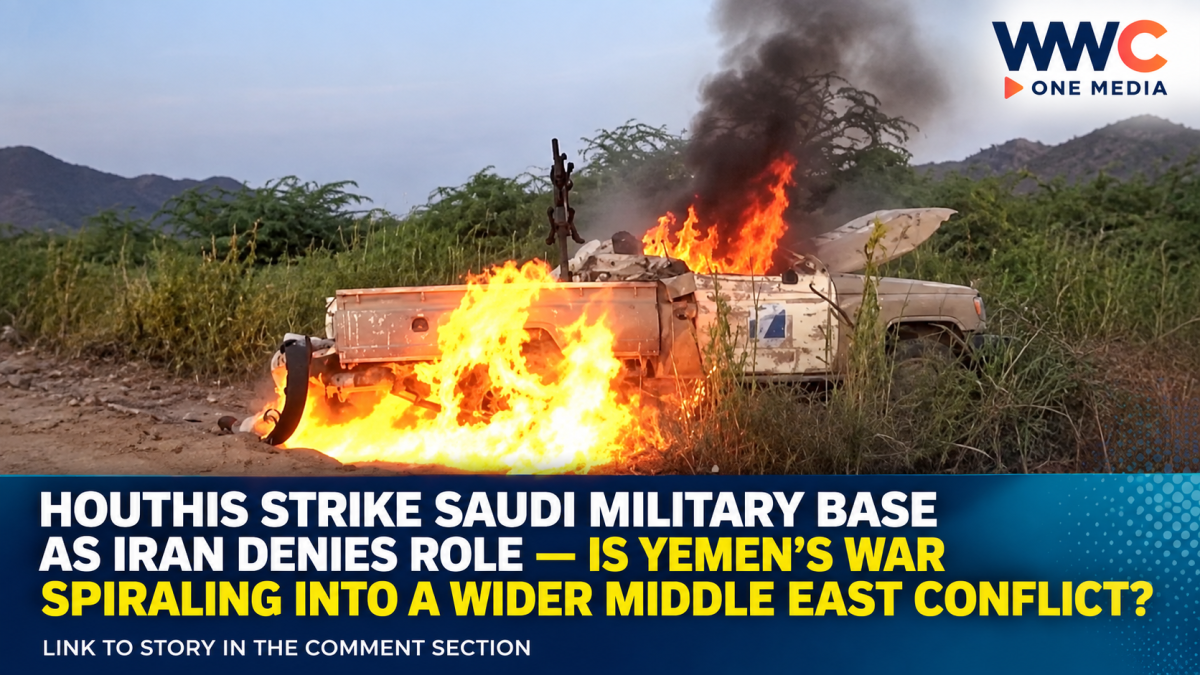
A fresh Houthi attack on Saudi Arabia is raising fears that Yemen’s long-running conflict could once again explode into a wider regional crisis, as Iran denied direct involvement while fighting and diplomatic tensions continued to intensify across the Middle East.
Yemen’s Iran-aligned Houthi movement claimed responsibility for attacks on Saudi military targets, using missiles and drones as hostilities between the Houthis and Saudi-backed forces escalated.
The latest developments mark a dramatic deterioration in a conflict that had seen years of relative calm following the 2022 truce.
Houthis Claim Attack on Saudi Military Target
The Houthis said they had launched attacks against Saudi military installations as fighting intensified inside Yemen.
Recent reports from Reuters, the Associated Press and other international outlets show that the conflict has expanded beyond Yemen’s internal frontlines, with Houthi attacks increasingly targeting Saudi military and energy infrastructure.
Reuters reported that the Houthis launched a major attack targeting Saudi Arabia’s Khamis Mushait airbase, while other reports described drone and missile attacks against military facilities and infrastructure in southern Saudi Arabia.
The group has also renewed threats against Saudi oil facilities, airports and strategic infrastructure.
The escalation is particularly significant because Saudi Arabia and the Houthis had largely avoided major direct confrontation for several years after an informal truce began in 2022.
That period of relative calm now appears increasingly fragile.
Iran Denies Direct Role
Iran has repeatedly denied directly directing Houthi military operations or being responsible for the group’s attacks.
Tehran has long rejected accusations from Saudi Arabia, the United States and other governments that it commands the Houthis, even though the movement is widely described by Western and regional officials as Iran-aligned.
However, recent reporting has added new scrutiny to the relationship.
Reuters reported in July that Iranian Revolutionary Guard commanders, advisers and military equipment were allegedly transported to Houthi-controlled territory in Yemen, based on accounts from regional and Iranian sources.
Another Reuters report said Iranian weapons and tactical advice had helped the Houthis during their recent offensive along Yemen’s Red Sea coast.
Iran disputes allegations that it directly controls Houthi military decisions.
The distinction is now becoming increasingly important as the conflict threatens to draw in more regional powers.
Yemen Conflict Returns to Dangerous Territory
Yemen has been divided by war for more than a decade.
The Houthis control the capital Sanaa and much of northern Yemen, while the internationally recognized government operates primarily from the south and receives support from Saudi Arabia and its allies.
Saudi Arabia intervened militarily in Yemen in 2015 as part of a coalition supporting the internationally recognized government against the Houthis.
The conflict eventually produced one of the world’s most serious humanitarian crises.
A truce that began in 2022 dramatically reduced cross-border attacks, but the agreement did not produce a permanent political settlement.
Now, renewed fighting is threatening to undo years of fragile de-escalation.
Reuters and the Associated Press have reported that the Houthis have recently intensified military operations inside Yemen while also launching attacks against Saudi targets.
The renewed violence has displaced tens of thousands of Yemenis and raised fears of another major humanitarian disaster.
Strategic Red Sea Routes Raise Global Stakes
The conflict is no longer just about Yemen.
Recent Houthi advances and attacks have placed increasing attention on the Bab el-Mandeb Strait, one of the world’s most strategically important maritime passages.
The waterway connects the Red Sea to the Gulf of Aden and is a critical route for global shipping and energy supplies.
The Houthis have recently expanded their presence along Yemen’s Red Sea coast, including the capture of strategic territory and islands, according to reports from Reuters and the Associated Press.
That has raised fears that the Houthis could gain greater leverage over international shipping routes.
The situation is especially alarming because regional tensions have already disrupted another critical maritime chokepoint: the Strait of Hormuz.
With both waterways under growing pressure, governments and energy markets are increasingly concerned about potential disruptions to global oil supplies.
Saudi Oil Infrastructure Back in the Crosshairs
Saudi Arabia’s energy infrastructure has long been a major target for Houthi attacks.
The Houthis previously carried out missile and drone attacks on Saudi oil facilities, airports and other strategic sites during earlier stages of the war.
In July, the Houthis said they had targeted Saudi Arabia’s east-west oil transport infrastructure, a strategically important pipeline system connecting the kingdom’s oil-producing eastern region with Red Sea export facilities.
The pipeline is particularly important because it gives Saudi Arabia an alternative route for moving oil when shipping through the Strait of Hormuz becomes risky.
Any successful disruption to that infrastructure could have consequences far beyond the region.
Recent attacks and security threats have already contributed to increased concerns over global energy supplies and investor confidence.
US Faces Pressure to Respond
The escalating Houthi campaign is also creating a new challenge for Washington.
Saudi Arabia has sought greater support as the security situation deteriorates, while the United States faces pressure to avoid being pulled into another major military confrontation.
Reuters reported that Washington has provided intelligence and other forms of support while remaining cautious about direct military intervention.
The United States already faces broader regional security challenges, and a deeper intervention in Yemen could risk expanding the conflict even further.
Analysts have warned that renewed Houthi attacks on Saudi Arabia, combined with fighting around critical Red Sea routes, could open another dangerous front in the wider Middle East crisis.
What Happens Next?
The immediate question is whether the latest attacks will trigger a stronger Saudi military response.
Saudi Arabia has spent years trying to reduce its direct involvement in Yemen and focus on domestic economic transformation and major international projects.
But continued Houthi attacks on military bases, oil infrastructure and strategic shipping routes could make restraint increasingly difficult.
Iran’s denial of direct involvement adds another layer of uncertainty.
If the conflict continues to escalate, the consequences could extend far beyond Yemen and Saudi Arabia.
A renewed full-scale Yemen war could threaten global shipping, put additional pressure on oil markets, worsen an already devastating humanitarian crisis and further destabilize a Middle East already facing multiple interconnected conflicts.
For now, the Houthis are escalating their attacks, Saudi Arabia is weighing its response and Iran continues to deny direct responsibility.
The biggest question may be the one no side can yet answer:
Is this another temporary escalation in Yemen — or the beginning of a much wider regional confrontation?




Leave a Reply