
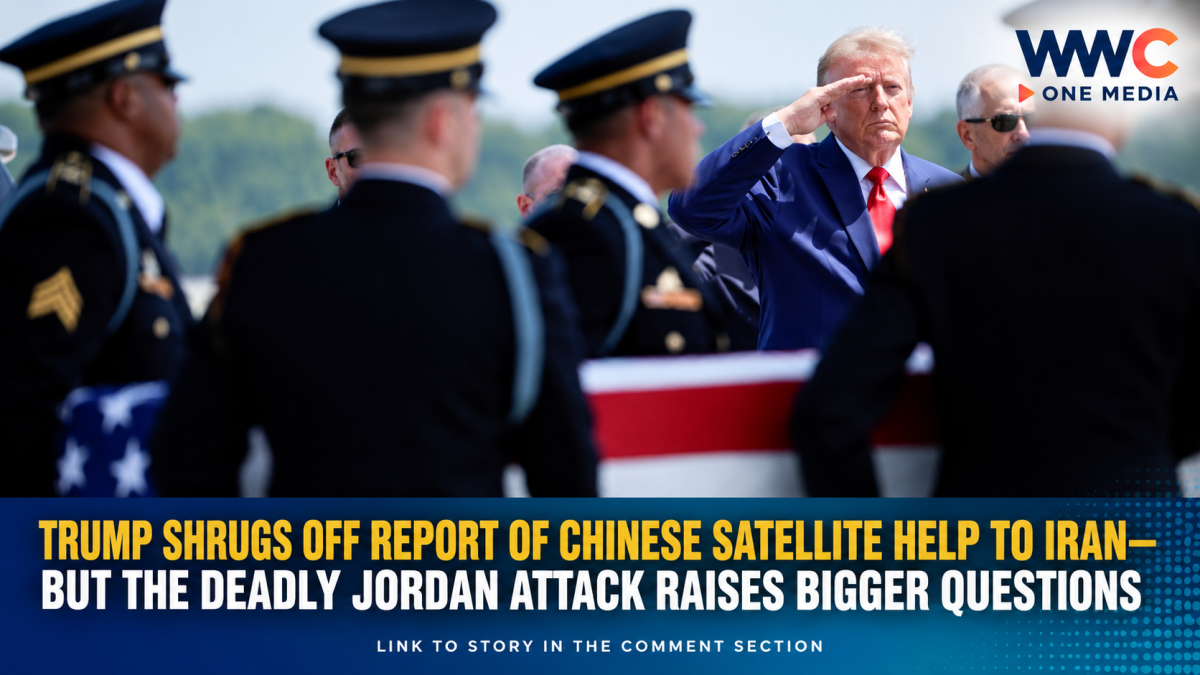
WASHINGTON — President Donald Trump has downplayed a report that Chinese entities provided Iran with high-resolution satellite imagery of a U.S. military base in Jordan before an Iranian missile attack that killed three American service members in July.
The report, first detailed by The Wall Street Journal, said U.S. officials had linked satellite imagery obtained by Iran to the July 17 attack on Muwaffaq Salti Air Base in Jordan. Four other U.S. service members were wounded in the strike, according to military reporting.
The revelation has potentially explosive implications because the imagery could have helped Iran obtain a clearer picture of the American military facility before the attack.
But U.S. officials cited in the report stopped short of accusing Beijing itself of directly participating in the attack. The specific Chinese entities allegedly involved have also not been publicly identified. Reuters said it could not independently verify the Wall Street Journal’s account.
Trump: China and the U.S. Both Conduct Surveillance
Asked whether he would raise the issue with Chinese President Xi Jinping, Trump did not directly say whether the matter would be discussed.
Instead, the president compared China’s intelligence-gathering activities with those of the United States.
Trump said that when people accuse China of spying on the U.S., his response is essentially that Washington conducts surveillance of China as well.
The remarks represent a notably restrained response to an allegation that could otherwise further strain relations between Washington and Beijing—particularly because the alleged intelligence assistance was reportedly connected to an attack that resulted in American military deaths.
What Happened at the Jordan Base?
Muwaffaq Salti Air Base is a strategically important U.S.-linked military facility in Jordan. Iranian ballistic missiles struck the base on July 17, with the attack hitting an area where American personnel were housed.
Three U.S. troops were killed and four others were wounded, according to military reporting. The attack became one of the deadliest recent incidents involving American forces in the conflict with Iran.
The latest allegation centers on satellite imagery reportedly obtained by Iran before and after the attack.
According to the Wall Street Journal’s sources, the imagery was high-resolution and came from Chinese entities. U.S. officials subsequently connected the intelligence to the deadly strike, although the publicly available reporting does not establish that Beijing ordered or coordinated the attack.
China Rejects the Allegation
The allegation has been met with a denial from Beijing.
Chinese officials have rejected accusations of improper assistance and demanded evidence, while China’s embassy in Washington has defended cooperation between China and Iran as consistent with international law.
That distinction is crucial: the current reporting points to Chinese entities, not confirmed direct involvement by the Chinese government.
Why the Report Matters
The issue comes as Washington and Beijing attempt to manage a broader and increasingly complicated relationship.
China has maintained close economic and strategic ties with Iran, while the United States has continued imposing pressure on Tehran during the ongoing conflict.
Reuters has also reported on a broader system that has allowed Iranian oil revenues to facilitate purchases of Chinese goods despite U.S. sanctions, highlighting the depth of the economic relationship between Beijing and Tehran.
The satellite-imagery allegations therefore arrive against an already tense backdrop.
They also raise a major military question for Washington: How much external intelligence is Iran receiving that could improve its ability to locate and strike American forces?
Trump-Xi Meeting Now Under a Sharper Spotlight
Trump and Xi are expected to meet in the United States on September 24, although Beijing has not officially confirmed the meeting.
Trump has continued to describe his relationship with Xi positively, saying the Chinese leader has behaved reasonably and that Washington and Beijing have likewise acted reasonably.
That diplomatic posture could make the satellite-imagery controversy particularly sensitive.
For now, there is no publicly established evidence that Beijing directly ordered or coordinated the Iranian attack. But if U.S. investigators ultimately demonstrate that Chinese-provided intelligence materially enabled an operation that killed American troops, the political consequences could be far greater.
And that is the question looming over Washington ahead of the expected Trump-Xi meeting: Was the satellite imagery simply part of routine commercial or intelligence activity—or did it become a critical piece of information that helped Iran find American targets?
The answer could determine whether the controversy fades as another intelligence dispute—or becomes a new flashpoint in U.S.-China relations.




Leave a Reply