
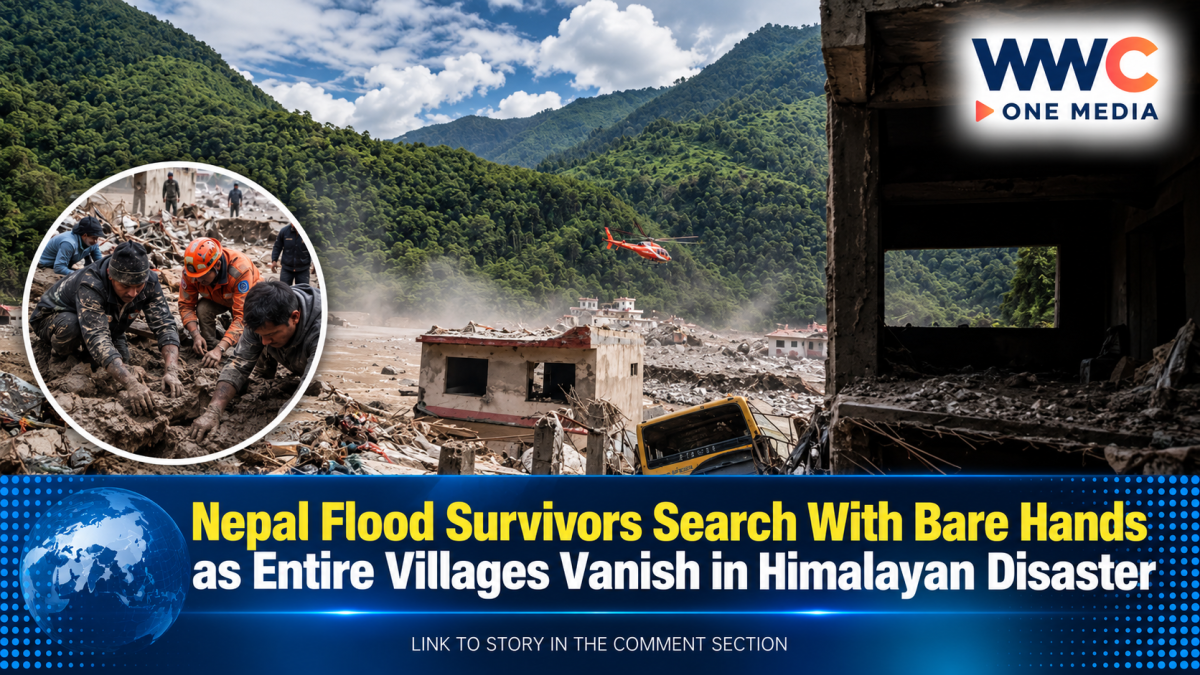
RASUWA, Nepal — With no shovel left and almost nothing remaining of his home, Dil Bahadur Shrestha has been searching through thick mud with his bare hands for the body of his wife.
He already knows she is probably dead.
But after 50 years together, he cannot bring himself to stop looking.
His wife, Jamuna Shrestha, was last seen trying to save her chickens and goats as deadly floodwaters tore through their community in Betrawati, Nepal. Within minutes, their home and much of the town had been swallowed by mud, debris and a torrent of water.
Now, Shrestha is one of thousands of survivors searching for loved ones after one of the worst disasters to strike the Himalayan region in years.
More than 1,200 people have been killed in Nepal and Tibet, while thousands remain missing as rescue teams struggle to reach communities that have been almost completely erased.
‘Everything Was Destroyed Within Two Minutes’
Shrestha, 70, had been working in his rice fields and feeding his cows on the opposite side of the river when disaster struck.
He said he felt the ground shake before seeing what appeared to be a massive black wave racing down the valley.
He ran toward the forest for safety, watching bridges disappear behind him as the flood surged through the area.
“Everything was destroyed within two minutes,” he said.
His wife was still at their home.
The couple had already rebuilt once after Nepal’s devastating 2015 earthquake, which killed thousands of people. This time, the disaster left Shrestha standing alone among the ruins of the life they had spent decades building.
Their home is gone.
Their possessions have disappeared.
And somewhere beneath the mud, he believes his wife may still be buried.
A Town Buried in Mud
The destruction in Betrawati is almost impossible to comprehend.
The disaster began after a melting glacier high in the Himalayas near the Nepal-Tibet border crashed into the valley below, triggering catastrophic flash floods along the Bhotekoshi and Trishuli rivers.
Within minutes, floodwaters reached communities downstream.
In Betrawati, mud now covers entire neighborhoods.
Only the upper floors of some buildings remain visible. Houses have been swept away or flipped over by the force of the water. School buses lie overturned. Shops have been carried hundreds of meters from where they once stood.
Even the river has changed course, cutting through areas where roads and highways once existed.
Across the debris are the remnants of ordinary lives:
Children’s toys.
Kitchen utensils.
Medicine.
Books.
Eyeglasses.
Personal belongings scattered across a landscape that no longer resembles a town.
At least 250 people are missing in Betrawati alone.
Entire Villages Have Disappeared
Further north in Rasuwa district, near the border with Tibet, the destruction becomes even more severe.
Some villages have been swept away almost entirely.
Others remain cut off because roads have collapsed and the ground is too unstable for rescue teams to enter safely.
Army helicopters have become the only way to reach some survivors.
In the border village of Timure, search teams have recovered dozens of bodies after finally gaining access to the area.
In Syabru Besi, another mountain community was almost completely wiped out.
Officials said hundreds of residents were missing, while much of the village had been reduced to what looked like a muddy riverbed.
Only one building was reportedly left standing.
For survivors who escaped into the surrounding mountains, rescue did not come immediately.
Some spent days in the forest with little or no food, surviving on water while waiting for helicopters to reach them.
Thousands Still Missing
The scale of the missing is one of the most frightening aspects of the disaster.
More than 5,000 people are reported missing in Nepal, while hundreds more remain unaccounted for in the Tibet region of China.
Search and recovery teams continue working through mud, damaged buildings and debris fields.
But the conditions are making their work extraordinarily difficult.
Many communities remain inaccessible by road.
Landslides have destroyed major routes.
Aid trucks have become stranded.
And rescue teams must constantly assess whether unstable terrain could trigger another disaster.
For families waiting for news, every passing day brings less certainty.
Children Among the Missing
The disaster has also devastated entire families.
Doctors and aid workers have reported finding children who lost their parents in the floods.
More than 200 students from a local school are also among the missing, believed to have been caught by the floodwaters while heading to morning classes.
A teacher said the school received only about 10 minutes of warning before the disaster struck.
A school bus carrying students was stopped before reaching the most dangerous area, allowing those children to survive.
But for many others, there was no time to escape.
The flood destroyed not only homes and roads, but schools, livelihoods and the communities children had known their entire lives.
Aid Struggles to Reach the Worst-Hit Areas
The destruction of Nepal’s road network has created another major crisis.
The route from Kathmandu toward Rasuwa has become a dangerous journey along muddy, unpaved roads and unstable mountain terrain.
Trips that would normally take far less time can now stretch beyond 12 hours.
Many aid trucks cannot travel beyond Dhunche, leaving some of the hardest-hit communities dependent on helicopters for food, medicine and emergency supplies.
Relief camps have been established along the limited routes that remain open.
Doctors are treating survivors and distributing medicine and food.
But the scale of the disaster means the need is enormous.
For some communities, rescue operations are still continuing more than a week after the floods struck.
A Disaster Beyond Numbers
The death toll and missing-person figures tell only part of the story.
Behind every number is a family searching through the mud.
A parent waiting for a child.
A child who no longer has a home.
A survivor standing where an entire village once existed.
For Dil Bahadur Shrestha, the disaster cannot be measured in statistics.
He remembers his wife feeding their animals.
He remembers their home.
And he remembers the life they rebuilt together after surviving another devastating disaster more than a decade earlier.
Now he walks through the ruins, still searching.
Still hoping.
Still unable to accept that she may never come back.
In Nepal’s worst-hit districts, the floodwaters may have receded — but for thousands of survivors, the real disaster is only beginning as they search for the missing, bury the dead and face the impossible task of rebuilding communities that have been wiped from the map.
WWC ONE MEDIA J.M.D




Leave a Reply