
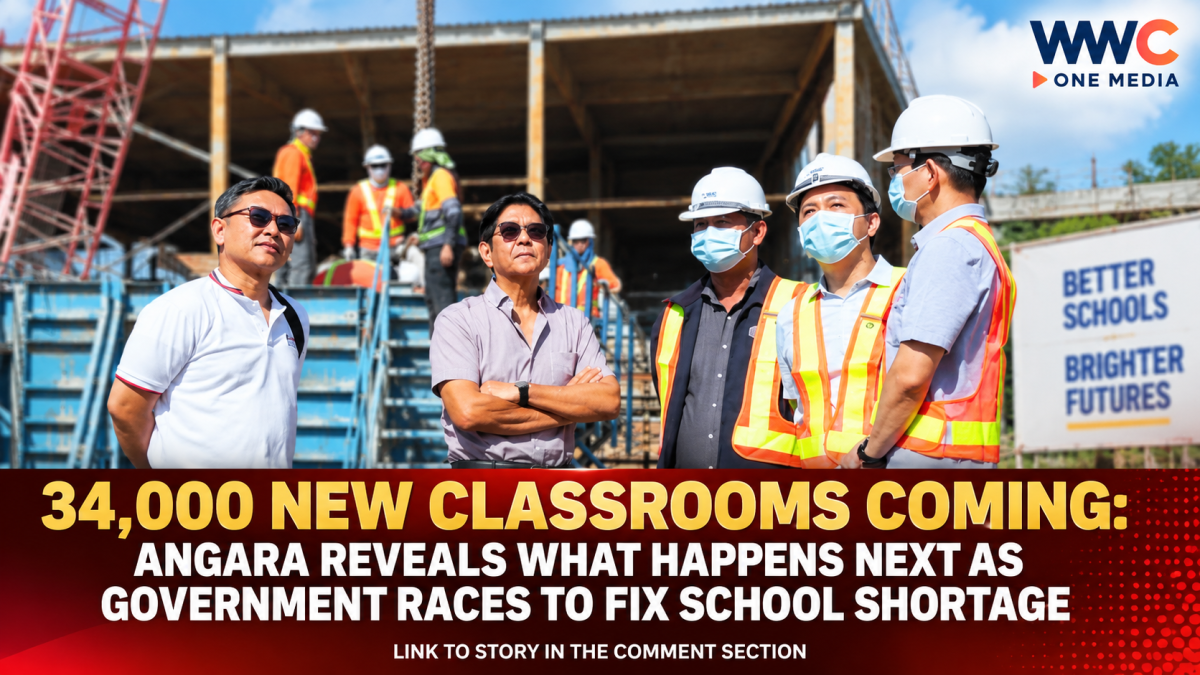
MANILA, Philippines — Thousands of Filipino students could soon have more space to learn as the Department of Education (DepEd) pushes ahead with an ambitious classroom-building program aimed at easing the country’s long-standing shortage of school facilities.
Education Secretary Sonny Angara has said that around 34,000 classrooms are targeted for construction in 2026, as the government accelerates infrastructure projects nationwide.
The classroom drive comes as the Marcos administration puts education at the center of its remaining term, with classroom shortages continuing to affect overcrowded public schools across the country.
Government releases billions for classroom construction
The push gained momentum after the Department of Budget and Management approved the release of P17.27 billion to DepEd in April 2026.
The funding will support the construction of 4,960 classrooms nationwide, including essential furniture and fixtures. The money was charged against the P85.40-billion Basic Education Facilities Fund under the 2026 national budget.
The release is part of the government’s wider effort to address overcrowding and improve learning environments, particularly in communities where schools lack adequate facilities.
The 2026 budget had already received a major boost for education infrastructure. EDCOM 2 reported that the Basic Education Facilities Fund received an additional P57.3 billion, helping support the government’s broader target of roughly 34,000 new classrooms during the year.
LGUs take a bigger role
One of the biggest changes in the classroom program is the increased role of local governments.
Instead of relying primarily on the Department of Public Works and Highways for classroom construction, DepEd is giving qualified local government units greater responsibility for implementing projects.
Under the arrangement, LGUs can handle procurement and construction, while DepEd identifies priority schools, provides standard designs and technical specifications, reviews plans, conducts inspections and releases funds in tranches.
The shift is designed to shorten implementation timelines and allow projects to respond more directly to local needs.
By June, DepEd said 79 LGUs had become partners in the localized classroom-building program, with the department strengthening monitoring, digital validation and financial safeguards as projects move toward implementation.
First wave already moving
The classroom program is no longer just a budget proposal.
In April, DepEd cleared 14 provinces to proceed with procurement and construction after supplemental agreements with participating LGUs were finalized.
The provinces included Ifugao, Sorsogon, Mountain Province, Abra, Quezon, Samar, Ilocos Sur, Pangasinan, Oriental Mindoro, Biliran, Dinagat Islands, Misamis Oriental, Southern Leyte and Siquijor.
Earlier, the government announced an initial P9.6-billion classroom construction phase covering 4,000 classrooms.
Under that first phase, provincial governments were expected to build about 1,200 classrooms, while DepEd would procure around 2,800 prefabricated classrooms.
A massive classroom gap remains
Despite the scale of the program, the challenge remains enormous.
The government has cited a classroom shortage running into the six figures, highlighting how years of population growth, school congestion and inadequate infrastructure have created pressure on public schools.
President Ferdinand Marcos Jr. said in February that the classroom shortage stood at about 145,000 units as of December 2025. Meanwhile, Angara earlier cited a shortage of around 165,000 classrooms, illustrating the scale of the infrastructure problem and the need for sustained construction beyond a single budget year.
This means the planned 34,000 classrooms would represent a significant step—but would not completely eliminate the national shortage on their own.
More than buildings
For DepEd, classroom construction is being pursued alongside other education reforms.
Angara has also identified learning recovery and teacher expansion as major priorities for 2026. DepEd is implementing the Academic Recovery and Accessible Learning (ARAL) Program, while the 2026 budget allows for the promotion of as many as 100,000 teachers and the creation of 30,000 new teaching positions.
The government is also investing in school connectivity and other facilities, recognizing that simply adding rooms will not solve all of the problems confronting Filipino learners.
For students currently studying in congested classrooms, however, the construction program could provide one of the most visible improvements—if projects are completed on schedule and meet required standards.
The bigger question
The government’s 34,000-classroom target represents one of the country’s largest recent pushes to expand basic education infrastructure.
But the real test will come after the groundbreaking ceremonies: how quickly can these projects be completed, where will they be built, and will the new classrooms reach the schools facing the most severe shortages?
With billions of pesos already released and LGUs taking a larger role, the administration is betting that a faster, more localized construction system can finally make a measurable dent in the country’s classroom crisis.
For millions of Filipino learners, the outcome will be measured not in budget figures—but in whether they finally have a safe, uncrowded and adequate place to learn.
WWC ONE MEDIA J.M.S




Leave a Reply