
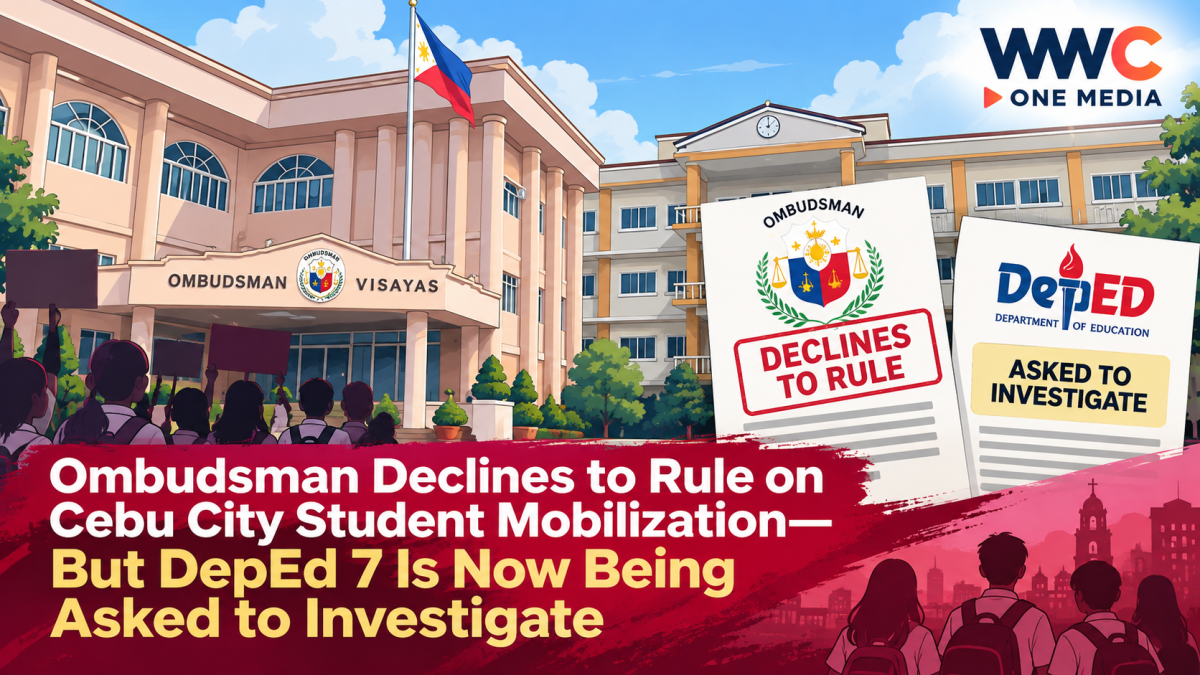
CEBU CITY, Philippines — The Office of the Ombudsman-Visayas has declined to issue an advisory ruling on the controversial mobilization of students to Cebu City Hall during deliberations over a scholarship proposal, but the issue is far from over.
Instead, the anti-graft body has referred the matter to the Department of Education in Central Visayas, or DepEd 7, for a fact-finding investigation into the circumstances surrounding the students’ presence at Plaza Sugbo and Cebu City Hall.
The development means that while the Ombudsman will not issue an opinion on whether laws or rules were violated, questions surrounding the alleged mobilization of mostly senior high school students remain open.
Why Did the Ombudsman Decline to Issue a Ruling?
The Ombudsman-Visayas acted on a complaint endorsed by the Cebu City Council, which sought appropriate action over the alleged mobilization of students during deliberations on a proposed agreement involving the Asian College of Technology International Educational Foundation Inc., or Actief.
In a notice dated Aug. 26, 2026, the Ombudsman approved an evaluator’s recommendation to deny the council’s request.
The reason was not a ruling that the student mobilization was proper.
Instead, the Ombudsman explained that it does not issue advisory opinions on matters that could later develop into actual cases within its jurisdiction. The policy is intended to preserve the agency’s impartiality should the controversy eventually require an investigation or adjudication.
What Exactly Happened at Cebu City Hall?
The controversy began in April when buses carrying mostly senior high school students arrived at Plaza Sugbo and Cebu City Hall while councilors were deliberating a proposal involving Actief’s Pit-os campus and the Cebu City scholarship program.
The proposal sought to authorize the city government to enter into an agreement that would expand higher-education options for students from mountain barangays.
But the presence of the students during the deliberations immediately triggered controversy.
According to earlier reports, some students said they believed they were attending a scholarship orientation but were instead brought to a legislative session involving the controversial scholarship proposal.
Concerns About Minors and Political Mobilization
The incident prompted Cebu City Council members to seek a broader investigation.
Among the concerns raised were possible issues involving:
- Child protection
- The participation of minors in off-campus activities
- Parental consent
- Possible data privacy concerns
- The alleged use of student participation for political or legislative influence
Council resolutions also raised potential questions under the Special Protection of Children Against Abuse, Exploitation and Discrimination Act, the Data Privacy Act and the Anti-Graft and Corrupt Practices Act.
However, it is important to note that the Ombudsman did not make findings on those allegations in its Aug. 26 notice.
DepEd 7 Now Takes Center Stage
While the Ombudsman declined to provide an advisory opinion, Deputy Ombudsman for the Visayas Dante Vargas separately forwarded the matter to DepEd 7.
Regional Director Arturo Bayocot was asked to conduct a fact-finding inquiry into the circumstances surrounding the students’ participation and determine what administrative or corrective action, if any, should be taken.
The focus now shifts to whether proper regulations were followed when the students participated in the off-campus activity.
That means the controversy has not been dismissed in the broader sense.
The Ombudsman may have stepped back from issuing an advisory ruling—but DepEd 7 has been asked to find out what actually happened.
What the Ombudsman’s Decision Does—and Does Not—Mean
The Ombudsman’s decision is particularly significant because it can easily be misunderstood.
The agency’s refusal to issue an advisory opinion does not mean it cleared those involved.
It also does not mean the Ombudsman concluded that the mobilization was legal, proper or free from violations.
According to the SunStar report, the anti-graft body’s decision was based on its policy of preserving impartiality in matters that could potentially become cases within its jurisdiction.
In other words, the Ombudsman chose not to prejudge the controversy.
The Scholarship Proposal at the Heart of the Controversy
The student mobilization happened during deliberations over the possible inclusion of Actief’s Pit-os campus in Cebu City’s scholarship program.
The measure was authored by Councilor Alvin Arcilla and sought to expand higher-education opportunities, particularly for students from Cebu City’s mountain barangays.
But the debate over the proposal became overshadowed by the unexpected presence of buses carrying students to the area.
The controversy eventually became bigger than the scholarship proposal itself.
Attention shifted to a more troubling question:
Why were students brought to City Hall during a sensitive legislative deliberation—and did they fully understand why they were there?
Cebu City Council Had Called for Multiple Investigations
Earlier, the Cebu City Council sought investigations by several agencies into the alleged mobilization.
Councilor Mikel Rama raised concerns over the participation of minors, including allegations that students may have been brought to City Hall under misleading circumstances.
The earlier resolution called for fact-finding inquiries involving agencies such as the National Bureau of Investigation, Philippine National Police, DepEd and the Ombudsman.
The goal was to determine who organized the activity and whether any laws or regulations may have been violated.
Why the Case Matters Beyond Cebu City
The controversy raises wider questions about the protection of students and minors during public and political activities.
Schools and government agencies regularly organize off-campus activities, orientations and educational events.
But when students—particularly minors—are brought into politically sensitive environments, questions can arise about:
- Whether parents gave informed consent
- Whether students understood the purpose of the activity
- Whether schools followed DepEd regulations
- Whether students were exposed to political activities
- Whether their images or personal information were used appropriately
These are among the issues that make the DepEd 7 fact-finding inquiry significant.
What Happens Next?
The immediate focus is now on DepEd 7.
The regional education office has been asked to examine the circumstances surrounding the students’ participation and determine whether any administrative or corrective action is necessary.
The inquiry could potentially clarify:
- Who organized the transportation of students
- Why students were brought to Plaza Sugbo and Cebu City Hall
- What students and parents were told beforehand
- Whether proper consent was obtained
- Whether school regulations were followed
- Whether any corrective action should be taken
For now, no final finding of wrongdoing has been made in the Ombudsman’s latest action.
The Bigger Question Remains Unanswered
The Ombudsman has declined to give Cebu City an advisory ruling.
But the controversy has not disappeared.
Instead, the investigation has moved into a new phase.
Mostly senior high school students were brought to Cebu City Hall during deliberations on a controversial scholarship proposal. Questions were raised about why they were there and whether proper procedures were followed. The Ombudsman refused to prejudge the case—but DepEd 7 is now being asked to investigate.
The scholarship debate may have triggered the controversy.
But the next chapter could be about something much bigger:
When DepEd 7 finally completes its fact-finding inquiry, will it confirm that the student activity followed proper rules—or reveal why the buses were really sent to Cebu City Hall that day?




Leave a Reply