
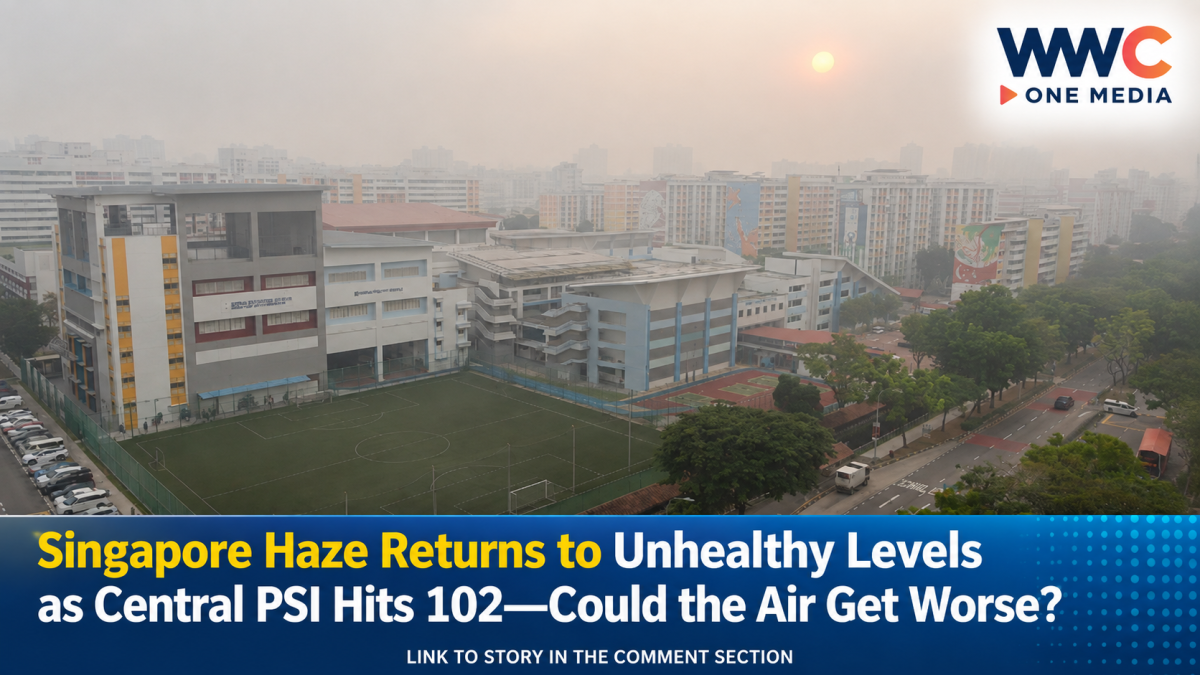
SINGAPORE — Air quality in Singapore has slipped back into the unhealthy range as haze continues to affect the city-state, with the central region recording a 24-hour Pollutant Standards Index (PSI) reading of 102 at noon on Monday, Sept 14.
The latest reading marks another worrying turn in Singapore’s haze situation after several days of fluctuating air quality.
While the other four regions remained in the moderate range, authorities warned that air quality could continue to fluctuate between moderate and the lower end of the unhealthy range over the next 24 hours.
Central Singapore First to Cross the Unhealthy Threshold
At noon, the central region recorded the highest 24-hour PSI reading at 102, officially pushing it into the unhealthy category.
Singapore’s other regions remained moderate, with readings ranging from 79 to 91.
A PSI reading of 101 to 200 is classified as unhealthy under Singapore’s air quality guidelines. Earlier in the morning, conditions were still in the moderate range, but the central region deteriorated as haze persisted.
The latest haze episode is particularly significant because Singapore had experienced four days of moderate readings before air quality once again crossed into the unhealthy range.
PM2.5 Levels Also Climb
Fine particulate matter, known as PM2.5, has also risen across Singapore.
AsiaOne reported earlier on Monday morning that the one-hour PM2.5 reading in central Singapore reached 107 micrograms per cubic metre, while air quality readings across the island continued to show signs of deterioration.
PM2.5 particles are especially concerning because they are extremely small and can penetrate deep into the respiratory system.
During haze episodes, PM2.5 is often a key pollutant affecting air quality and public health.
What’s Causing the Haze?
The haze has been linked to persistent hotspots and fires in parts of Indonesia.
Channel NewsAsia reported that haze continued to affect Singapore as hotspots and smoke persisted in Indonesia, with prevailing winds capable of carrying smoke across national borders.
The wider regional situation has also become increasingly serious.
Reuters reported last week that major wildfires in Indonesia had contributed to a sharp increase in respiratory illnesses, while smoke and haze were also affecting neighbouring countries, including Singapore and Malaysia.
NEA Warns Conditions Could Remain Unstable
Singapore’s National Environment Agency has been closely monitoring the haze situation and has warned that the 24-hour PSI could remain between the moderate and low unhealthy ranges.
The agency has continued issuing haze updates as conditions fluctuate across the island.
The changing readings mean that Singapore residents could see air quality improve temporarily before worsening again, depending on wind conditions and the persistence of regional fires.
What Does “Unhealthy” Air Quality Mean?
Singapore classifies a 24-hour PSI reading between 101 and 200 as unhealthy.
During unhealthy haze conditions, authorities generally advise the public to reduce prolonged or strenuous outdoor physical activity.
People who are more sensitive to air pollution may need to take additional precautions, particularly when haze levels rise or remain elevated for long periods.
Sensitive groups can include people with existing heart or lung conditions, as well as children and older adults.
Not the First Haze Spike This Month
Singapore’s air quality has repeatedly moved between moderate and unhealthy levels in recent days.
On Sept 10, the central region’s PSI climbed as high as 105, with other parts of Singapore also experiencing elevated pollution levels.
The recent haze episode marked Singapore’s first unhealthy PSI readings linked to haze since October 2023, according to reports citing official environmental data.
The latest reading of 102 shows that despite temporary improvements, the haze problem has not disappeared.
The Biggest Question: Will It Get Worse?
For now, Singapore’s haze situation remains unpredictable.
The central region has returned to the unhealthy range, PM2.5 levels have climbed, and regional hotspots continue to pose a threat.
Authorities are continuing to monitor the situation closely, while the public is being urged to stay updated on the latest air quality readings and haze advisories.
Singapore’s skies may look calmer at one moment—but the numbers tell a different story.
With the PSI already back above the unhealthy threshold, the biggest question now is whether changing winds will bring relief—or push Singapore’s haze crisis to even more dangerous levels.




Leave a Reply