
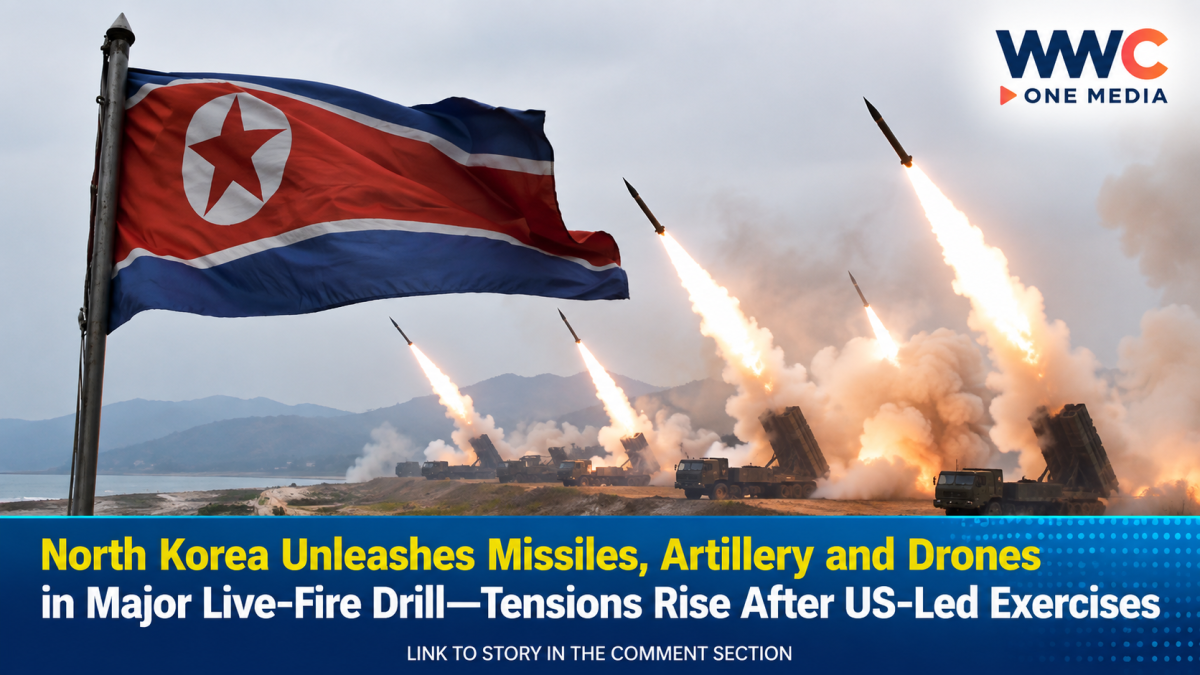
SEOUL — North Korea has carried out a major live-fire military exercise involving artillery, ballistic missiles, cruise missiles and attack drones, in its latest show of force amid escalating tensions on the Korean Peninsula.
North Korean state media KCNA said on Monday, Sept 14, that several missile launches carried out over the weekend were part of a large-scale “joint firepower attack drill” involving five army units.
The exercise tested a wide range of weapons and highlighted Pyongyang’s ability to coordinate different strike systems under a unified command.
Missiles, Drones and Rocket Launchers in One Massive Drill
According to KCNA, the drill involved long-range artillery and missile units and tested several major weapons systems.
These included:
- Attack drones
- Tactical cruise missiles
- Tactical ballistic missiles
- Long-range artillery
- Large-calibre multiple rocket launchers
North Korea described the exercise as a “joint firepower attack drill” designed to improve the military’s ability to coordinate concentrated firepower and maintain combat readiness.
State media said the exercise was intended to boost troop morale and strengthen the army’s capability to carry out overwhelming attacks when ordered.
The drill was also described by North Korean officials as a demonstration of the country’s “huge destructive power,” underlining Pyongyang’s continued focus on integrating different weapons platforms into a coordinated strike network.
South Korea Says Missiles Flew About 250km
South Korea’s Joint Chiefs of Staff said North Korea launched several short-range ballistic missiles from the Wonsan area on its east coast.
The missiles travelled approximately 250km toward the sea off North Korea’s eastern coast, according to the South Korean military.
South Korean and US authorities have been analysing the launches and the specifications of the weapons involved.
The estimated range is significant because short-range missile systems remain a key part of North Korea’s military strategy and could potentially target locations across the Korean Peninsula.
The Timing Is Raising New Questions
The missile launches came shortly after South Korea, the United States and Japan completed a five-day trilateral military exercise known as Freedom Edge.
The exercise focused on improving cooperation against North Korean threats.
Pyongyang has repeatedly condemned joint military drills involving Washington, Seoul and Tokyo, often describing them as preparations for invasion or military confrontation.
The United States and its allies maintain that their exercises are defensive.
The close timing between the end of Freedom Edge and North Korea’s latest live-fire exercise has therefore raised fresh questions about whether Pyongyang intended the drill as a direct response and a demonstration of military readiness.
What Makes This Drill Different?
North Korea has conducted numerous missile tests and artillery exercises in recent years.
But the latest drill stands out because it reportedly brought together multiple types of weapons in a coordinated exercise.
Rather than demonstrating a single missile or artillery system, the operation involved drones, cruise missiles, ballistic missiles and large rocket launchers.
Analysts say this type of exercise can demonstrate an integrated strike capability, allowing different military units and weapons platforms to operate under coordinated command and control.
That could provide valuable operational experience for North Korea as it continues modernising its conventional and strategic military capabilities.
Where Was Kim Jong Un?
One notable detail was the apparent absence of North Korean leader Kim Jong Un from the exercise.
KCNA’s report focused on military officials and the participating army units, rather than presenting the drill as an event personally overseen by Kim.
Analysts cited by Reuters said the delayed announcement and Kim’s absence could indicate that North Korea intended to portray the exercise as a routine military operation while still demonstrating its growing weapons capabilities.
However, the scale and variety of weapons involved ensured the drill would attract close attention from South Korea, Japan and the United States.
North Korea’s Military Build-Up Continues
The latest drill comes as North Korea continues expanding and modernising its military capabilities.
In recent days, Pyongyang has also highlighted its growing naval strength, including the deployment of a major warship reportedly capable of carrying nuclear-capable weapons.
The development has added to growing concerns over North Korea’s efforts to strengthen its ability to launch weapons from land and sea.
Separately, recent reports have raised concerns about continued developments in North Korea’s nuclear programme, including activity associated with uranium enrichment facilities.
Together, these developments are adding to pressure on regional governments trying to manage one of Asia’s most volatile security situations.
A New Warning to Washington, Seoul and Tokyo?
The latest live-fire drill sends a clear message: North Korea wants to demonstrate that it can deploy different weapons systems together during a potential conflict.
The timing, coming immediately after the US-South Korea-Japan military exercise, is also difficult to ignore.
While North Korea has not officially described the drill as retaliation for Freedom Edge, Pyongyang has repeatedly criticised trilateral military cooperation among Washington, Seoul and Tokyo.
The demonstration of ballistic missiles, cruise missiles, artillery and drones is likely to intensify concerns that North Korea is preparing for more complex and coordinated military operations.
What Happens Next?
For now, South Korea and the United States are continuing to analyse the latest launches.
But the bigger concern is whether this exercise will be followed by more missile tests or other military demonstrations.
The Korean Peninsula is already facing heightened tensions, with North Korea expanding its weapons capabilities while South Korea, Japan and the United States strengthen military cooperation.
This latest exercise shows that Pyongyang is not slowing down.
Missiles were fired. Artillery units were mobilised. Drones joined the attack drill. And just days after a major US-led exercise ended, North Korea delivered its own powerful message.
The question now is: Was this simply another military drill—or a warning that Pyongyang’s next move could be even bigger?



Leave a Reply