
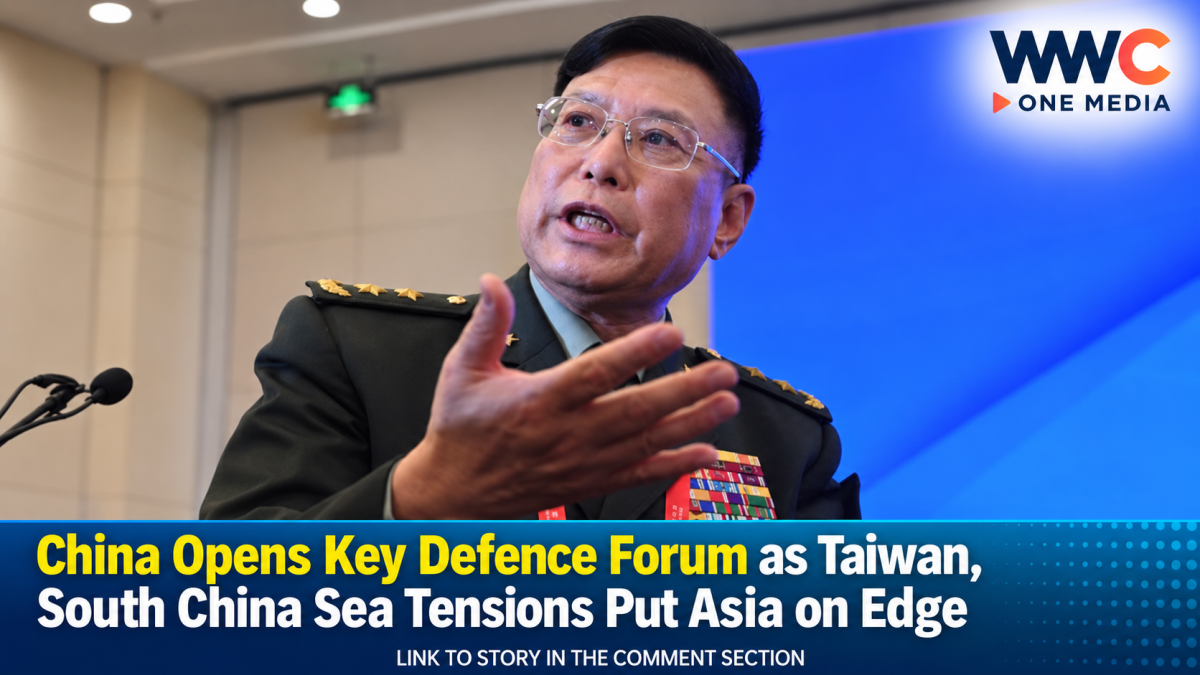
China is preparing to host one of its most important annual security gatherings this week as tensions over Taiwan, the South China Sea and the future of US involvement in Asia continue to reshape the region’s military landscape.
The 13th Beijing Xiangshan Forum will take place from Sept 15 to 17 in Beijing, bringing together defence officials, military representatives, diplomats and security experts from around the world.
The three-day meeting comes at a particularly sensitive moment for China, with disputes involving Taiwan and Japan adding to wider uncertainty over the balance of power in the Indo-Pacific.
China pushes its vision of global security
Chinese Defence Minister Dong Jun is expected to open the forum with a call for greater international cooperation on security and a more multipolar global order.
Beijing has increasingly used the Xiangshan Forum to promote its own approach to international security while presenting China as an alternative to what it describes as a US-dominated security system.
The forum also provides an opportunity for Chinese officials to argue that countries should resolve disputes through dialogue and cooperation rather than military confrontation.
But China’s message is likely to face scrutiny from countries that remain concerned about Beijing’s increasingly assertive military activities.
Taiwan remains a major concern
Taiwan is expected to be one of the central security issues surrounding the gathering.
China claims Taiwan as part of its territory and has not ruled out the use of force to bring the island under Beijing’s control.
Military activity around Taiwan has increased significantly in recent years, with Chinese forces conducting frequent exercises and patrols around the island.
For the United States and its regional partners, the possibility of a conflict across the Taiwan Strait remains one of the most serious potential flashpoints in Asia.
A crisis over Taiwan could also draw in Japan because of the country’s geographic proximity and its close security alliance with Washington.
South China Sea tensions add to the pressure
The forum also takes place as tensions continue across the South China Sea.
China claims most of the strategically important waterway, overlapping with the claims of several Southeast Asian countries, including the Philippines and Vietnam.
Confrontations between Chinese and Philippine vessels have become increasingly frequent, while Manila has strengthened defence cooperation with the United States and other partners.
The Philippines has also repeatedly called for respect for the 2016 international arbitration ruling that rejected the legal basis for China’s expansive claims.
Beijing rejects the ruling and continues to maintain its claims.
The disputes have made the South China Sea another major test of China’s relations with its neighbours.
US-China rivalry hangs over the meeting
The Xiangshan Forum is often viewed as China’s counterpart to Singapore’s Shangri-La Dialogue, another major annual gathering focused on Asia-Pacific security.
The two forums have taken place against the backdrop of intensifying US-China strategic competition.
Washington has expanded security cooperation with Japan, the Philippines, Australia and other regional partners as China has increased its military capabilities.
At the same time, uncertainty over the durability of US commitments to Asia has encouraged countries in the region to carefully manage their relationships with both superpowers.
The US delegation at this year’s forum is expected to be led by Cynthia Carras of the Pentagon, providing an opportunity for military-to-military engagement despite broader strategic tensions.
Japan could face sharper criticism
While Washington is likely to remain a focus of Chinese messaging, Japan could attract particularly strong attention.
Relations between Beijing and Tokyo have deteriorated amid disagreements over Taiwan, military expansion and historical issues.
Japan has been rapidly strengthening its defences in its southwestern islands, many of which are close to Taiwan.
Tokyo has also deepened military cooperation with the United States and other regional partners.
China views these developments with suspicion and has repeatedly accused Japan of moving away from its postwar pacifist position.
The recent election victory in Okinawa of a candidate more aligned with Tokyo’s defence policies could further facilitate Japan’s military build-up in the strategically important prefecture.
Southeast Asia watches closely
The forum will also provide a window into how Southeast Asian countries are navigating the increasingly complicated security environment.
Vietnam and Malaysia are among the regional countries expected to send high-level representatives.
For Southeast Asian governments, maintaining economic ties with China while preserving strategic autonomy has become increasingly difficult as US-China competition intensifies.
Many countries are seeking stronger defence partnerships without wanting to be forced into choosing between Beijing and Washington.
China’s ability to present itself as a security partner, rather than simply a military power, will therefore be closely watched.
A test of China’s diplomatic influence
The Xiangshan Forum gives Beijing an important platform to promote its vision of a new international security order.
Yet China’s growing military power has also generated concern among neighbouring countries, particularly over its actions in disputed waters and around Taiwan.
That creates a fundamental challenge for Beijing: convincing other countries that China can play a leading role in regional security while reassuring them that its growing military capabilities will not be used coercively.
With Taiwan, the South China Sea and Japan all contributing to regional uncertainty, the discussions in Beijing this week are likely to offer an important indication of how China intends to position itself in an increasingly contested Indo-Pacific.




Leave a Reply