
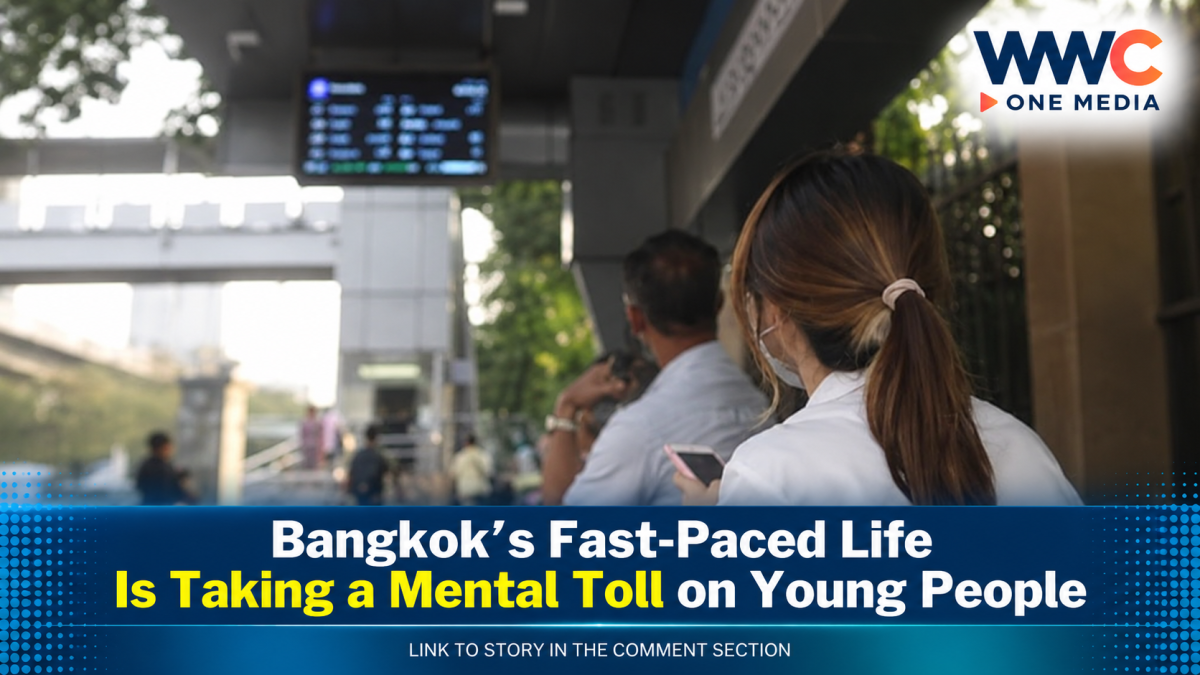
BANGKOK, Thailand — Bangkok never seems to stop.
The alarms ring before sunrise. Commutes can take hours. Roads are packed. Trains are crowded. School and work deadlines pile up. By the time many young people return home, there is often little energy left for rest.
For a growing number of Bangkok’s younger residents, the pressure of city life is becoming more than an ordinary source of stress.
It is raising serious concerns about mental health.
New figures and recent discussions among health professionals and city officials suggest that young people are among those facing the greatest risk of depression and emotional distress in Thailand’s capital, where a relentless pace of life, economic pressure, traffic congestion and social isolation can combine to create a heavy psychological burden.
Young People Face the Highest Risk
Recent mental health screening data released by Bangkok authorities showed that residents aged 15 to 34 had the highest risk of depression among the age groups assessed.
According to figures reported by Thai media, about 21.25 percent of people aged 15 to 34 screened were identified as being at risk of depression.
Officials stressed that screening results do not mean every person identified is clinically diagnosed with depression. Instead, the figures are intended to identify people who may need further assessment, support or treatment.
The findings nevertheless have raised concern about the mental health of young people growing up and working in one of Southeast Asia’s busiest cities.
Bangkok officials have also reported that the city’s overall prevalence of depression is higher than the national average, adding urgency to efforts to expand access to mental health services.
The Stress Starts Before the Day Even Begins
For many Bangkok residents, stress begins with the commute.
Young workers and students often leave home early to avoid traffic, only to find themselves spending long periods stuck on congested roads or packed into public transportation.
The journey itself can become an exhausting part of daily life.
A study examining commuting and health in Bangkok and surrounding areas found that transportation choices can have consequences for both physical and mental well-being, highlighting the connection between the way people travel and their overall quality of life.
Recent reporting on Bangkok’s transportation system has also highlighted the daily frustrations faced by commuters, including traffic congestion, crowded public transport, high travel costs and long journeys in extreme heat and heavy rain.
For young people already dealing with academic competition, demanding jobs and rising living costs, those daily struggles can become another layer of pressure.
A City That Moves Faster Than Its Residents
Bangkok offers opportunity.
It is a center for education, business, technology, entertainment and culture.
But opportunity often comes with competition.
Young people entering the workforce face pressure to find stable jobs, earn enough to cover rising living expenses and keep up with increasingly demanding expectations.
Students face academic pressure while trying to plan their futures.
Young professionals are expected to build careers while managing financial responsibilities and navigating an increasingly expensive urban environment.
The result can be a feeling that life is moving faster than they can keep up with.
Mental health advocates say this type of pressure does not always arrive as one dramatic crisis.
Sometimes it builds slowly.
A difficult commute.
A stressful day at work.
Financial worries.
Lack of sleep.
Social pressure.
Another deadline.
Another day.
Over time, those pressures can accumulate.
Stress Does Not Always Look Like Depression
One of the biggest challenges is that mental health problems are not always immediately visible.
A young person may continue going to school.
They may show up at work.
They may spend time with friends.
They may appear completely normal.
But internally, they could be struggling with stress, anxiety, loneliness or emotional exhaustion.
Recent discussions involving Bangkok officials and mental health organizations have emphasized the need to make support easier to access, particularly for younger people who may not know where to seek help or may be reluctant to discuss emotional problems openly.
Experts and youth advocates have increasingly called for safe spaces where young people can talk without fear of being judged.
The challenge is not simply identifying people in crisis.
It is reaching them before their problems become a crisis.
Social Media Can Add Another Layer of Pressure
Modern city life does not end when people leave school or work.
For many young people, social media means comparison and pressure continue online.
There is pressure to look successful.
Pressure to appear happy.
Pressure to earn more.
Pressure to travel, achieve and constantly move forward.
The gap between what people experience privately and what they see online can make feelings of failure or isolation even more difficult to manage.
Youth advocates in Thailand have identified academic pressure, family relationships, identity struggles and social influences as interconnected factors affecting young people’s mental well-being.
For those living in a fast-moving city, finding time to simply slow down can become surprisingly difficult.
Bangkok Expands Mental Health Support
Bangkok authorities are now trying to shift toward earlier intervention.
The city has been expanding mental health screening and support systems, including the development of Bangkok Mind, which is intended to connect screening, treatment and referrals through digital and other support channels.
The goal is to identify people who may be struggling before their condition becomes more severe and make professional help easier to reach.
Mental health advocates have also called for more support in schools and communities, arguing that young people need more than treatment after a crisis.
They need places where they feel safe talking about what they are experiencing.
That could mean better counseling services, stronger support networks, accessible public spaces and adults trained to listen without immediately judging.
Can a City Be Designed for Better Mental Health?
The growing debate over mental health in Bangkok is also raising a bigger question.
Can the design of a city affect how people feel?
Urban planners, researchers and youth advocates increasingly argue that it can.
Long working hours, expensive transportation, traffic congestion, overcrowding and limited access to green spaces can all affect quality of life.
Recent Thai PBS reporting highlighted calls for cities to consider mental well-being when planning transportation, public spaces and urban development. Young residents have argued that accessible parks, community spaces and other areas where people can rest and connect should be viewed as part of a healthier city.
Bangkok cannot eliminate stress.
No major city can.
But the environment people live in can either make stress harder to manage or give them opportunities to recover from it.
The Pressure of Growing Up in a City That Never Sleeps
For Bangkok’s young people, the challenge is not simply surviving traffic or meeting the next deadline.
It is finding balance in a city that often demands constant movement.
The recent mental health figures serve as a warning that emotional well-being cannot be treated as a private problem for individuals to solve alone.
Families matter.
Schools matter.
Employers matter.
Communities matter.
And the city itself matters.
Bangkok is known for its energy, ambition and ability to keep moving.
But for the young people struggling to keep pace, slowing down may be just as important as moving forward.
A city can offer endless opportunities — but if its young people are too exhausted, stressed and emotionally overwhelmed to enjoy them, Bangkok may have to ask whether the race to move faster is leaving an entire generation behind.
WWC ONE MEDIA J.M.D




Leave a Reply