
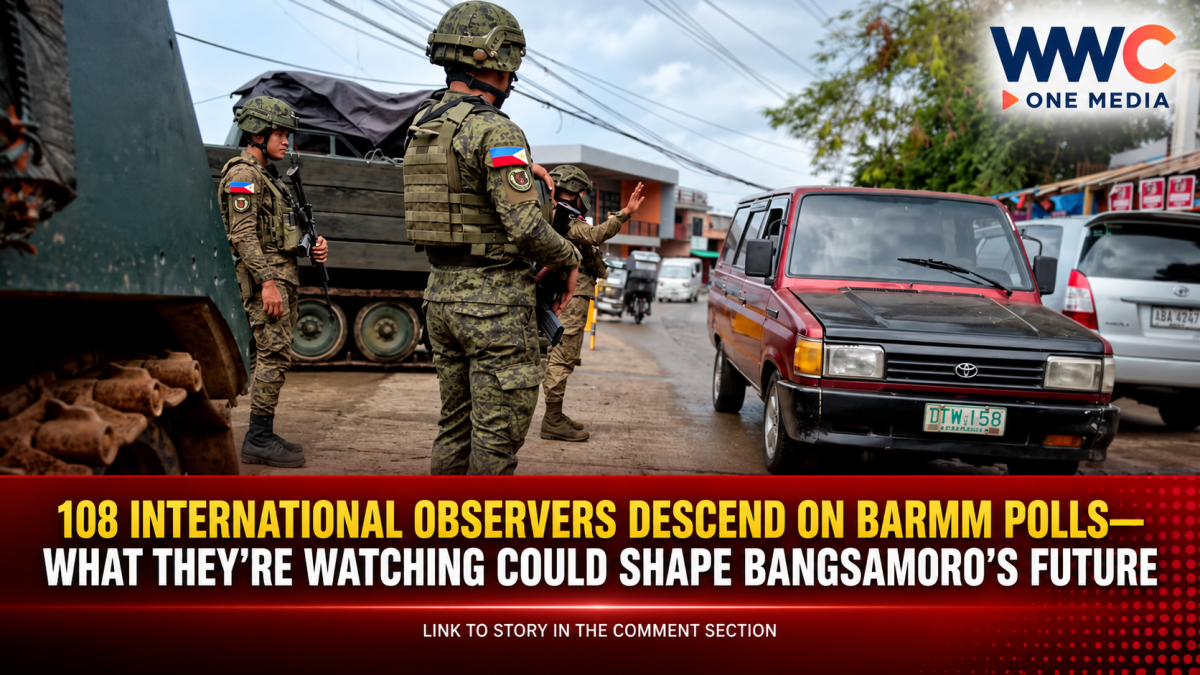
COTABATO CITY, Philippines — The Bangsamoro Autonomous Region in Muslim Mindanao (BARMM) is entering a defining moment as 108 international election observers from 16 organizations and diplomatic delegations arrive to monitor the region’s first regular parliamentary elections on September 14.
The international presence adds another layer of scrutiny to a vote widely viewed as a major test of Bangsamoro’s transition from an interim government to an elected parliamentary system—and of the peace process that has reshaped the region after decades of armed conflict.
The observers include representatives from the International Republican Institute (IRI), Asian Network for Free Elections (ANFREL), National Democratic Institute (NDI), Japan, Australia, the United Kingdom, Palestine and other international organizations and delegations, according to the Bangsamoro government.
Their arrival comes just as nearly 2.4 million registered voters prepare to choose the first members of the 80-seat Bangsamoro Parliament, replacing the appointed Bangsamoro Transition Authority that has governed the region since BARMM was established in 2019.
Why the international observers matter
The observers are not there to endorse candidates or determine who wins.
Instead, they will assess how the elections are conducted, including voting procedures, election administration, political participation, security conditions and other aspects of the electoral process. Their respective missions are expected to release findings and recommendations after the polls.
BARMM officials say the international presence can help strengthen public confidence in an election that carries enormous political and symbolic significance.
OPAPRU Secretary Mel Senen Sarmiento described the observers’ presence as a sign of international interest in the Bangsamoro people’s democratic aspirations and a vote of confidence in the electoral process.
COMELEC Chairperson George Garcia has likewise welcomed observers, saying the poll body wants the world to see that the Bangsamoro elections are being conducted under rigorous scrutiny. COMELEC began encouraging international and local observers months before election day.
Major election groups already on the ground
The ANFREL-NDI joint Technical Assessment Mission has been studying the Bangsamoro electoral environment since July.
Its assessment has focused not only on voting procedures but also on political participation, election-related violence, security, women and youth participation, Indigenous Peoples, persons with disabilities, internally displaced persons and other potentially marginalized groups.
Long-term observers have also been deployed across all five BARMM provinces and the Special Geographic Areas, with election-day monitoring expected to cover voting, counting and transmission of results.
The International Republican Institute, meanwhile, deployed a separate delegation from September 10 to 15. The mission is led by IRI Vice Chairman Randy Scheunemann and is meeting election authorities, political parties and civil society organizations.
But the election is taking place under a security cloud
The international scrutiny comes against a backdrop of continuing security concerns.
The Philippine National Police has insisted that the overall situation remains under control, while acknowledging the need for heightened vigilance in areas affected by political, clan and security tensions. More than 9,000 police personnel have been deployed for election security, according to the PNP.
Earlier reporting also documented dozens of gun-related incidents during the election period, including deadly attacks in Maguindanao del Sur. In one September 7 incident, two brothers were shot dead despite the election gun ban.
That security environment has made independent observation particularly important.
The ANFREL-NDI mission has specifically identified electoral and political violence, conflict dynamics and security vulnerabilities among the issues it is examining.
A vote years in the making
The September 14 election is more than another regional ballot.
It represents the next major step in implementing the Comprehensive Agreement on the Bangsamoro (CAB), the 2014 peace agreement between the Philippine government and the Moro Islamic Liberation Front (MILF).
The election is intended to complete the transition from the appointed Bangsamoro Transition Authority to an elected regional government.
The 80-member Parliament will consist of 40 party representatives, 32 district representatives and eight sectoral representatives. Members of Parliament will subsequently choose the region’s chief minister.
MILF chair Ahod “Al Haj Murad” Ebrahim had earlier appealed to the international community to send observers, calling the election a defining stage in implementing the Bangsamoro peace agreement. He specifically sought participation from diplomatic missions including those of the United Nations, European Union, United States, United Kingdom, Malaysia, Türkiye, Saudi Arabia, Qatar, United Arab Emirates, Brunei, Spain and Norway.
What is at stake on September 14?
For Bangsamoro voters, the election represents the first opportunity to directly choose the Parliament that will govern the autonomous region.
For the national government and the MILF, it is a critical test of whether the political transition envisioned by the peace agreement can operate through democratic institutions.
And for international observers, the question goes beyond whether ballots are successfully counted.
They will be watching whether voters can participate freely, whether candidates can campaign without intimidation, whether marginalized communities have meaningful access to the process, and whether the results-management system can withstand scrutiny.
The stakes are therefore unusually high.
BARMM’s first parliamentary election is being watched not simply as a regional contest, but as a test of whether decades of peace negotiations can ultimately produce a functioning, representative and credible democratic government.
And with more than 100 international observers now preparing to watch the process, what happens inside Bangsamoro’s polling stations on September 14 could reverberate far beyond the region.


Leave a Reply