
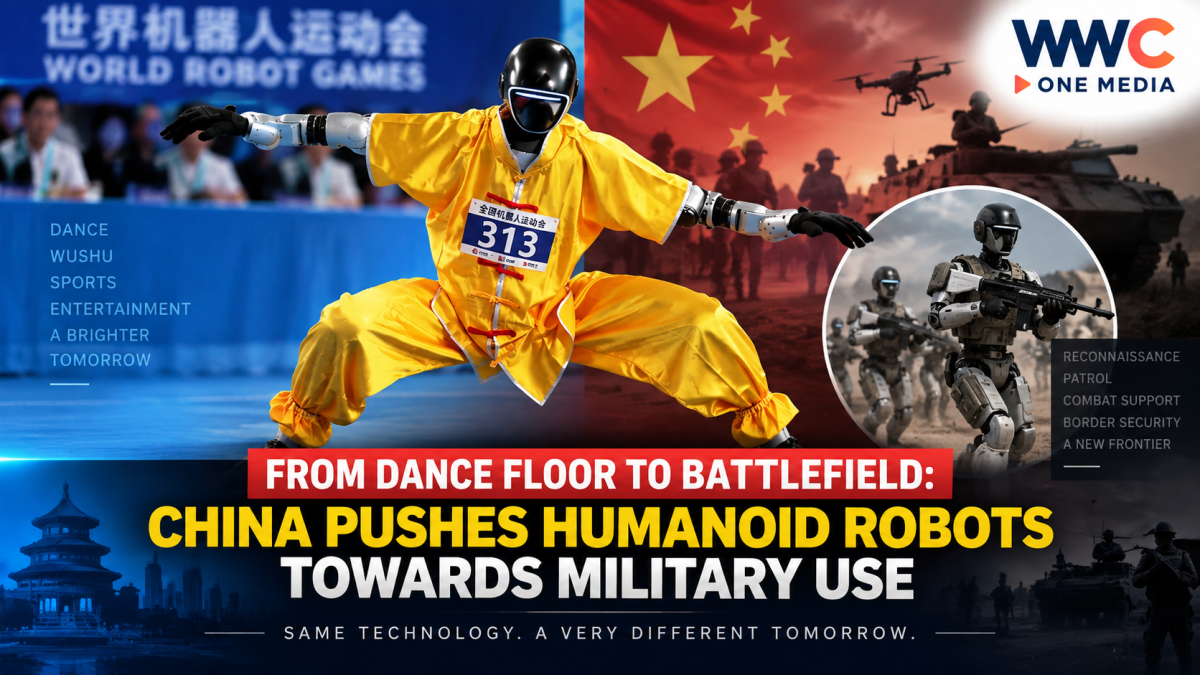
China is rapidly exploring how humanoid robots could move beyond factories, competitions and entertainment and eventually become part of future military operations.
The development has gained attention after the World Humanoid Robot Games in China last month, where humanoid machines competed in running, boxing, football and dancing. One robot even completed 100 metres in 8.64 seconds — faster than Usain Bolt’s official world record of 9.58 seconds — although the machines remain far from matching humans in many practical tasks.
Just two days after the games ended, the People’s Liberation Army’s official newspaper called for faster efforts to move cutting-edge robotic technology from laboratories into military training and applications.
A Reuters review of more than 100 Chinese military procurement notices, academic studies, patents, government records and defence-industry materials found that China’s military researchers are examining humanoid robots for roles including reconnaissance, logistics, urban combat and operations in dangerous environments.
One research programme at China’s National University of Defense Technology has considered humanoid robots operating alongside soldiers in urban assault teams. Researchers envision the machines carrying out tasks that could expose human troops to particularly high risks, with some work pointing to a possible deployment timeframe of five to 10 years.
The military’s interest is being supported by China’s unusually large commercial robotics industry. Chinese manufacturers accounted for about 95 per cent of global humanoid robot shipments in 2025, according to Bank of America Global Research, giving Chinese defence researchers access to a rapidly expanding pool of hardware, components and engineering expertise.
China is also investigating both autonomous and remotely operated systems. Norinco, a major Chinese state-owned defence company, has developed the Fuxi humanoid robot, which has been presented as capable of tasks including sentry duties and remotely controlled operations. Military researchers are also working on technologies that would allow robots to perceive their surroundings, manipulate objects and operate with greater independence.
The push reflects lessons China and other militaries have drawn from the Russia-Ukraine war, where drones have transformed surveillance, targeting, logistics and battlefield attacks. Chinese researchers have increasingly focused on how robotic systems could complement conventional forces rather than simply replace soldiers.
But the technology is still nowhere near the science-fiction image of autonomous robot armies.
Humanoid robots consume significant amounts of energy, can be unreliable and remain limited in their ability to understand unpredictable environments. Recent Reuters reporting has also found that many Chinese humanoids still struggle with ordinary industrial tasks, often relying on carefully choreographed movements rather than genuinely autonomous decision-making.
That gap is particularly important on a battlefield, where machines would have to cope with damaged terrain, communications disruptions, enemy interference and rapidly changing situations.
There are also major legal and ethical questions. If increasingly autonomous machines are eventually given the ability to identify targets or use weapons, militaries would have to determine how responsibility is assigned when a system makes a deadly mistake.
For now, there is no evidence that armed humanoid robots have been deployed as regular combat units by China’s People’s Liberation Army. Instead, the country’s current push appears focused on research, testing and building the industrial base needed to make such systems possible.
The significance may therefore lie less in the robots competing on a dance floor today and more in what their increasingly sophisticated movement, perception and manipulation capabilities could mean for warfare tomorrow.




Leave a Reply