
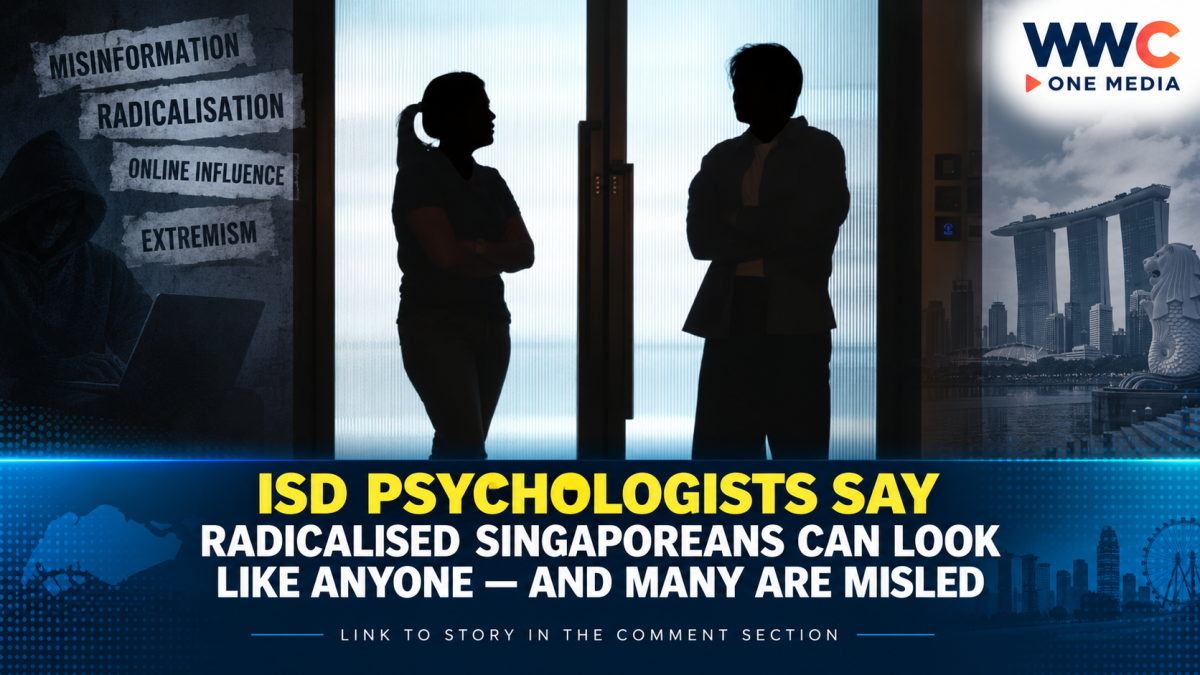
People who become radicalised in Singapore may not fit the stereotypical image of an extremist, with Internal Security Department (ISD) psychologists warning that many are otherwise ordinary people who have been misled or manipulated into accepting extremist ideologies.
The insight comes from two ISD intelligence psychologists, who spoke publicly about their work rehabilitating people detained or placed under restriction orders under Singapore’s Internal Security Act (ISA). Their identities were withheld because of the sensitive nature of their work.
One psychologist, identified only as Dave, said he was surprised early in his career when a youth detainee appeared completely ordinary in conversation and behaviour.
The experience changed his understanding of radicalisation. He said extremist threats are not always obvious and can be subtle or difficult to detect, adding that no one is completely immune to radicalisation.
He described many radicalised individuals as “normal” people who had been misled, with some effectively duped into believing extremist ideologies. This, he said, reinforced the importance of understanding an individual’s personal circumstances, motivations and vulnerabilities rather than treating rehabilitation as a one-size-fits-all process.
Rehabilitation goes beyond changing beliefs
ISD psychologists conduct psychological assessments and interventions for people detained or issued restriction orders for terrorism-related activities.
Their work can include programmes designed to strengthen critical thinking, emotional regulation, identity development and coping skills.
Rehabilitation is broadly built around three areas — ideological, psychological and social rehabilitation — with programmes tailored to each individual’s needs and circumstances. Psychological and risk assessments are also used to determine whether someone has made sufficient progress before release.
The approach has produced significant results. According to the ISD, more than 80 per cent of Singaporeans detained under the ISA since 2002 have subsequently been released after making good progress in rehabilitation.
Youth radicalisation is becoming a bigger concern
The issue has become particularly pressing among young people.
Singapore’s 2026 terrorism threat assessment said the number of youth radicalisation cases has risen sharply, from four cases between 2017 and 2021 to 15 cases since 2022. Authorities have highlighted the role of the internet, social media and other online environments in exposing young people to extremist material.
One former youth detainee, referred to by the psychologist as Daniel, was detained in January 2020 at the age of 17 after posting defaced images of then-President Halimah Yacob and calling for Islamic State to behead her.
He was eventually released in January 2022. His rehabilitation involved his family, psychologists, case officers, religious counsellors, mentors and educational institutions, which worked together to provide support tailored to his needs.
Radicalisation can take different forms
Singapore’s authorities have dealt with cases involving both Islamist extremism and far-right ideologies, underscoring that radicalisation is not confined to one religious, ethnic or political background.
ISD has previously said that individuals can become self-radicalised online through extremist propaganda and increasingly may have no previous links to established terrorist organisations.
That makes early intervention more complicated. A person may not have direct contact with a terrorist group but can still consume increasingly extreme material, develop rigid beliefs and eventually begin considering violence.
The psychologists therefore also work with community mental-health practitioners, helping them recognise possible signs of radicalisation and connect vulnerable individuals with appropriate support before the process deepens.
Singaporeans are also being prepared for a possible attack
The psychologists’ work extends beyond people who have already been radicalised.
As part of Singapore’s SGSecure movement, Home Team psychologists help prepare officers and members of the public for the psychological challenges of a terrorist attack or other major crisis.
Authorities say members of the public can play an important role during an emergency — from helping others evacuate and providing first aid to offering psychological first aid.
But there are psychological barriers to acting. These include the “bystander effect”, where people assume someone else will intervene, as well as concerns about being seen as interfering or reporting something that ultimately turns out not to be dangerous.
A 2025 social experiment involving 2,500 people in Tampines and Bishan found that fewer than 500 noticed suspicious items placed in public areas, highlighting the difficulty of getting people to remain alert without creating unnecessary fear.
The broader message from Singapore’s psychologists is therefore not simply to look for people who appear dangerous.
It is to recognise that radicalisation can happen gradually, sometimes to people who initially seem completely ordinary — making critical thinking, awareness, early support and rehabilitation important parts of Singapore’s strategy against terrorism.



Leave a Reply