
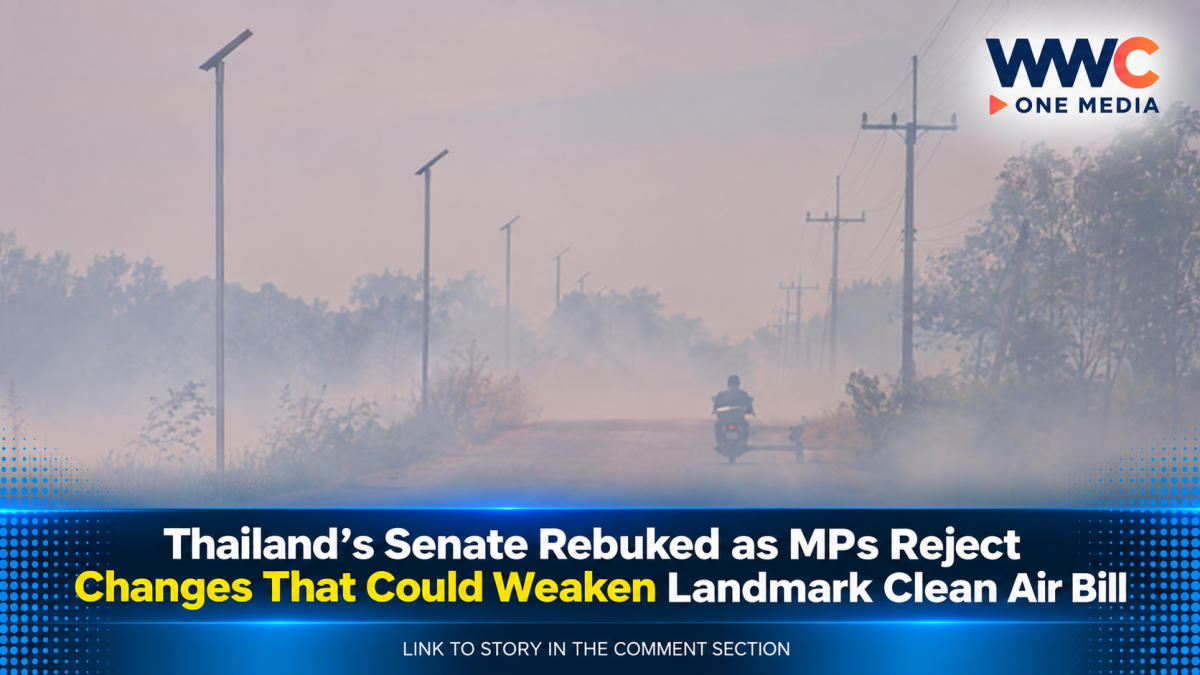
BANGKOK, Thailand — Thailand’s long-awaited Clean Air Bill has entered a new and critical stage after the House of Representatives overwhelmingly rejected Senate amendments that lawmakers and environmental advocates warned could weaken public protections and strip key enforcement powers from the proposed law.
In a near-unanimous vote, MPs rejected the Senate’s revised version of the Clean Air Management Bill by 414 votes to two, sending the legislation to a joint committee of both chambers for another round of negotiations.
The dramatic vote has become a major setback for the Senate’s version of the bill and a significant victory for lawmakers and campaigners who argued that some of the amendments risked turning a landmark environmental law into a weaker and less effective measure.
The Bangkok Post editorial said the House was right to reject what it described as the Senate’s “adulterated” version of the legislation.
Why Thailand’s Clean Air Bill Matters
Thailand has spent years battling severe air pollution, particularly seasonal PM2.5 pollution caused by a combination of agricultural burning, forest fires, industrial emissions, vehicle exhaust and cross-border haze.
The proposed Clean Air Management Bill is intended to provide Thailand with a more comprehensive legal framework for addressing air pollution and holding polluters accountable.
The legislation has been widely anticipated by environmental groups because existing laws have often been criticized as fragmented and insufficient to deal with pollution at its source.
But after the Senate reviewed the bill, lawmakers discovered that major provisions had been altered, removed or restructured.
That triggered an unusually strong response in the House.
MPs Say Senate Removed the Bill’s ‘Teeth’
One of the biggest concerns was the removal or weakening of provisions designed to make pollution easier to track and polluters easier to identify.
MPs and environmental advocates specifically objected to changes affecting the Pollutant Release and Transfer Register, or PRTR.
The system is designed to provide information about pollution released into the environment and the movement of potentially harmful substances.
Critics argued that weakening or removing the PRTR mechanism could make it harder for communities and authorities to identify the sources of pollution.
Thai lawmakers also raised concerns about the removal of provisions that would have strengthened citizens’ legal rights in serious pollution cases.
Public Protection Measures Became a Major Flashpoint
The Senate’s changes also sparked controversy over provisions involving legal protection for communities affected by severe pollution.
Reports said the revised version removed or changed mechanisms that could have allowed citizens and environmental organizations to seek urgent court protection in serious pollution cases.
Provisions related to collective legal action were also among the disputed areas.
Critics argued that these rights are particularly important because individuals affected by large-scale pollution often lack the resources to take on major companies or other powerful polluters on their own.
Environmental advocates warned that removing such mechanisms could weaken public participation and make the law less effective for ordinary citizens.
The Senate-approved version also faced criticism over concerns involving the role of business representatives in clean-air committees and possible conflicts of interest.
Concerns Over Centralization of Power
Another major dispute involves how clean-air policy would be managed at the provincial level.
The House’s earlier version emphasized a stronger role for local and provincial mechanisms.
Critics said Senate amendments could shift more power toward central authorities and alter the structure of provincial clean-air committees.
Lawmakers argued that pollution problems are often highly local.
Northern provinces, for example, face seasonal haze linked to agricultural burning and forest fires.
Bangkok faces a different combination of vehicle emissions, industrial activity and urban pollution.
Other regions have their own environmental challenges.
Critics therefore argue that a national clean-air law needs strong national standards while still giving local authorities and communities meaningful roles in responding to pollution.
The debate has become a broader argument over whether environmental policy should be centralized or whether communities closest to the problem should have greater power.
Senate Changed Nearly 90 Sections, Critics Say
Some lawmakers said the Senate had gone beyond making technical adjustments to the legislation.
According to critics, the Senate revised nearly 90 sections of the bill.
They argued that the scale of the changes affected the original principles of the legislation rather than simply improving its language or legal structure.
The disputed changes included issues involving pollution tracking, public rights, committee structures, business representation and enforcement mechanisms.
The Democrat Party was among those raising concerns, warning about possible centralization of power, conflicts of interest and the removal of important pollution-control mechanisms.
House Vote Sends Bill to Joint Committee
The House’s 414-2 vote means neither chamber’s version will automatically become law.
Instead, a 20-member joint committee will now attempt to resolve the differences between the House and Senate versions.
The committee will include representatives from both chambers.
Its task will be particularly important because the dispute is not limited to minor wording.
The two sides differ over fundamental questions:
Who should have power over clean-air policy?
How should pollution be tracked?
What rights should citizens have?
How much influence should businesses have over environmental decision-making?
How strongly should polluters be held accountable?
The committee’s decisions could determine whether the final law becomes a powerful new environmental tool or a significantly weaker compromise.
The Polluter-Pays Principle Is Under Pressure
Another key issue involves the principle that those responsible for pollution should bear the cost of preventing and repairing environmental damage.
Environmental advocates have long argued that pollution should not become a financial burden carried primarily by taxpayers and affected communities.
The original approach included mechanisms intended to encourage producers and businesses to take greater responsibility for pollution generated by their products or activities.
Critics said some Senate changes removed or weakened measures intended to encourage better waste and pollution management.
One disputed provision involved a deposit-and-return-style mechanism for products considered likely to create pollution, with financial incentives for proper management rather than burning or improper disposal.
The debate has therefore expanded beyond clean air alone.
It is also about who pays for pollution.
Thailand Cannot Afford Another Weak Environmental Law
The urgency surrounding the legislation comes from the scale of Thailand’s pollution crisis.
PM2.5 pollution regularly affects millions of people.
During severe haze periods, schools have been disrupted, outdoor activities restricted and vulnerable groups warned to limit exposure.
The economic impact is also significant.
Pollution affects tourism, productivity and public health while placing additional pressure on healthcare systems.
For many environmental advocates, the Clean Air Bill represents a rare opportunity to create a single, comprehensive framework that tackles pollution across multiple sectors.
That is why the Senate amendments generated such a strong backlash.
The concern is not simply that lawmakers disagree over legal wording.
Critics fear Thailand could spend years developing a major environmental law only to see its most important enforcement tools weakened before it takes effect.
A Test of Political Will
The Clean Air Bill is now becoming a test of Thailand’s political commitment to environmental protection.
Virtually everyone agrees that pollution is a serious problem.
The more difficult question is what the government is willing to do about those responsible for causing it.
Strong pollution laws can impose new costs on industries.
They can require businesses to disclose emissions.
They can increase enforcement.
They can give communities greater legal power.
Those measures can also create political resistance.
The joint committee will now have to find a balance between environmental protection, economic concerns and legal practicality.
But campaigners insist that compromise should not mean removing the core protections that made the Clean Air Bill important in the first place.
The Senate’s Version Was Rejected — But the Battle Is Not Over
The House vote was a clear rejection of the Senate’s amendments.
But it was not the end of the legislative battle.
The joint committee now faces the difficult task of deciding which provisions survive.
Environmental groups and lawmakers will be watching closely to see whether key protections involving pollution disclosure, public participation, legal remedies and accountability are restored.
The final version could shape how Thailand responds to air pollution for decades.
For the millions of people who breathe polluted air every year, the debate is no longer just about parliamentary procedure.
It is about whether Thailand will finally give its citizens a law capable of protecting one of their most basic needs.
Clean air.
The House has delivered a powerful message by rejecting the Senate’s version. Now the real test begins: whether Thailand’s lawmakers can produce a Clean Air Bill with enough strength to fight the pollution crisis — instead of another law that looks tough on paper but fails when the air turns toxic.
WWC ONE MEDIA J.M.D




Leave a Reply