
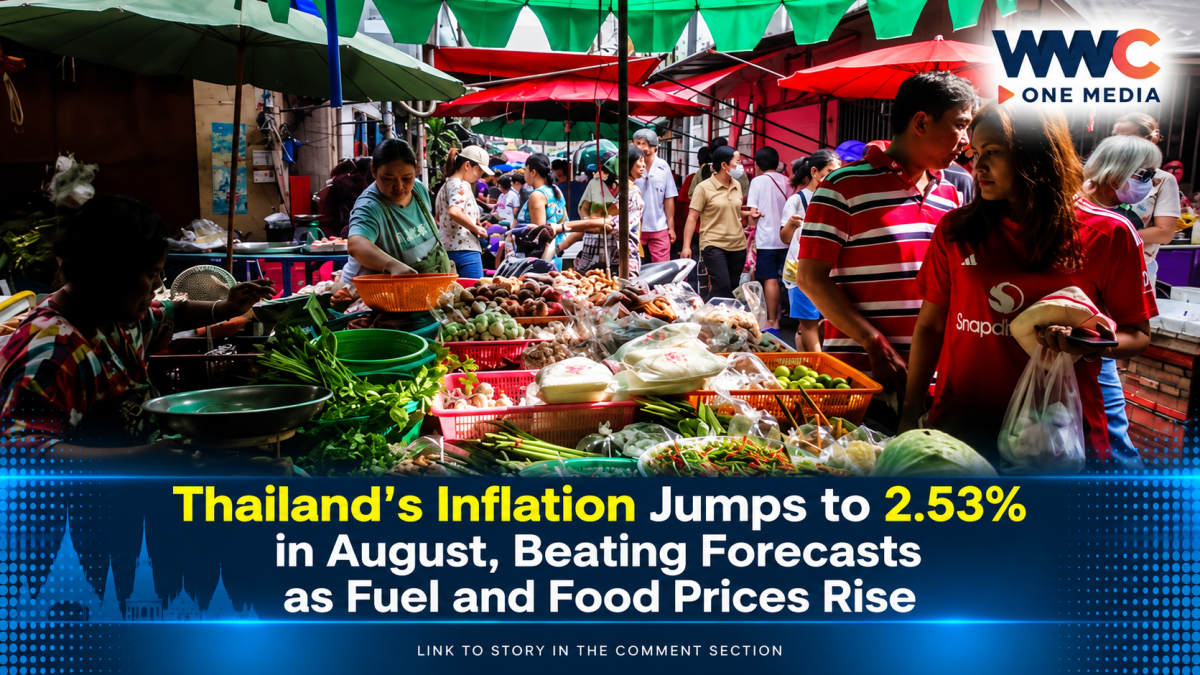
BANGKOK, Thailand — Thailand’s headline inflation accelerated sharply in August, rising 2.53% from a year earlier and exceeding market expectations as higher fuel and food prices added fresh pressure to household budgets.
The August reading marked a significant increase from 1.95% in July and came in above the 2.37% median forecast in a Reuters poll. Despite the acceleration, inflation remained within the Bank of Thailand’s target range of 1% to 3%.
The latest figures signal that Thailand’s period of relatively subdued inflation may be giving way to renewed price pressures, particularly as global energy markets remain volatile.
Fuel Prices Drive Inflation Higher
Higher domestic fuel prices were a major factor behind August’s increase, according to reports on the latest Commerce Ministry data.
Global energy prices have faced renewed pressure amid geopolitical tensions in the Middle East, with higher oil costs increasingly affecting transportation, logistics and other parts of the economy.
The impact is particularly important for Thailand, where fuel costs can quickly spread through supply chains and push up the prices of goods and services.
Recent global market reports have warned that rising diesel prices could increase inflationary pressure because the fuel plays a major role in transportation, shipping, farming and manufacturing.
Food Prices Add to Pressure on Households
Food prices also contributed to the August increase.
Reports on the inflation data pointed to higher prices for ready-to-eat food and fresh food, including products such as eggs, chicken, vegetables and fruit.
On a month-to-month basis, Thailand’s consumer price index rose 0.56% in August, while food and non-alcoholic beverage prices increased 0.78%, according to reporting on the Commerce Ministry figures.
The increase means consumers are facing pressure from both sides: higher transportation and energy costs on one hand and rising food expenses on the other.
For households already dealing with high living costs, even moderate increases across several everyday categories can quickly affect monthly budgets.
Core Inflation Also Moves Higher
Thailand’s core CPI, which excludes volatile fresh food and energy prices, rose 1.44% year-on-year in August.
That was slightly above the 1.39% forecast in the Reuters poll.
Core inflation is closely watched because it can provide a clearer picture of underlying price pressures in the economy.
A rise in headline inflation caused solely by oil or fresh food can sometimes prove temporary.
But higher core inflation may indicate that price increases are becoming more broadly embedded across the economy.
The Bank of Thailand had already warned before the August data release that higher costs were gradually being passed through to consumers, particularly in prepared food and cooking ingredients.
Inflation Returns to the Centre of Economic Debate
The latest reading comes after months of changing inflation trends.
Thailand’s headline CPI rose 2.79% in May, slowed to 2.42% in June, and then fell further to 1.95% in July before jumping back to 2.53% in August.
The August rebound could complicate the outlook for policymakers.
The Bank of Thailand’s Monetary Policy Committee kept its key policy rate unchanged at 1.00% on Aug. 26, saying Thailand’s economic growth remained low and uneven even as inflation was expected to rise through the rest of the year and into early 2027.
That creates a difficult balancing act.
Thailand needs to support economic growth and vulnerable households.
But policymakers must also watch for signs that rising energy and food costs are spreading more widely through the economy.
Commerce Ministry Expects Prices to Keep Rising
The Commerce Ministry expects headline inflation to continue increasing, according to Nantapong Chiralerspong, head of the ministry’s Trade Policy and Strategy Office.
The ministry’s full-year inflation forecast remains at 1.5% to 2.5%, although the outlook could face additional pressure if global energy prices continue to climb.
The first eight months of 2026 produced average headline inflation of 1.37% year-on-year, according to the latest reporting.
That means Thailand is still within its official annual forecast range for now.
However, the direction of prices in the coming months will be closely watched.
Middle East Tensions Add a New Risk
One of the biggest threats to Thailand’s inflation outlook is the global energy market.
Oil prices have risen amid escalating tensions in the Middle East, increasing concerns about supply disruptions and higher transportation costs.
For Thailand, a sustained rise in global oil prices could have consequences far beyond petrol stations.
Higher fuel costs can affect:
- Public and private transportation
- Food production
- Agricultural operations
- Manufacturing
- Shipping and logistics
- Consumer goods
Reuters has reported that diesel prices have become an increasingly important inflation concern because of their broad impact on economic activity and supply chains.
What It Means for Thai Consumers
The August inflation figures do not signal a return to the severe price shocks Thailand experienced in previous years.
But the acceleration is still significant.
Inflation moved from 1.95% in July to 2.53% in August in just one month, bringing it closer to the upper half of the central bank’s target range.
For consumers, the real impact will depend on whether higher prices remain concentrated in fuel and food or begin spreading more broadly.
If global energy prices stabilize, some of the pressure could ease.
But if oil prices continue climbing and businesses pass higher transportation and production costs on to consumers, inflation could remain elevated.
The Bank of Thailand has already identified Middle East developments, trade policies and weather conditions as risks requiring close monitoring.
Thailand Faces a Delicate Economic Balancing Act
The latest inflation data arrives at a sensitive moment for Thailand’s economy.
Growth remains uneven.
Small and medium-sized businesses continue to face challenges.
Households remain cautious about spending.
Yet inflation is now accelerating again.
The Bank of Thailand has said that while exports and investment have benefited from the global technology and AI cycle, the benefits have not been evenly distributed across the domestic economy.
That leaves policymakers with a difficult challenge: support an economy that still needs stronger and broader growth while preventing a renewed rise in living costs from hurting households.
For now, Thailand’s inflation remains inside the central bank’s target range.
But August’s 2.53% reading has delivered a clear warning.
After easing through the middle of the year, Thailand’s inflation is moving higher again — and with fuel prices, food costs and global uncertainty all adding pressure, the next few months could determine whether August was a temporary spike or the beginning of a broader return to rising prices.
WWC ONE MEDIA J.M.D




Leave a Reply