
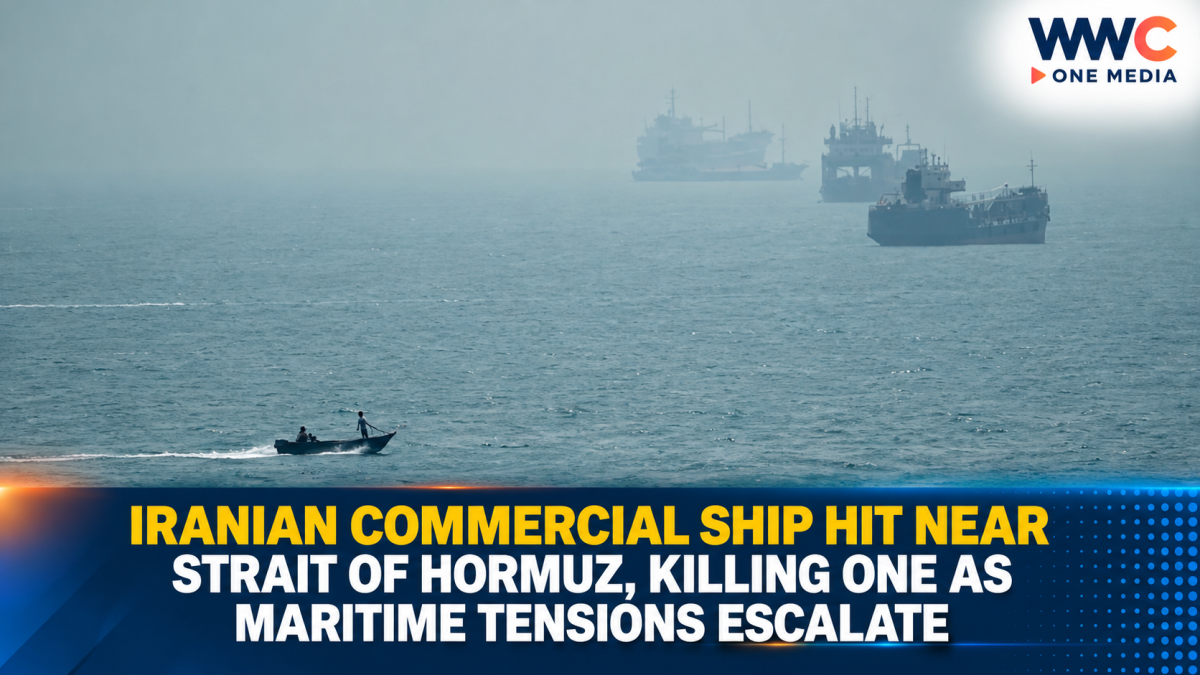
An Iranian commercial vessel was struck near the Strait of Hormuz early Sunday, killing at least one crew member and injuring several others, according to Iranian state media, as tensions continue to escalate around the strategically vital waterway.
The vessel was hit off Qeshm Island, a major Iranian island located near the Strait of Hormuz. Iranian state media reported that one member of the ship’s 10-person crew was killed. Early reports differed on the number of people injured, with some citing three wounded and later reports putting the figure at four.
Iranian state news agency IRNA quoted the governor of Qeshm as blaming what he described as a “terrorist enemy” for the strike. Iranian authorities had not immediately identified the projectile or publicly established who was responsible.
The United Kingdom Maritime Trade Operations agency separately reported that a vessel was hit by a projectile while transiting the Strait of Hormuz. It was not immediately clear whether the incident reported by the UK maritime authorities was the same attack as the one involving the Iranian commercial vessel.
There was no immediate public claim of responsibility from the United States, and US officials had not confirmed that American forces were involved.
Strait of Hormuz under growing pressure
The incident comes as the Strait of Hormuz faces extraordinary pressure amid the continuing conflict involving Iran, the United States and Israel.
The waterway is one of the world’s most important energy corridors, linking the Persian Gulf with the Gulf of Oman and the Arabian Sea. Any prolonged disruption to commercial shipping through the strait could have consequences well beyond the Middle East, particularly for oil and gas markets.
Commercial traffic through the waterway has already fallen sharply amid the conflict and security concerns. CNN reported that traffic was around 90 per cent below pre-conflict levels, while Reuters said the latest attacks have added to concerns over global energy supplies.
The latest ship strike also comes as oil prices have climbed above US$100 a barrel amid mounting concerns about disruptions to supplies and alternative shipping routes.
Diplomatic efforts face new setback
The attack occurred just as Iran was preparing for talks with regional countries over the management of shipping through the Strait of Hormuz.
Iran and Oman had been working on proposals concerning maritime traffic through the strategic waterway, with Gulf countries expected to take part in discussions.
However, the planned regional meeting in Oman was subsequently postponed, dealing another setback to diplomatic efforts aimed at easing the shipping crisis. Reuters reported that disagreements among regional countries contributed to the delay.
Iran has maintained that any reopening of the waterway would depend on broader conditions, including the lifting of the US blockade of Iranian ports.
The situation has become even more complicated as Iran-backed Houthi forces in Yemen have stepped up attacks in the region, putting pressure on another major maritime route around the Bab el-Mandeb Strait and the Red Sea.
Global shipping faces another warning
The latest strike adds to a growing list of maritime security incidents in and around the region.
With the Strait of Hormuz already operating under severe restrictions, another attack on a commercial vessel could further discourage shipping companies from sending vessels through the waterway.
That could increase shipping costs and add further pressure to already volatile energy markets.
For now, questions remain over who carried out the latest strike and whether it was connected to the wider military confrontation involving Iran.
But the incident has underscored the growing risks facing commercial vessels navigating one of the world’s most strategically important waterways.




Leave a Reply