
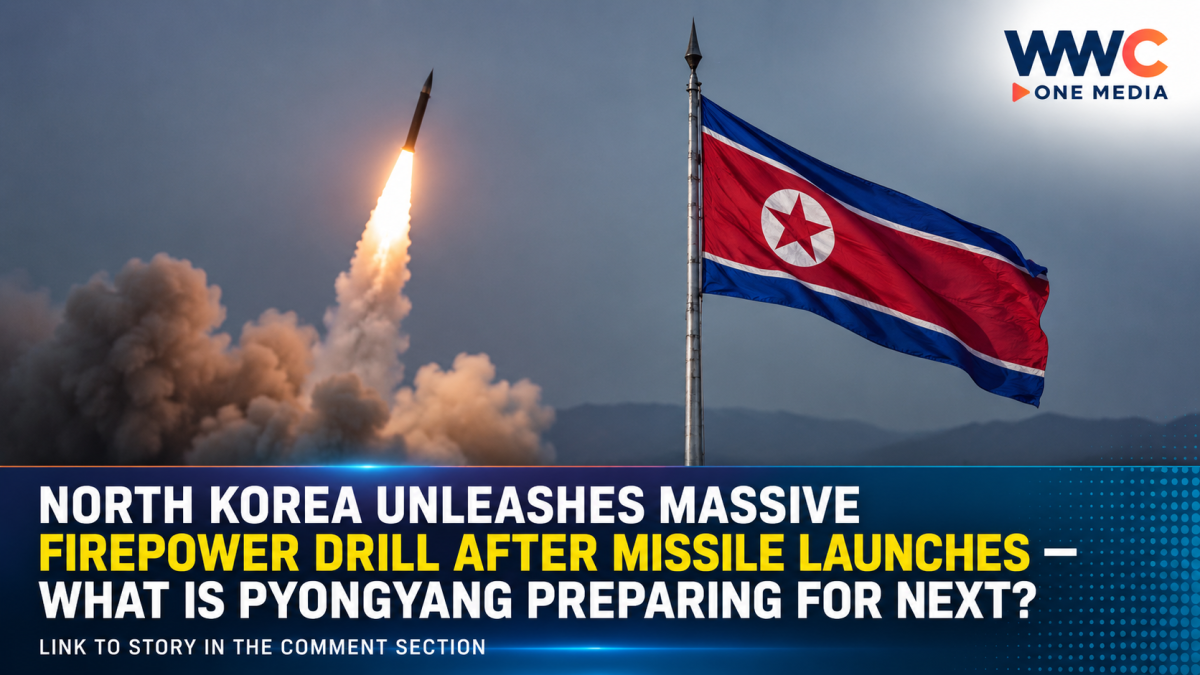
SEOUL — North Korea has announced that it conducted a major coordinated firepower attack drill involving long-range artillery, missiles and new combat systems, adding another dramatic chapter to escalating military tensions on the Korean Peninsula.
According to North Korea’s state-run Korean Central News Agency (KCNA), the drill was carried out on September 12 and involved artillery and missile units from multiple combined units of the Korean People’s Army.
The announcement came after South Korea detected several short-range ballistic missiles launched from the Wonsan area toward the eastern waters of the Korean Peninsula.
But the newly revealed details suggest Pyongyang’s latest military activity went beyond a simple missile launch.
Drones, Cruise Missiles and Heavy Artillery Mobilized
South Korean broadcaster SBS, citing KCNA, reported that units selected from five artillery and missile combined units took part in the exercise.
The weapons and systems reportedly included:
- Attack drones
- Strategic cruise missiles
- Large-caliber thermobaric multiple rocket launchers
- Tactical ballistic missiles
- Long-range artillery systems
North Korea claimed that all participating strike systems hit their designated targets with “100 per cent accuracy.” However, such claims could not be independently verified.
The exercise was reportedly observed by Pak Jong Chon, a senior vice-chairman of the Central Military Commission of the ruling Workers’ Party of Korea. Kim Jong Un was not reported to have attended the drill.
North Korea Tests Integrated Firepower Command
The significance of the exercise may lie not only in the weapons displayed but also in how North Korea says they were coordinated.
KCNA said the drill focused on improving the integrated command and control of different strike systems and increasing the ability of units to rapidly respond during a potential conflict.
North Korean officials said the training was designed to improve the military’s ability to coordinate artillery, missiles and other weapons through an integrated firepower command system.
SBS reported that North Korean officials described the exercise as part of efforts to continuously strengthen the country’s counterattack posture and improve rapid-response capabilities.
Drill Comes After Freedom Edge Exercise
The timing of the North Korean drill is particularly significant.
The missile launches and reported firepower exercise came immediately after the United States, South Korea and Japan concluded their five-day Freedom Edge trilateral military exercise.
According to the Associated Press, the three allies conducted training across air, sea and cyber domains, including maritime operations, air refueling and other coordination exercises.
South Korea has described the drills as defensive and aimed at strengthening the allies’ ability to respond to North Korea’s growing nuclear and missile threats.
Pyongyang, however, has repeatedly condemned such exercises as provocative and has warned of retaliatory measures.
Missiles Flew About 250 Kilometers
South Korea’s Joint Chiefs of Staff said several short-range ballistic missiles were launched from the Wonsan area and flew about 250 kilometers toward the sea.
Seoul said it had strengthened its surveillance posture and was sharing information with the United States and Japan.
South Korea’s national security council urged North Korea to stop ballistic missile launches, which Seoul says violate United Nations Security Council resolutions.
The US military said the latest launches did not pose an immediate threat to American territory or its allies but reaffirmed Washington’s commitment to defending South Korea, Japan and other regional partners.
A Bigger Pattern of Military Expansion
The latest show of force comes as North Korea continues expanding and modernizing its military capabilities.
In recent days, Pyongyang has also moved to strengthen its naval power, including the commissioning of a second advanced destroyer that North Korea says is capable of carrying powerful missile systems.
At the same time, the International Atomic Energy Agency recently reported concerns about the continued expansion of North Korea’s uranium enrichment infrastructure, including new developments at the Yongbyon nuclear complex. The findings have added to international concerns that Pyongyang is continuing to expand its capacity to produce material for its nuclear weapons programme.
North Korea’s expanding weapons programme, combined with its increasingly sophisticated missile, artillery, drone and naval capabilities, has intensified security concerns across Northeast Asia.
Is Pyongyang Sending a Message?
The latest drill appears to serve several purposes.
It demonstrates North Korea’s ability to coordinate different weapons systems in a single strike operation. It also sends a message to Washington, Seoul and Tokyo following their latest joint military exercises.
The exercise may be especially significant because of the combination of conventional artillery, tactical missiles, cruise missiles and drones — a mix that reflects North Korea’s effort to build a more flexible and layered strike capability.
Analysts have also noted that Kim Jong Un has continued expanding North Korea’s military capabilities following the collapse of nuclear diplomacy with Washington in 2019.
The Associated Press reported that North Korea’s growing weapons programme and strengthened relationships with Russia and China could give Pyongyang greater confidence in future negotiations with the United States.
For now, tensions remain high.
North Korea has demonstrated once again that its military strategy is not focused on a single weapon or missile system. Instead, Pyongyang is increasingly showcasing an arsenal that combines missiles, artillery, drones and naval capabilities.
And with the latest firepower drill now revealed, the biggest question facing the region may be what North Korea chooses to test — or demonstrate — next.
The Bottom Line
North Korea’s latest firepower attack drill is more than another military exercise.
By reportedly mobilizing long-range artillery, tactical ballistic missiles, cruise missiles, thermobaric rocket launchers and drones, Pyongyang is signaling its growing ability to coordinate multiple strike systems during a potential conflict.
Coming just after a major military exercise involving the United States, South Korea and Japan, the timing makes the message impossible to ignore.
The weapons were displayed.
The missiles were launched.
The firepower drill was completed.
But what comes next could determine whether tensions on the Korean Peninsula rise even further.




Leave a Reply