
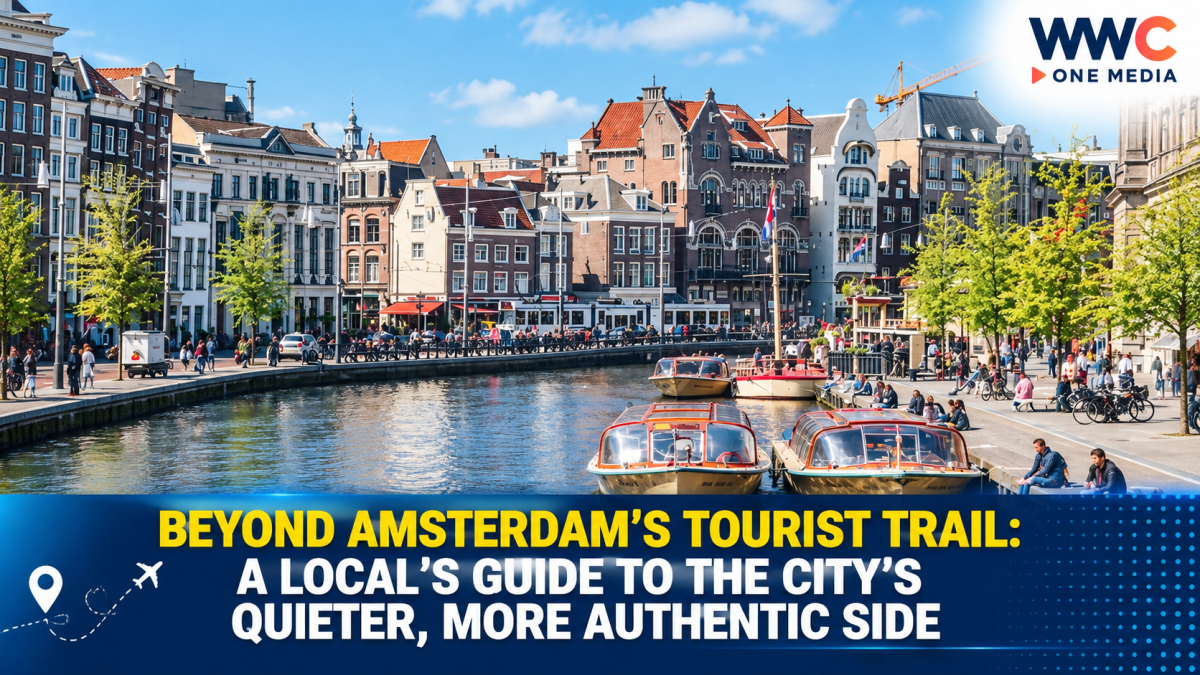
AMSTERDAM — Amsterdam is easy to recognise: postcard-perfect canals, narrow gabled houses, bicycles everywhere and some of Europe’s most famous museums.
But if you spend your entire trip around Dam Square, the Rijksmuseum and the busiest stretches of the Canal Ring, you may be seeing only the version of Amsterdam designed for visitors.
The city’s more relaxed personality emerges when you venture into its neighbourhoods, markets, parks and former industrial districts — places where cafés spill onto pavements, residents shop for groceries and independent businesses sit alongside centuries-old architecture.
Amsterdam’s official tourism organisation itself encourages visitors to leave the city centre and explore neighbourhoods such as Oud-West, De Pijp and Amsterdam-Noord, where you’ll find local markets, independent shops, alternative cultural venues and a very different pace of life.
So, where should you go if you’ve already ticked off the major sights?
1. Start in Oud-West instead of the usual city-centre circuit
Just beyond the central canal belt, Oud-West offers a more everyday side of Amsterdam.
The neighbourhood is known for independent boutiques, cafés, restaurants and smaller cultural venues — the sort of places where you can spend an afternoon without feeling as though you’re moving between one tourist attraction and another.
One of the area’s best-known local markets is Ten Katemarkt, where vendors sell everything from fresh produce and cheese to flowers and prepared food.
Amsterdam’s tourism board recommends the area specifically for visitors looking for hidden coffee spots, alternative entertainment and independent shops.
It is also close to Vondelpark, making it easy to combine neighbourhood wandering with a slower afternoon outdoors.
2. Explore De Pijp when the centre gets too crowded
If you want Amsterdam’s food and street-life energy without spending the entire day around the main tourist sights, head to De Pijp.
The neighbourhood is famous for the Albert Cuyp Market, where stalls sell produce, snacks, flowers and other everyday goods.
Rather than simply treating the market as a sightseeing stop, take your time. Grab something to eat, browse the surrounding streets and explore the cafés and restaurants scattered around the neighbourhood.
De Pijp is also a good reminder that Amsterdam’s food culture extends far beyond Dutch staples. The city’s markets reflect its multicultural population, with influences from Indonesian, Surinamese, Turkish, Moroccan and other communities.
3. Cross the IJ to Amsterdam-Noord
One of the easiest ways to make Amsterdam feel completely different is to take the free ferry across the IJ from behind Amsterdam Centraal.
Within minutes, the dense historic centre gives way to a former industrial landscape that has developed into one of the city’s most creative districts.
At the centre of it is NDSM Wharf, a former shipyard now associated with street art, creative spaces, events, restaurants and alternative culture.
Amsterdam’s official tourism board describes NDSM as a destination for industrial-style dining, street art and vintage shopping.
The contrast is part of the attraction.
Instead of postcard canals and centuries-old façades, you’ll find enormous industrial structures, murals, waterfront views and repurposed spaces.
It is Amsterdam at its messier, more experimental and contemporary best.
4. Wander Nieuwendammerdijk for old Amsterdam without the crowds
Amsterdam-Noord isn’t only about industrial redevelopment.
For something much quieter, head towards Nieuwendammerdijk, a historic street with roots in the city’s former fishing and trading communities.
Traditional houses line the route, while cafés and waterways give the area a village-like atmosphere.
One of the local landmarks is Café ‘t Sluisje, a historic brown café overlooking the harbour. Amsterdam’s tourism board highlights Nieuwendammerdijk as one of the city’s lesser-known historic corners.
It is the sort of place better suited to a slow walk than a checklist.
5. Look for Amsterdam’s hidden courtyards
Some of the city’s most atmospheric spaces aren’t visible from the street at all.
Amsterdam is home to historic hofjes — enclosed courtyards surrounded by residential buildings.
One of the best known is the Begijnhof, a historic courtyard hidden behind the busy streets of central Amsterdam.
The attraction isn’t a flashy landmark. It is the sudden change in atmosphere: step through the entrance and the noise of the shopping streets gives way to a quiet green courtyard surrounded by historic houses.
Because these spaces can be residential, visitors should treat them as living communities rather than conventional tourist attractions — keep voices down, respect privacy and follow posted access rules.
6. Step inside a church hidden above a canal house
For one of Amsterdam’s strangest historical experiences, visit Museum Ons’ Lieve Heer op Solder, or Our Lord in the Attic.
The museum is housed inside a 17th-century canal house and contains an extraordinary secret: a complete Catholic church concealed across its upper floors and attic.
It is one of Amsterdam’s most fascinating reminders that the city’s history isn’t always visible from the street.
The museum is located in the historic centre, but it can easily be missed amid the surrounding attractions. Amsterdam’s official tourism guide lists it among the city’s standout hidden gems.
7. Replace tourist souvenirs with a local market
If you want to understand a city, visit where people shop.
Amsterdam’s markets offer a glimpse into everyday life that souvenir stores around the Canal Ring simply can’t provide.
The tourism board recommends markets including Ten Katemarkt in Oud-West and Dappermarkt in Amsterdam-Oost.
Depending on the market, visitors can find flowers, fish, cheese, fruit, vegetables, fabrics and ready-to-eat snacks.
And don’t leave without trying some Dutch street food.
Look for kibbeling, battered pieces of fish usually served with sauce, or a broodje haring, a traditional herring sandwich.
These are experiences that feel much closer to everyday Amsterdam than simply photographing a canal from a tour boat.
8. Spend an afternoon in Amsterdam-Oost
For travellers willing to venture farther east, Amsterdam-Oost offers a different combination of neighbourhood life, markets, parks and food.
Dappermarkt is one of the area’s best-known markets, while the surrounding streets offer a more multicultural side of Amsterdam.
The district is particularly appealing to visitors who want to experience the city without constantly moving between major attractions.
Instead of asking, “What’s the next sight?” simply pick a café, browse a market and walk.
That’s often when Amsterdam becomes most interesting.
9. Find the city’s quieter canals
You don’t necessarily need to leave central Amsterdam to escape the crowds.
Sometimes the trick is simply to choose a different canal.
The most famous waterways can become busy with tour boats and pedestrians, but quieter stretches around the Jordaan and canals such as Brouwersgracht can offer a much slower experience.
Go early in the morning and the city can feel almost completely different.
The canal houses are still there. The bicycles are still there. But the crowds haven’t arrived yet.
10. Visit the smaller museums
Amsterdam’s blockbuster museums deserve their reputations, but the city has a huge collection of smaller institutions that can be easier to overlook.
One example is Huis Marseille, the Netherlands’ first photography museum, housed in a historic canal property.
The museum combines period rooms with contemporary photography exhibitions and is located in the atmospheric Nine Streets area.
Smaller museums can also make sense when you want a break from the crowds and don’t want to spend half a day navigating a huge collection.
Amsterdam’s official tourism organisation highlights everything from unusual museums and independent cinemas to alternative cultural venues as ways to experience the city beyond its most famous attractions.
11. Slow down in the brown cafés
Amsterdam’s brown cafés are an institution.
These traditional neighbourhood pubs are generally more about conversation, drinks and atmosphere than elaborate interiors or Instagram-ready design.
Some have been around for generations.
Rather than treating a brown café as another item on a sightseeing itinerary, use it as a place to pause.
Order a drink, sit by the window and watch Amsterdam go by.
That slower rhythm is part of the experience.
12. Don’t try to see everything
Perhaps the most important local-style Amsterdam tip is also the simplest:
Stop rushing.
Amsterdam is compact enough that visitors often try to squeeze an enormous number of attractions into a single day.
But the city rewards wandering.
Spend a morning in one neighbourhood rather than crossing the entire city for five separate attractions. Take the ferry to Noord. Browse a market. Sit in a café. Walk along a quieter canal.
Amsterdam’s official tourism board similarly recommends exploring different neighbourhoods rather than remaining inside the Canal Ring throughout your trip.
A better three-day Amsterdam plan
If you’ve already seen the major attractions, consider structuring a trip around neighbourhoods rather than individual landmarks.
Day 1 — Oud-West and De Pijp
Start around Ten Katemarkt, explore Oud-West, then head towards De Pijp and Albert Cuyp Market.
Day 2 — Amsterdam-Noord
Take the free ferry across the IJ, spend time around NDSM Wharf, then explore quieter Noord neighbourhoods such as Nieuwendammerdijk.
Day 3 — Jordaan and the quieter Canal Ring
Explore the Jordaan, look for hofjes, walk along quieter canals and visit a smaller museum such as Huis Marseille or Museum Ons’ Lieve Heer op Solder.
The advantage is that you’re not simply collecting attractions. You’re experiencing different versions of the same city.
Amsterdam’s real charm begins after the checklist ends
There is nothing wrong with visiting the Rijksmuseum, taking a canal cruise or photographing the city’s famous bridges.
Those places are famous for a reason.
But Amsterdam becomes more rewarding when you stop treating it as a collection of attractions.
Its personality lives in neighbourhood markets, tiny cafés, quiet courtyards, brown cafés, creative spaces and streets where residents are simply getting on with their day.
The best way to see another side of Amsterdam may be to stop looking for the next big sight — and start following the streets that tourists usually walk past.




Leave a Reply