
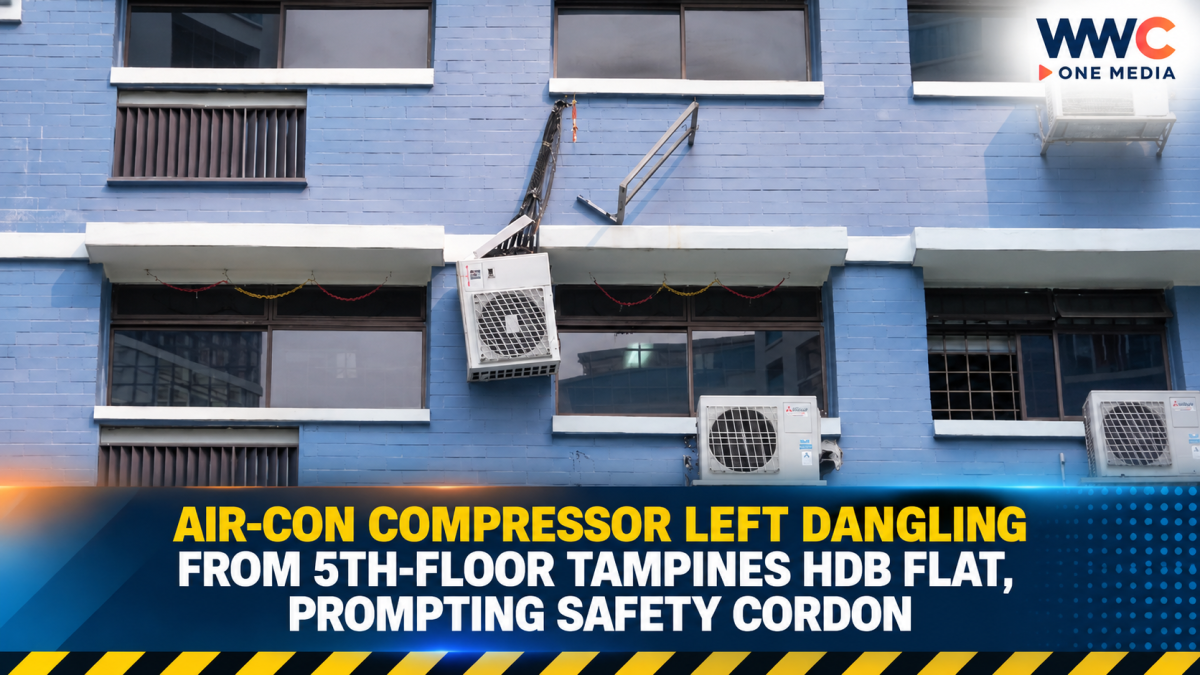
SINGAPORE — An air-conditioning compressor was left precariously dangling outside a fifth-floor HDB flat in Tampines on Sunday (Sept. 13), prompting authorities to cordon off the area below amid concerns that the heavy equipment could fall.
The incident happened at Block 732 Tampines Street 71, where photographs showed the air-conditioner compressor hanging outside the flat, supported only by its connecting pipes and electrical cables.
The metal bracket holding the unit had also partially come loose, with only one of its two arms still attached to the building’s facade.
The precarious situation was reported to AsiaOne by a resident at around 2.45pm.
Ground area cordoned off as unit dangled overhead
With the compressor hanging several storeys above ground level, netting was put up to cordon off the area directly underneath the affected flat.
A town council worker was seen speaking with residents, while a police Fast Response Car was later spotted at the block at around 3.30pm.
The incident raised an obvious concern for anyone walking beneath the affected stack: if the remaining bracket gave way, the compressor and metal frame could potentially fall from the fifth floor.
Fortunately, the unit was secured before that happened.
By 5.20pm, subsequent checks found that both the compressor and its bracket had been removed.
The relevant agencies had also contacted the flat owner, who was to carry out urgent rectification works.
Air-con unit did not actually crash to the ground
Despite the alarming photographs, the compressor did not fall from the building.
Instead, it became partially detached and was left hanging from its connecting pipes and cables.
That distinction is important because a falling outdoor air-conditioning compressor can pose a serious risk to pedestrians and residents below.
The incident therefore ended without the dramatic impact suggested by the headline, but the condition of the equipment still presented a potentially dangerous situation.
HDB owners can face heavy penalties
Singapore’s regulations place responsibility for the safe maintenance of air-conditioning equipment on flat owners.
Under the Building Control Regulations, flat owners can face a maximum S$20,000 fine, up to one year in jail, or both if an air-conditioning condensing unit — or its structural supporting system, open panel, frame or tray — falls because of a lack of maintenance.
That means an air-conditioner problem is not simply a matter of replacing a faulty appliance.
The supporting brackets and associated structures also need to remain secure.
Who should install an HDB air-con unit?
Owners should also be careful when installing or replacing an air-conditioning condensing unit.
According to the guidance cited in the report, flat owners should engage Building and Construction Authority-trained air-conditioning unit installers for installation or replacement work.
This is particularly important for outdoor condenser units, which are exposed to weather and are mounted outside the flat at height.
A weakening bracket, corroded component or poorly maintained installation can potentially turn an everyday household appliance into a falling-object hazard.
This isn’t the first time police have dealt with a dangerous air-con unit
The Tampines incident is not an isolated example of authorities having to respond to an unstable air-conditioning unit at an HDB block.
In July 2022, police forcibly entered a 10th-floor flat at Block 55 Chai Chee Drive after a similar air-conditioning-related safety situation occurred.
The owners were not at home at the time, and officers entered because of the potential danger.
Changes to the Police Force Act that took effect in January 2022 allow police officers to force entry when necessary to protect people from injury or death, including in certain emergencies.
A warning for HDB residents
The Tampines incident offers a simple but important reminder for homeowners: don’t wait until an outdoor air-conditioning unit looks obviously unstable before getting it checked.
Residents should pay attention to signs such as:
- Rust or corrosion around mounting brackets
- Unusual movement or vibration from the outdoor unit
- Cracked or damaged brackets
- Loose bolts or fasteners
- Unusual noises coming from the condenser
- Pipes or cables pulling against the unit
- Visible gaps between the bracket and building facade
If an outdoor unit or its supporting structure appears unstable, residents should keep people away from the area below and arrange for qualified professionals to assess and rectify the problem urgently.
A close call in Tampines
What could have become a far more serious incident was brought under control within a few hours.
The compressor and bracket were removed by the afternoon, and the immediate danger beneath the fifth-floor flat was eliminated.
But the sight of an air-conditioning compressor hanging above a public walkway is a stark reminder that maintenance matters just as much as installation.
For HDB residents, the lesson is straightforward: that outdoor unit may look like just another part of the home, but several storeys above the ground, a loose bracket can become a serious safety hazard.
The Tampines compressor did not fall — but it came loose enough to show just how dangerous an unsecured air-conditioning unit can become.


Leave a Reply