
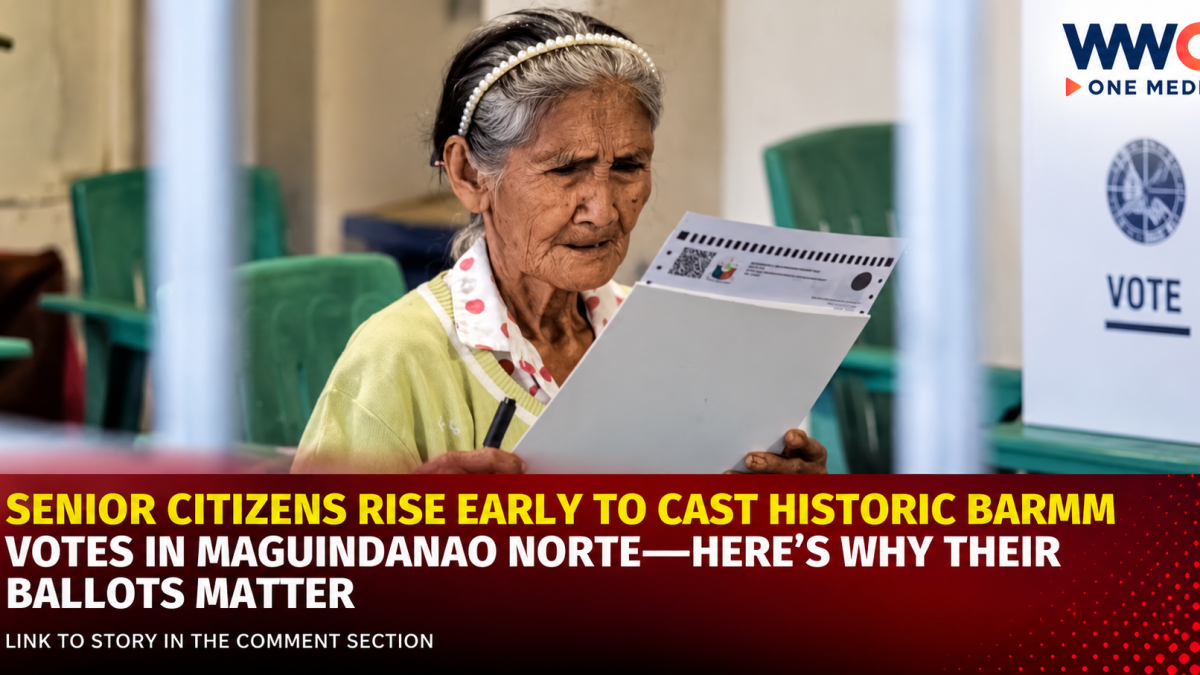
MAGUINDANAO DEL NORTE, Philippines — Before the regular voting hours began across the Bangsamoro Autonomous Region in Muslim Mindanao (BARMM), senior citizens were already among the early voters who arrived at polling centers in Maguindanao del Norte on Monday, September 14, taking part in a historic election that will shape the region’s first elected parliamentary government.
The early turnout of elderly voters came as the first regular BARMM parliamentary elections formally opened, marking a major milestone in the region’s transition from an interim administration to an elected parliamentary government.
Under election-day rules, senior citizens, persons with disabilities (PWDs), and pregnant voters were allowed to vote as early as 5 a.m., two hours before regular voting began at 7 a.m. Regular voting was scheduled to continue until 7 p.m.
Priority voters who did not vote during the early period could still cast their ballots during regular voting hours while retaining priority access in queues. Designated priority polling areas were also located on the ground floor of voting centers to make voting more accessible.
A historic ballot for the Bangsamoro
The voting in Maguindanao del Norte is part of a region-wide exercise involving nearly 2.4 million registered voters across BARMM. The Commission on Elections (Comelec) opened more than 5,000 voting precincts, with 5,212 precincts established across 105 municipalities and two cities in the region.
The election will determine the composition of the 80-member Bangsamoro Parliament.
Of the 80 seats, 40 are allocated to regional parliamentary political party representatives, 32 to parliamentary district representatives and eight to sectoral representatives.
Unlike national presidential elections, Bangsamoro voters are not directly electing a chief minister. Instead, voters elect members of Parliament, who will subsequently choose the Chief Minister from among themselves.
Voters face a different kind of ballot
The parliamentary election also introduces voting procedures that are unfamiliar to many voters.
A regular voter is expected to make eight selections: one regional parliamentary political party, one district representative and six sectoral representatives. The sectoral choices include two representatives for Settler Communities and one each for Women, Youth, Traditional Leaders and Ulama.
The two representatives for Non-Moro Indigenous Peoples are selected through a separate process and are not included among the eight regular ballot choices.
The new system has prompted extensive voter-education efforts throughout BARMM. The United Nations Development Programme said community-based voter education sessions reached more than 2,200 voters across the region, while participants showed substantial improvements in their understanding of the parliamentary system and voting process.
Maguindanao del Norte at the center of the historic vote
Maguindanao del Norte has been among the areas closely watched during preparations for the election.
Comelec previously conducted pilot testing of the voting process in Maguindanao del Norte and Tawi-Tawi, with officials saying voters were able to follow the procedures. Candidate photographs and other information were incorporated into the ballot design to help voters identify their choices.
Election preparations also included the deployment of security forces and heightened monitoring because of security concerns in parts of BARMM.
Comelec said 108 areas were classified as election areas of concern, with different levels of security risk ranging from relatively peaceful areas to locations facing serious threats.
The Philippine National Police was placed on full alert for the elections, while thousands of security personnel were deployed throughout the region. International observers were also monitoring the historic polls in several areas, including Maguindanao del Norte.
More than an election
The significance of Monday’s vote extends beyond the selection of parliamentary representatives.
The election represents the next major step in the political transition created by the Bangsamoro peace process, replacing the appointed Bangsamoro Transition Authority with an elected regional government.
The Associated Press described the polls as a crucial milestone in the region’s pursuit of self-government and lasting peace after decades of insurgency and conflict. BARMM was established in 2019 as part of the peace process involving the Philippine government and the Moro Islamic Liberation Front.
For the senior citizens who arrived early in Maguindanao del Norte, however, the historic moment came down to something simple: showing up, exercising their right to vote and helping determine who will lead the Bangsamoro region into its next chapter.
Their early presence at the polling centers offered a powerful image as BARMM held its first parliamentary election—a reminder that the region’s transition to elected government ultimately depends on voters turning out to make their voices heard.


Leave a Reply