
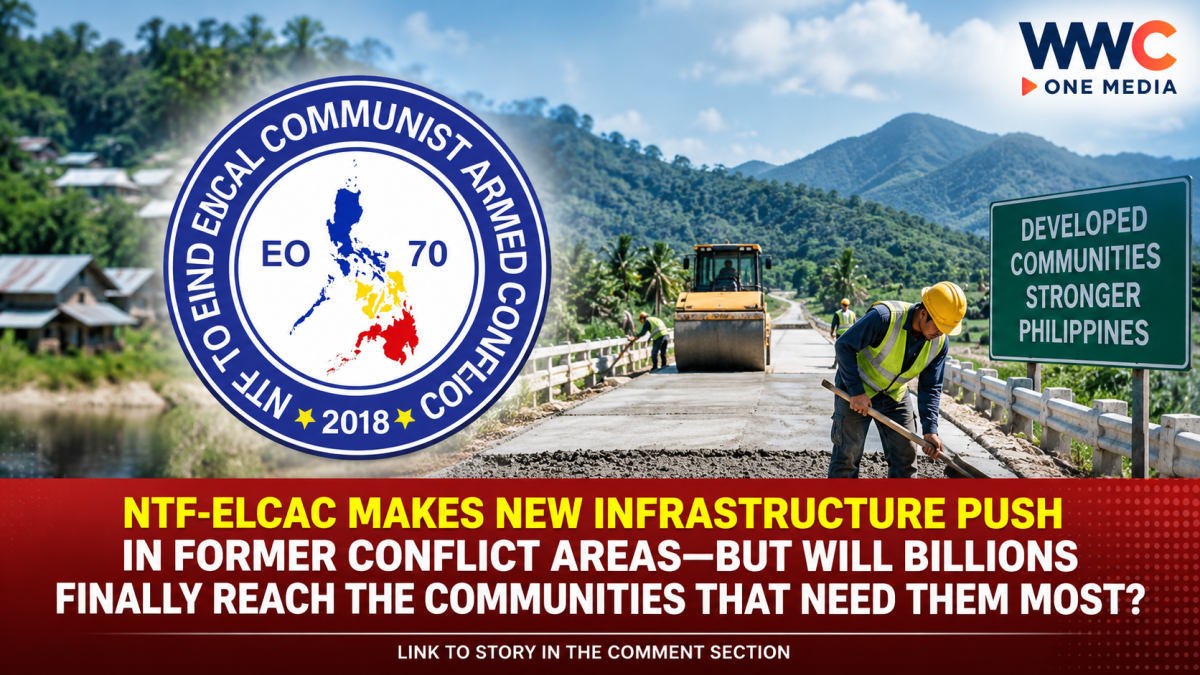
MANILA, Philippines — The government is stepping up efforts to bring roads, schools, water systems, health facilities and other basic infrastructure to communities once affected by armed conflict, as the National Task Force to End Local Communist Armed Conflict (NTF-ELCAC) continues to link peace efforts with economic and social development.
The infrastructure push is being carried out largely through the Support to Barangay Development Program (SBDP) and related government initiatives designed to close long-standing development gaps in geographically isolated and disadvantaged areas (GIDAs).
The program is built around a straightforward premise: communities that have endured years of conflict and isolation need more than improved security. They also need reliable roads, electricity, schools, healthcare, water systems and livelihood opportunities if peace is to become sustainable.
Recent government figures show the scale of the investment.
The Department of Budget and Management (DBM) said in March 2026 that it released ₱8.08 billion for priority projects in more than 800 insurgency-cleared barangays under the Local Government Support Fund–Support to Barangay Development Program. The funding was intended to accelerate the delivery of government services in communities previously affected by armed conflict.
The Department of the Interior and Local Government (DILG) likewise reported that from 2021 to 2025, the LGSF-SBDP financed 7,922 projects worth ₱36.82 billion, benefiting nearly 16 million Filipinos.
Those projects included 3,882 farm-to-market roads, 696 school buildings, 1,403 water supply and sanitation systems, 626 health stations and 949 rural electrification projects.
From conflict zones to development corridors
The infrastructure strategy reflects the government’s broader “whole-of-nation” approach under Executive Order No. 70, which established the NTF-ELCAC framework.
The task force’s own description of the Barangay Development Program identifies its main objective as bringing sustainable development to former conflict-ridden communities, particularly GIDA areas that have historically struggled to access government services.
The potential impact is particularly significant in rural communities where poor roads can isolate farmers from markets, inadequate water systems can undermine public health, and limited electricity and telecommunications can restrict education and economic opportunities.
Recent developments suggest that the government is increasingly emphasizing this development component as security conditions improve.
In August, National Anti-Poverty Commission Secretary Lope Santos III called for the expansion—not reduction—of the NTF-ELCAC’s Barangay Development Program, citing improvements in poverty indicators in several former conflict-affected areas.
According to figures cited by Santos, poverty incidence in Northern Samar declined from 51.8% in 2015 to 19.3% in 2021, while Eastern Samar’s rate fell from 40.9% in 2018 to 24.7% in 2023.
He argued that connecting isolated barangays to roads, telecommunications and electricity can help sustain poverty reduction and open communities to wider economic opportunities.
The numbers are growing—but so are questions
The government’s development figures are substantial, but implementation and accountability remain important issues.
The NTF-ELCAC says its BDP has already generated thousands of projects across formerly conflict-affected communities, while the DILG and DBM have emphasized that funding is coursed through local government units rather than being directly managed by the task force itself.
Earlier implementation records also showed that funding does not automatically translate into completed infrastructure. In 2024, the Philippine News Agency reported that although nearly 99% of the ₱2.16-billion allocation for that year’s program had been released, DILG officials said beneficiary local governments were still undertaking procurement for the projects.
That history puts the spotlight not only on how much money is allocated, but on how quickly projects are completed, whether they meet quality standards and whether communities actually experience measurable improvements in their daily lives.
Occidental Mindoro offers a glimpse of what could come next
The debate over development and insurgency has also gained attention following economic improvements reported in Occidental Mindoro.
The Philippine News Agency recently reported that the province recorded economic growth of 11.2%, with local officials linking improved roads, electricity, livelihoods and government services to the province’s broader turnaround and reduction in insurgency-related incidents.
The example illustrates the government’s argument that development can reinforce peace by reducing isolation and giving communities greater access to markets, education, healthcare and livelihood opportunities.
But the challenge now is sustaining those gains.
For communities emerging from decades of conflict, a newly constructed road or school is only the beginning. The larger test is whether infrastructure can create lasting economic opportunities, improve public services and prevent vulnerable communities from slipping back into poverty and instability.
As the NTF-ELCAC pushes for continued infrastructure support, the question increasingly moves beyond how much the government will spend.
It is whether those investments will translate into better roads, better schools, reliable electricity, accessible healthcare and real economic opportunities for the people who have waited the longest for them.
And for thousands of former conflict-affected barangays, that may ultimately be the measure of whether the country’s peace-and-development strategy succeeds.




Leave a Reply