
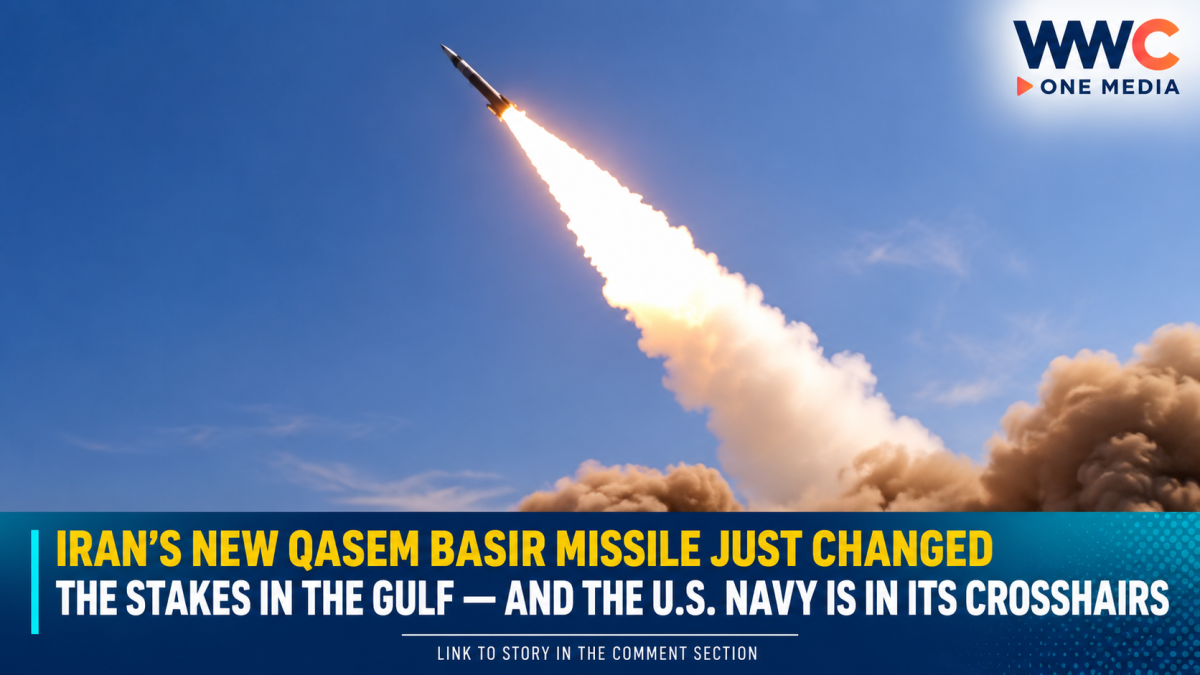
Iran’s latest missile threat is raising the stakes in an already dangerous Middle East war, with Tehran claiming that its new Qasem Basir ballistic missile has been used against U.S. warships near the strategically vital Strait of Hormuz.
But one crucial question remains unanswered: Was the Qasem Basir actually used in the reported attack?
Iranian officials have claimed that an advanced ballistic missile was fired at U.S. naval vessels and have presented the Qasem Basir as a major advance in the country’s missile capabilities. The United States has confirmed that Iranian ballistic missiles were launched toward American warships, but U.S. officials have not independently confirmed that the Qasem Basir was the weapon used.
That distinction matters because the Qasem Basir is designed to make Iran’s missile force more difficult to defend against.
A new threat aimed at U.S. naval power
The Qasem Basir is a solid-fuel, medium-range ballistic missile that Iran unveiled in 2025. Iranian descriptions put its range at roughly 1,200 kilometers (745 miles) and describe a maneuverable reentry vehicle and improved precision. Reports also say the missile can carry a warhead of approximately 500 kilograms.
Its reported capabilities are particularly significant because Iran is attempting to challenge U.S. naval forces operating around the Persian Gulf and Strait of Hormuz.
According to Asia Times, the reported combat debut of the missile could represent a significant escalation because increasingly sophisticated Iranian targeting systems could make U.S. naval operations more contested and potentially more dangerous.
However, the reported capabilities should not automatically be treated as independently verified battlefield performance.
The Critical Threats Project notes that Iran claims to have used the missile against U.S. naval vessels, but says it remains unclear whether the Qasem Basir was actually employed in the recent attacks.
U.S. warships were targeted
The confrontation intensified on September 5, when Iranian forces launched ballistic missiles toward U.S. naval vessels near the Strait of Hormuz.
The targets reportedly included the nuclear-powered aircraft carrier USS George Washington and a guided-missile destroyer.
U.S. authorities said the warships successfully evaded the incoming missiles and that no American personnel were killed in the attack.
The significance goes beyond a single missile exchange.
For much of the conflict, attacks connected to the maritime confrontation had largely focused on commercial shipping. The reported targeting of major U.S. warships represents a potentially more dangerous phase because an attack that seriously damages or sinks an American naval vessel could trigger a much larger military response.
Why the Qasem Basir matters
Ballistic missiles are not new to Iran.
What makes the Qasem Basir potentially significant is the combination of range, maneuverability and reported terminal guidance.
The missile is reportedly equipped with a maneuverable reentry vehicle, meaning its warhead can change its trajectory during the terminal phase of flight. Such maneuverability can make interception more difficult for air-defense systems.
Reports have also described electro-optical seeker technology intended to help the weapon engage moving targets.
But there is a major limitation: even a sophisticated anti-ship missile needs accurate targeting information.
The Critical Threats Project notes that Iranian forces would still need sufficiently precise information about a ship’s location before launching such a weapon.
That means the broader Iranian targeting network could be just as important as the missile itself.
Strait of Hormuz becomes the bigger battlefield
The missile escalation comes as tensions surrounding the Strait of Hormuz continue to intensify.
The waterway is one of the world’s most important energy corridors, and disruptions there can quickly affect oil markets, shipping costs and global energy supplies.
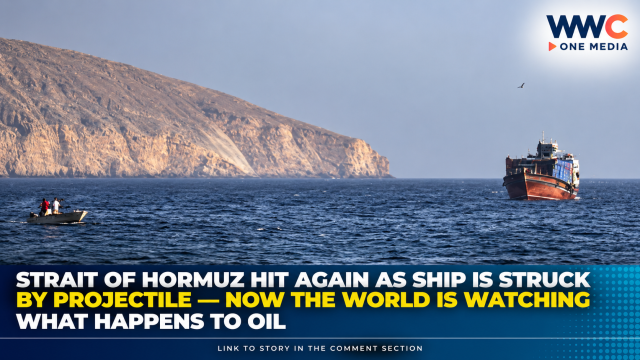
Reuters reported on September 13 that a vessel was reportedly struck by a projectile while transiting the Strait of Hormuz, with the extent of damage and the condition of its crew initially unclear. The report came amid continuing disruption to regional energy infrastructure and shipping.
That makes every new attack around the waterway potentially consequential far beyond the Middle East.
Iran has also threatened what it calls “economic warfare” and has discussed creating an exclusion zone around the Gulf.
The United States has rejected Iran’s attempt to dictate control over the waterway, while Gulf states have warned that their energy exports and commercial activity cannot be held hostage by the conflict.
The conflict is spreading beyond Iran and the U.S.
The danger is no longer confined to Iranian and American forces.
Iran-backed Houthi forces have also intensified attacks against Saudi Arabia. Reuters reports that Houthi attacks wounded dozens of people and struck energy-related targets, highlighting the risk that the conflict could develop into a broader regional confrontation.
The United States now faces a complicated strategic problem.
It has overwhelming naval and air power, but protecting warships and commercial shipping across a huge maritime battlespace becomes increasingly difficult when adversaries can deploy long-range missiles, drones and asymmetric tactics.
Iran does not necessarily need to defeat the U.S. Navy outright.
It may only need to make operating in the region sufficiently dangerous to increase the economic and political cost of the war.
A missile does not have to sink a carrier to change the war
That may be the most important point emerging from the latest escalation.
The Qasem Basir does not have to destroy an American aircraft carrier to influence the battlefield.
If Iranian missiles force U.S. warships to maneuver defensively, increase their distance from Iranian territory or devote greater resources to missile defense, Tehran could achieve a strategic effect without scoring a conventional battlefield victory.
Asia Times argues that this could challenge assumptions about U.S. naval superiority in the Gulf.
But analysts caution against assuming that Iran has suddenly neutralized American naval power.
The United States retains extensive intelligence, surveillance, air-defense, electronic-warfare and naval capabilities. And the U.S. military says the targeted warships successfully evaded the recent missile attack.
The real danger lies in what happens next.
The next missile could carry a much bigger consequence
The Qasem Basir episode illustrates how quickly the conflict can move from an exchange of threats to a direct confrontation between major military platforms.
If Iran successfully hits a U.S. warship, Washington would face enormous pressure to respond.
If that response strikes deeper into Iran, Tehran could retaliate against American forces, Gulf allies or shipping.
And if commercial vessels become increasingly caught in the crossfire, the consequences could spread rapidly through global energy markets.
That is why the latest Qasem Basir claims deserve attention — but also caution.
Iran says it has demonstrated a new missile capability. The United States confirms the missile attack but has not independently established that the Qasem Basir was the weapon used.
What is already clear is that the conflict around the Strait of Hormuz has entered a more dangerous phase.
And the question now hanging over the Gulf is no longer simply whether Iran can threaten U.S. warships.
It is whether the next missile exchange can be contained before one strike turns an escalating confrontation into a much larger war.



Leave a Reply