
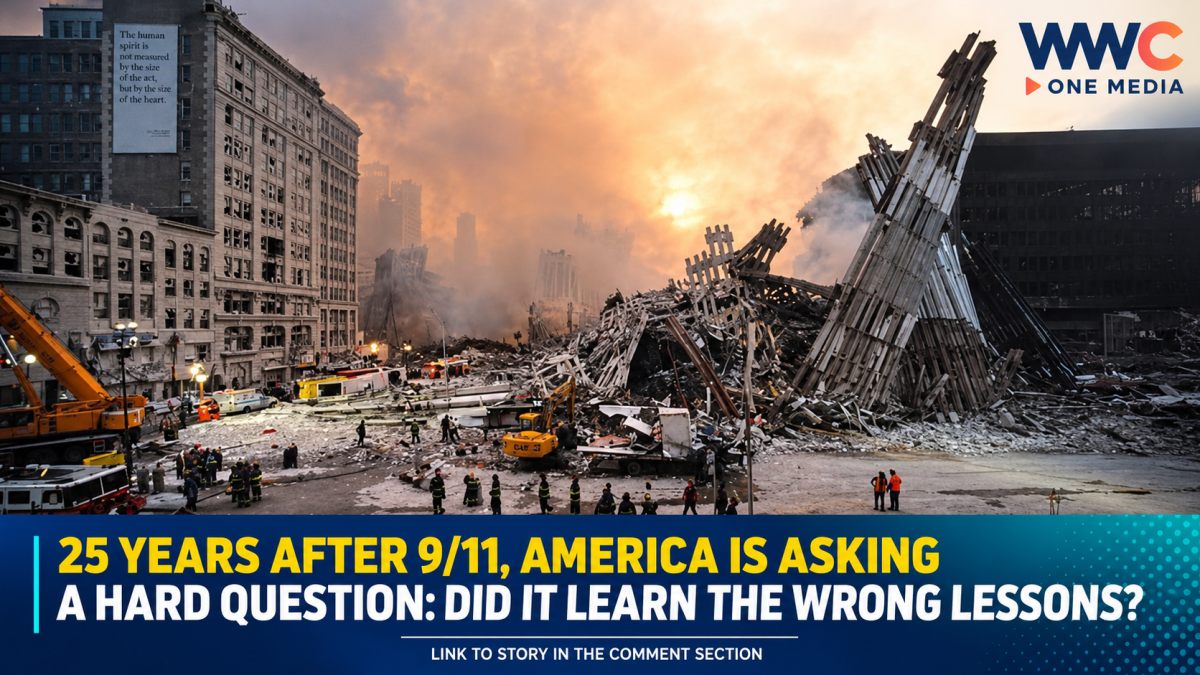
Twenty-five years after the September 11, 2001 terrorist attacks, a difficult question is resurfacing in Washington and beyond: did the United States respond to the tragedy in ways that ultimately created new problems of their own?
An Asia Times analysis by Leon Hadar argues that the central mistake was not simply the failure to prevent the attacks, but the conclusions Washington drew afterward — particularly the decision to pursue prolonged wars, nation-building and an expanded national-security state.
The September 11 attacks killed nearly 3,000 people and fundamentally changed U.S. foreign policy. Within months, Washington launched what became known as the Global War on Terror, beginning with military action in Afghanistan and later expanding to Iraq and other counterterrorism operations.
But 25 years later, experts and policymakers are increasingly examining both what worked and what went wrong.
From Afghanistan to Iraq: How the response expanded
The initial U.S. campaign in Afghanistan was aimed at removing the Taliban from power and disrupting al-Qaeda, the terrorist organization responsible for the attacks.
What followed, however, became a much larger nation-building project.
The United States spent two decades fighting an insurgency and attempting to establish a functioning democratic government before withdrawing its remaining forces in 2021. The Taliban subsequently returned to power.
The Council on Foreign Relations says the Afghanistan campaign demonstrated the difficulty of nation-building and ultimately became an example of how Washington could become overextended.
Iraq represented an even more consequential expansion of the post-9/11 strategy.
The George W. Bush administration invaded Iraq in 2003, although Iraq was not responsible for the September 11 attacks. The invasion was justified in part by intelligence concerning weapons of mass destruction that was later discredited.
CFR notes that the Iraq War contributed to a prolonged and destructive conflict, while the instability that followed helped create conditions in which extremist organizations, including ISIS, could emerge and expand.
The lesson Washington may have misunderstood
Hadar’s argument is that Washington interpreted 9/11 as proof that the United States needed an even larger military and political footprint overseas.
According to the Asia Times analysis, this produced what he describes as four major strategic mistakes: expanding intervention abroad, embracing nation-building as a response to terrorism, accepting extraordinary security powers as normal, and treating prolonged military commitments as essential to maintaining American credibility.
That interpretation is opinion, rather than an established historical consensus. But several independent assessments of the post-9/11 era identify related problems.
The 9/11 Commission itself concluded that the United States had suffered a “failure of imagination” before the attacks, along with failures involving policy, capabilities and management. It also found that agencies had struggled to share and act upon critical information about al-Qaeda.
The lesson, therefore, was not simply that America needed more military power. It was also that governments needed better intelligence coordination, stronger institutional structures and the ability to recognize emerging threats before they became catastrophic.
Security improved — but so did government power
The post-9/11 transformation was not limited to foreign policy.
The United States created the Department of Homeland Security, expanded intelligence capabilities and dramatically strengthened airport security.
The Transportation Security Administration became a defining part of American travel, while surveillance and counterterrorism authorities expanded considerably. Axios notes that some of these security practices remain deeply embedded in American life 25 years later, although debates continue over how much security is appropriate and where the balance between security and individual freedom should lie.
CFR similarly argues that the creation of DHS and expanded intelligence capabilities made the United States safer from certain foreign threats, but that the post-9/11 period also contributed to deeper political distrust and polarization.
For critics of the post-9/11 security state, the concern is that emergency measures introduced after an extraordinary attack can become permanent.
That is one of the strongest themes in Hadar’s analysis: whether extraordinary powers created in response to terrorism remained justified after the immediate threat had changed.
The cost of the “forever wars”
The consequences were also geopolitical.
CFR argues that the two long wars consumed enormous American resources while creating opportunities for other powers to alter the international balance.
The United States entered the post-9/11 period as the world’s dominant superpower. Two decades later, Washington faces a far more complicated international environment involving a rising China, a more confrontational Russia and a broader challenge to the post-Cold War order.
That does not mean 9/11 alone caused today’s geopolitical landscape.
The rise of China, Russia’s actions, the global financial crisis, Brexit, the COVID-19 pandemic and subsequent political changes all played major roles. But the wars launched after 9/11 became an important part of the story.
The lesson for the next crisis
The United Nations, marking the 25th anniversary of the attacks, emphasized that terrorism remains a serious threat but stressed that combating it requires national, regional and international cooperation grounded in international law. The UN also warned that terrorism and violent extremism cannot be addressed through repression alone.
That creates perhaps the most important question for the next generation of policymakers.
The challenge is not simply how to prevent another 9/11.
It is how to respond to the next unexpected threat without allowing fear, anger or political pressure to produce consequences that last for decades.
Twenty-five years after the Twin Towers fell, the United States has learned many lessons about intelligence, airport security and counterterrorism.
The harder question is whether it has learned when military power should be used — and when restraint may actually make America safer.
That debate is far from over.


Leave a Reply