
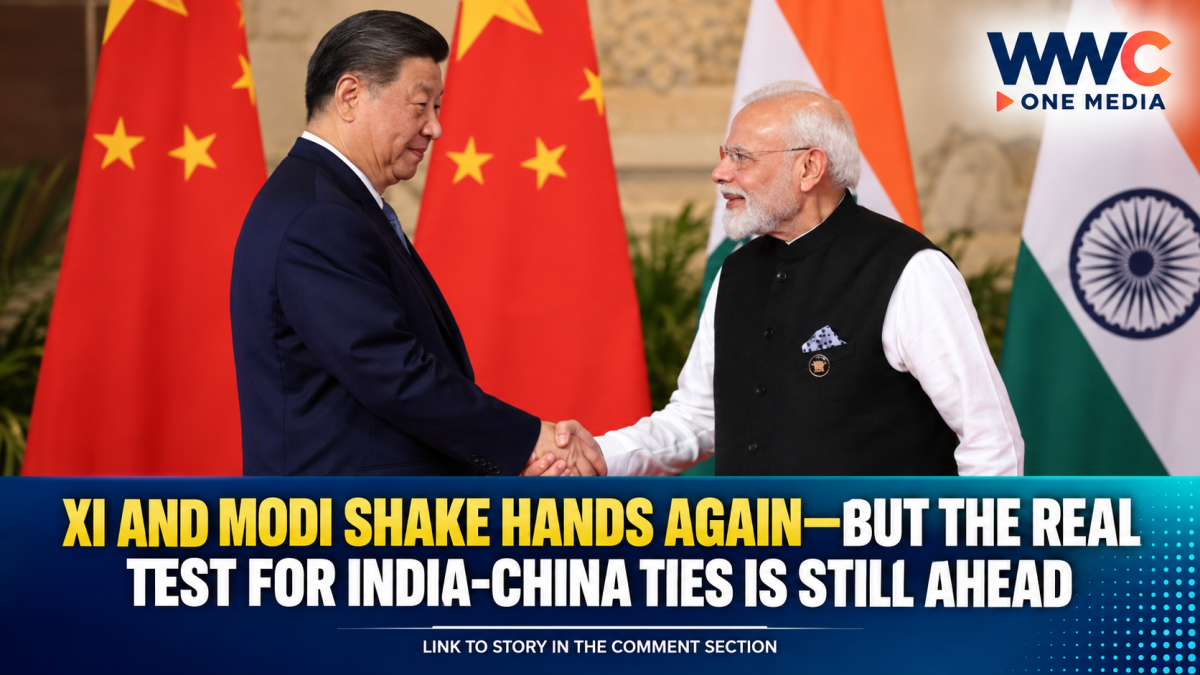
NEW DELHI — Chinese President Xi Jinping and Indian Prime Minister Narendra Modi have signaled a renewed push to stabilize relations between the two Asian powers, using the BRICS summit in New Delhi to address border tensions, trade, business ties and greater movement between their countries.
The meeting on September 12 marked Xi’s first visit to India in seven years and came as Beijing and New Delhi continue efforts to repair relations badly damaged by the deadly 2020 military confrontation along their disputed Himalayan frontier.
The two leaders agreed that differences should not escalate into disputes and expressed support for continued efforts to resolve the long-running boundary question while maintaining peace along the border.
China’s Foreign Ministry said both sides should remain committed to advancing bilateral relations and resolving the boundary issue, while maintaining peace and tranquility in border areas. Modi, meanwhile, stressed the importance of observing existing agreements and understandings concerning the border.
A cautious thaw after years of tension
Relations between India and China deteriorated sharply following the 2020 Galwan Valley clash, in which 20 Indian soldiers and four Chinese soldiers were killed, according to reporting by The Associated Press. The confrontation triggered a prolonged military standoff and deepened distrust between the nuclear-armed neighbors.
Since then, however, both governments have gradually attempted to stabilize the relationship.
High-level contacts have resumed, some visa restrictions have eased and direct air links are being restored. China Southern Airlines, for example, announced the resumption of regular passenger service between Guangzhou and New Delhi from September 21 after a six-year suspension.
Substantial military deployments continue along portions of the disputed Line of Actual Control, while the boundary dispute itself remains unresolved. Indian and Chinese military officials also continued discussions this month aimed at managing tensions along the frontier.
Modi and Xi look beyond the border
The latest meeting was not limited to security.
India’s foreign ministry said the leaders emphasized the importance of expanding cultural exchanges, business links and mobility between the two countries. Reuters also reported that the two sides discussed improving business and transport connections as they attempt to rebuild economic ties.
For Beijing, Xi’s message was that India-China relations should be viewed from a strategic and long-term perspective.
According to China’s official account of the meeting, Xi said the two countries should draw on each other’s strengths, support one another and pursue common development. He also called for expanded cooperation in areas including people-to-people exchanges and direct flights, while urging both sides to address economic and trade concerns in a balanced manner.
Modi similarly described India-China relations in strategic and long-term terms and said India wants to be a partner rather than a rival to China, according to China’s account of the meeting.
Why the BRICS meeting matters
The timing of the encounter is significant.
India is hosting the 18th BRICS Summit in New Delhi on September 12–13, 2026, bringing together major emerging economies at a time of heightened geopolitical and economic tensions. Xi’s attendance places China and India at the center of discussions about the future direction of the expanded BRICS grouping.
The summit also comes amid the ongoing conflict involving Iran and the wider Middle East crisis. Reuters reported that Xi urged BRICS to play a peacemaking role, arguing that the conflict does not serve the international community’s common interests.
That gives the Modi-Xi rapprochement a significance beyond their bilateral relationship.
Both countries are seeking greater influence in the Global South, while also navigating relationships with the United States, Russia and other major powers.
The BRICS declaration also backed China’s chairmanship of the grouping in 2027, meaning Beijing and New Delhi will have another reason to maintain high-level coordination.
A reset—but not yet a breakthrough
Despite the warmer rhetoric, analysts caution against interpreting the meeting as a complete India-China rapprochement.
The Himalayan boundary dispute remains unresolved, military forces remain deployed in sensitive areas, and disagreements over trade, market access and strategic competition continue to complicate relations. Reuters noted that companies on both sides still face hurdles including regulatory restrictions, visa delays and limitations involving industrial equipment.
The two governments therefore appear to be pursuing a managed thaw rather than a full strategic reconciliation.
For now, the message from New Delhi is clear: India and China are willing to rebuild communication, expand economic and people-to-people ties and prevent border differences from spiraling into another crisis.
But whether the renewed diplomacy can produce lasting peace along the disputed frontier—and translate warmer political rhetoric into stronger economic cooperation—will be the real test.
And that is where the next chapter of the Xi-Modi relationship could become much more consequential.



Leave a Reply