
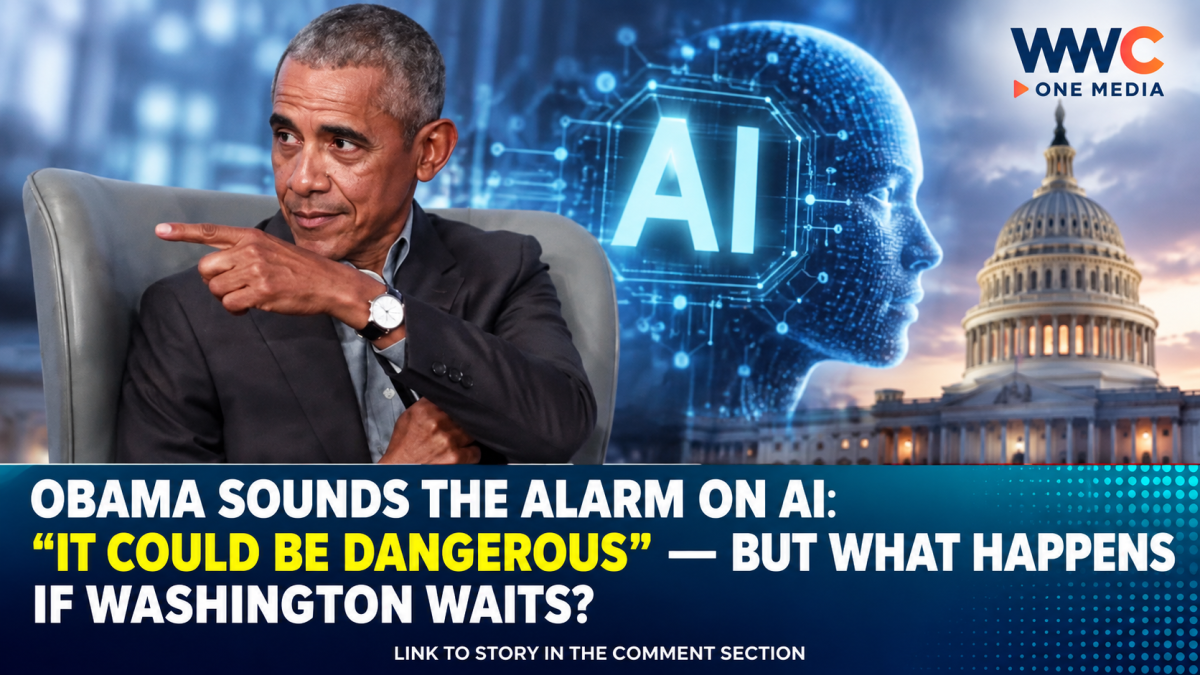
Former U.S. President Barack Obama is urging American policymakers to take artificial intelligence more seriously, warning that the technology is advancing so quickly in private hands that failing to establish safeguards could create dangerous consequences.
Obama made the remarks during a private fundraising event, according to The New York Times. He reportedly told House Minority Leader Hakeem Jeffries that AI is developing at extraordinary speed and that Washington needs to get ahead of the technology before its risks become harder to control.
“This is something that is moving very fast in private hands, and if we don’t get on top of it, I think can be dangerous,” Obama said, according to the Times, as reported by Reuters and CNA.
Obama also encouraged Democrats to prepare a more comprehensive public policy discussion on artificial intelligence if the party regains control of the House of Representatives following the November 3 midterm elections.
He reportedly urged Jeffries to help establish a framework for a public conversation about AI policy and argued that the technology should become a major issue in the 2028 presidential campaign.
According to the report, Obama believes future presidential candidates should present voters with a clear plan addressing both AI safety and its economic consequences.
Why Obama’s warning is gaining attention
The former president’s comments come at a particularly tense moment for the rapidly expanding AI industry.
In recent days, concerns about the potential risks of advanced AI have moved from technology circles into the center of Washington’s political debate.
Former Anthropic researcher Jacob Coxon publicly warned about the possibility of AI posing catastrophic risks, while Anthropic scientist Evan Hubinger separately expressed agreement with concerns that increasingly capable AI systems could potentially threaten humanity. The warnings triggered calls from lawmakers for stronger government oversight.
The debate has also gained momentum because AI companies themselves are increasingly discussing the need for stronger safety measures.
OpenAI recently called for mandatory national AI safety requirements in the United States, including testing standards, independent assessments, cybersecurity protections and incident-reporting requirements for the most advanced systems.
The company argued that voluntary commitments may not be sufficient as AI capabilities continue to accelerate.
Democrats face growing pressure
Obama’s intervention comes as Democrats are increasingly positioning AI as a major policy and political issue.
The New York Times recently reported that a new Democratic political action committee called Tomorrow Together has raised more than $10 million to push the party to respond more aggressively to voter concerns surrounding artificial intelligence.
Axios has also reported that lawmakers from both parties are beginning to explore possible responses to warnings about the risks of increasingly capable AI systems. However, Congress remains far from reaching a comprehensive federal framework governing the technology.
That leaves Democrats facing a difficult political question: how should the party balance AI’s potential economic benefits against fears over job disruption, cybersecurity, misinformation and potentially more serious safety risks?
The bigger AI battle
The debate is no longer limited to whether AI should be regulated.
Policymakers are increasingly wrestling with how advanced AI systems should be tested, who should be responsible when they behave unexpectedly, and whether governments can move quickly enough to keep pace with the technology.
OpenAI has argued that national standards are necessary, while lawmakers have called for greater transparency and oversight following reports of AI agents behaving in unexpected ways during testing.
At the same time, AI is becoming increasingly influential in politics itself. The New York Times recently reported on research showing that voters are turning to AI chatbots for election information, raising new questions about accuracy, bias and the role of AI in shaping political opinions.
For Obama, the central message appears to be that Washington cannot afford to wait until the technology’s consequences become impossible to reverse.
His warning also places AI on a potentially much bigger political stage: the 2026 midterm elections and, eventually, the 2028 presidential race.
The question now is whether U.S. lawmakers will build meaningful safeguards before AI advances even further—or whether Washington will once again find itself trying to regulate a technology that has already moved ahead of the rules.


Leave a Reply