
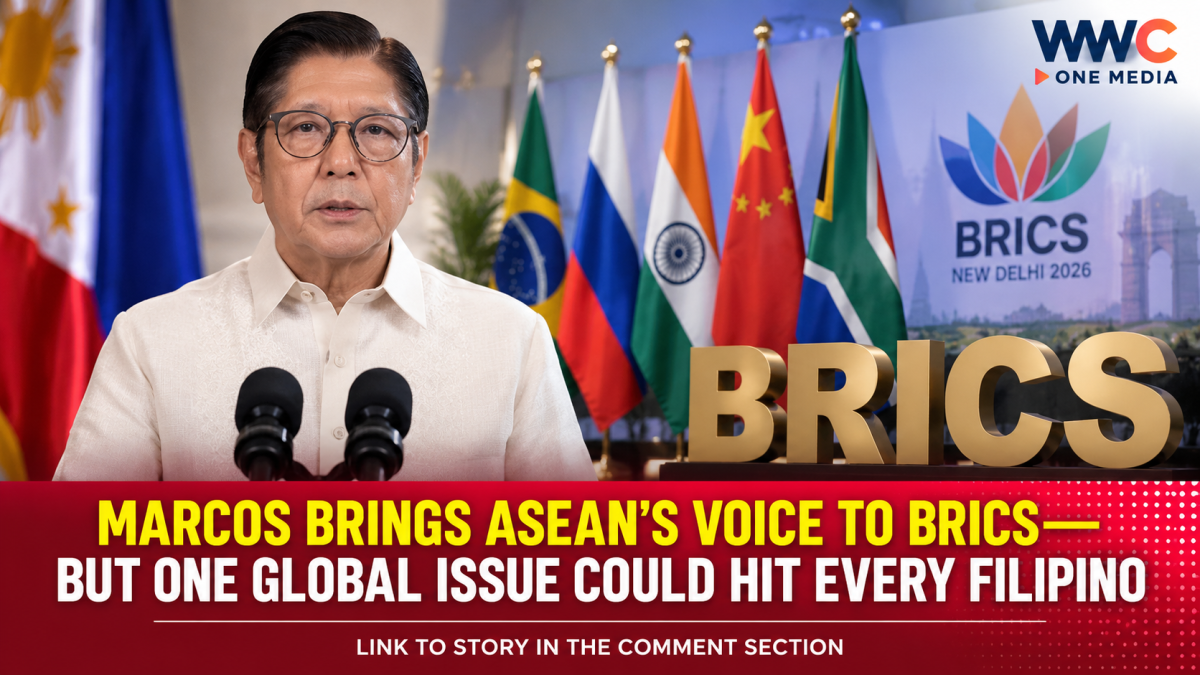
NEW DELHI, India — President Ferdinand “Bongbong” Marcos Jr. is bringing the Philippines’ and ASEAN’s concerns on peace, food security and energy security to the 18th BRICS Summit in New Delhi, as global economic and geopolitical pressures continue to threaten stability.
Marcos arrived in India for the two-day summit on September 12–13, where he is participating as chairman of the Association of Southeast Asian Nations (ASEAN) and as an invited outreach country.
The President said the Philippines sees the BRICS gathering as an important opportunity to work with major emerging economies at a time when the global economy is facing profound changes and mounting pressures.
“We will engage the BRICS community… on advancing our quest for peace, inclusive growth, regional resilience, sustainable development, food and energy security, and a rules-based international order,” Marcos said before leaving the Philippines.
The agenda comes as conflicts and geopolitical tensions continue to create uncertainty for global trade, energy markets and food supplies. BRICS leaders meeting in New Delhi have likewise placed strong emphasis on international security, economic cooperation and energy stability.
According to the Philippine Information Agency and the Presidential Communications Office, Marcos intends to highlight the priorities of the Philippines’ ASEAN chairmanship, particularly peace and security, prosperity, people empowerment, sustainable development and resilience.
Why food and energy security matter to Filipinos
The President’s push comes at a particularly sensitive time for the Philippines.
Global conflicts can quickly affect the prices and availability of fuel, shipping, agricultural inputs and other essential commodities. Energy disruptions can also translate into higher transportation and production costs, eventually putting additional pressure on Filipino households and businesses.
The government has therefore been seeking greater diversification of energy sources and stronger international partnerships to reduce exposure to external shocks.
Marcos has previously discussed energy and food security with other major powers. During his June 2026 meeting with Russian President Vladimir Putin on the sidelines of the ASEAN-Russia summit, the two leaders also discussed cooperation in food and energy security amid the effects of the Middle East conflict.
Philippines seeks stronger ties with BRICS economies
The BRICS engagement also provides Manila with an opportunity to expand economic and diplomatic relationships with some of the world’s major emerging economies.
The Presidential Communications Office said cooperation between ASEAN and BRICS could open opportunities in trade diversification, investment, regional security and climate resilience. The Philippines also wants to ensure that its engagement with BRICS remains consistent with ASEAN centrality.
Marcos is also expected to meet Indian Prime Minister Narendra Modi during the visit to discuss the Philippines-India Strategic Partnership and the implementation of their five-year Plan of Action covering 2025 to 2029.
The President is likewise scheduled to engage Indian business leaders as Manila seeks to build on investment commitments announced during his 2025 state visit to India. Those commitments were valued at about $5.8 billion across sectors including technology, health, energy and infrastructure.
A wider geopolitical backdrop
Marcos’ participation comes as BRICS itself grapples with major geopolitical tensions.
Reports from the New Delhi summit said BRICS leaders have expressed concern over conflicts in the Middle East and Ukraine and have pushed for greater adherence to international law. Reuters also reported that the bloc agreed on a joint declaration that condemns unilateral war, while negotiations sought to bridge differing positions among members.
Energy security has also emerged as a major concern. Reporting from the summit said BRICS leaders emphasized stable and diversified energy markets, resilient supply chains and stronger infrastructure as part of an orderly and inclusive energy transition.
For Manila, these discussions are particularly significant because disruptions in international shipping and energy markets can have direct consequences for an import-dependent economy.
What Marcos wants ASEAN to gain
Rather than treating the BRICS meeting simply as an economic forum, the Marcos administration is positioning the Philippines’ participation as a way to make ASEAN’s priorities heard among major emerging economies.
The government says the Philippines wants partnerships that remain open and resilient while delivering tangible benefits in trade, investment, security, climate resilience and sustainable development.
Marcos’ participation therefore carries a dual message: the Philippines wants to strengthen economic opportunities with emerging powers while continuing to support ASEAN centrality and a rules-based international order.
With global conflicts continuing to threaten energy supplies, food prices and international trade, the discussions in New Delhi could have consequences well beyond the summit room—including for the economic pressures ultimately felt by Filipino consumers.

Leave a Reply