
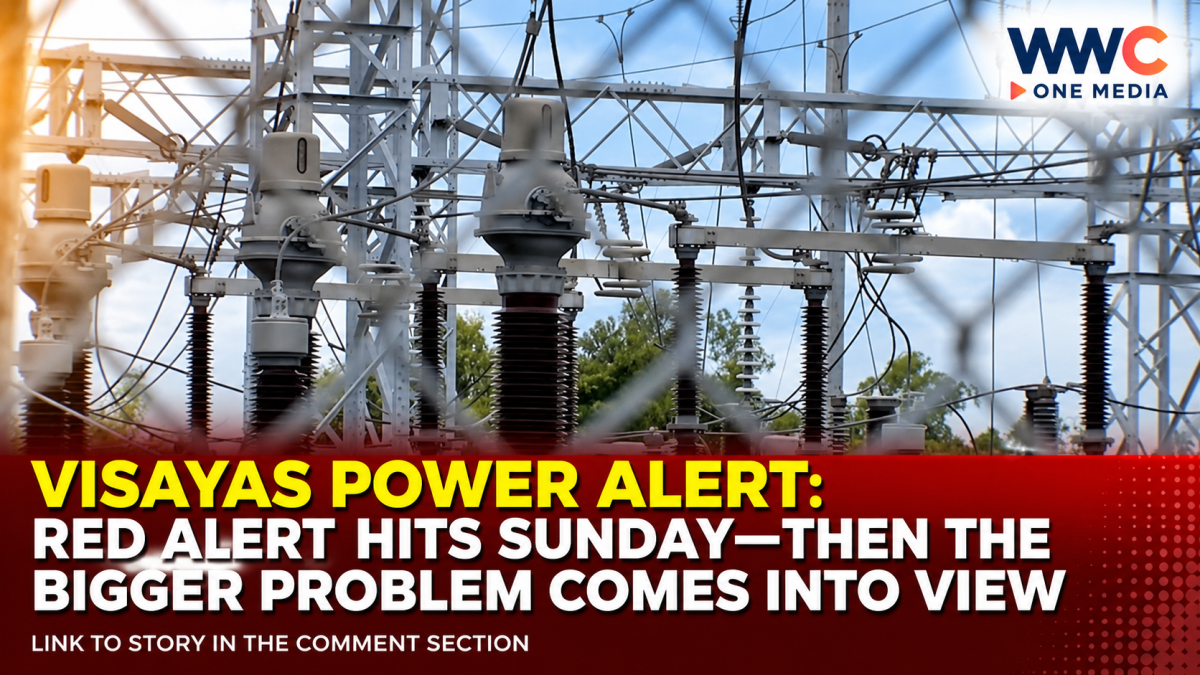
The Visayas power grid is once again facing a critical supply squeeze, with the National Grid Corporation of the Philippines (NGCP) placing the region under yellow and red alert statuses on Sunday, September 13, 2026.
The red alert is scheduled from 6 p.m. to 9 p.m., when electricity demand is expected to put the tightest pressure on available supply. Yellow alerts are scheduled from 5 p.m. to 6 p.m. and again from 9 p.m. to 11 p.m.
According to NGCP, the Visayas grid is expected to have only 2,158 megawatts (MW) of available capacity against a projected peak demand of 2,292 MW.
That leaves the grid with a significant supply gap at a time when demand is expected to climb.
Why is the Visayas grid under alert again?
NGCP said the continuing pressure is being driven by the unavailability of several major generating units.
Among those unavailable are Therma Visayas Inc. (TVI) Units 1 and 2 and Panay Energy Development Corp. (PEDC) Unit 3, all important sources of power for the Visayas grid.
NGCP also reported that a total of 1,044.5 MW of capacity is unavailable because of generating plants on forced outage or operating at reduced, or derated, capacity.
The unavailable capacity includes plants that have been out since September as well as facilities that have experienced outages stretching back several months and years.
At the same time, the Visayas cannot rely fully on additional electricity from Mindanao because power imports from the interconnected Mindanao grid remain limited.
What does a red alert mean for consumers?
A red alert does not automatically mean that every household in the Visayas will lose electricity.
Rather, it signals that available supply is insufficient to meet consumer demand together with the transmission grid’s regulating requirements.
A yellow alert means the grid’s operating margin has fallen below the level required to cover contingency requirements.
However, when the supply situation becomes critical, NGCP can direct distribution utilities to reduce their load through manual load dropping, which can result in rotating power interruptions in affected areas.
This distinction is important: a grid alert is a warning about the condition of the power system, not a guaranteed outage schedule for every location.
The numbers show a problem that has been building
The latest alert is not an isolated incident.
Data cited by the Philippine Information Agency showed that the Visayas grid recorded 96 yellow alerts and 33 red alerts from January 1 through September 7.
The repeated alerts have been accompanied by rotational power interruptions in some parts of the region as supply struggles to keep pace with demand.
Cebu has been particularly exposed because the province accounts for a substantial share of electricity consumption in the Visayas, while generation within Cebu is not enough to cover its requirements. The province therefore relies partly on electricity transmitted from Mindanao and other areas.
DOE races to bring power plants back online
The Department of Energy has been pushing power companies and grid operators to restore generating units that are currently unavailable.
Among the measures being pursued is the accelerated return of generating capacity in both the Visayas and Mindanao, which could eventually provide more breathing room for the interconnected grid.
The government is also accelerating the deployment of 253 MW of battery energy storage and ancillary capacity in strategic locations across the Visayas.
The planned capacity includes:
- 63 MW in Cebu
- 50 MW in Panay
- 100 MW in Negros
- 40 MW in Leyte
Battery storage can respond rapidly when a generating unit trips or when the grid suddenly needs additional support, potentially helping prevent the system from reaching more critical conditions.
Could the situation improve soon?
There are signs of additional generating capacity potentially returning to service, but the immediate power situation remains tight.
The DOE has been coordinating the restoration of several generating units in the Visayas and Mindanao while also examining recurring forced outages and transmission constraints.
Government officials have emphasized that stabilizing the grid is the immediate priority as authorities work toward restoring a more reliable electricity supply.
For consumers, however, the key issue remains the same: whether enough generating capacity returns before the next period of peak demand.
And with another red alert scheduled during Sunday’s evening peak, the pressure on the Visayas grid is far from over.
What consumers should watch
Residents and businesses in the Visayas should monitor advisories from their local distribution utilities, particularly during peak-demand periods.
Consumers should also remember that an NGCP alert does not by itself identify exactly which communities will experience an interruption. Local distribution utilities determine the specific areas affected if load reduction becomes necessary.
The bigger concern is that repeated red and yellow alerts point to a deeper supply problem—one that cannot be solved by a single generating unit returning online.
For now, the Visayas is heading into another critical evening window.
The question is no longer simply whether the grid can survive Sunday’s peak demand—but how quickly the region can restore enough reliable capacity to prevent another round of power shortages.




Leave a Reply