
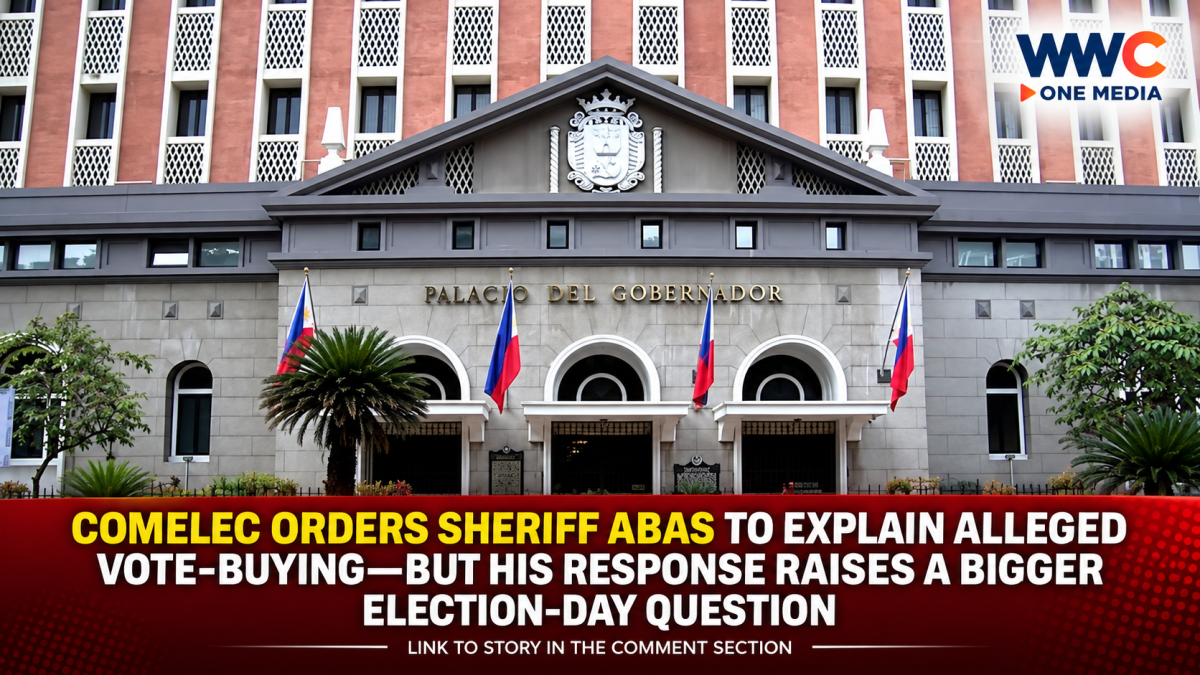
COTABATO CITY — The Commission on Elections (Comelec) has ordered former poll chairman and current BARMM parliamentary candidate Atty. Sheriff Abas to explain an alleged vote-buying incident after photos showing his sample ballots clipped with cash circulated on Facebook.
The Comelec issued a show-cause order, giving Abas 24 hours to submit his explanation regarding the allegations. The move comes just a day before the historic September 14, 2026 Bangsamoro Autonomous Region in Muslim Mindanao (BARMM) parliamentary elections).
Abas, who is running for district representative in the First Parliamentary District of Cotabato City, has strongly denied the allegation.
In a social media post, the former Comelec chairman described the reports as part of what he called a smear campaign and urged the public to verify information before sharing it.
“Fake news and character assassination have no place in elections,” Abas said, while stressing that allegations should be brought before the Comelec through the proper process rather than circulated on social media.
The controversy comes as election authorities intensify their campaign against vote-buying across BARMM.
Comelec tightens the screws on vote-buying
The Abas case comes against the backdrop of a broader Comelec effort to prevent vote-buying and other election violations in the region.
Comelec Chairman George Erwin Garcia earlier announced the creation of task forces across BARMM, including the provinces and the cities of Cotabato and Basilan, specifically to monitor and respond to possible vote-buying incidents.
Garcia warned that the commission could act quickly when it receives a complaint or video evidence. He also said the Comelec has the authority to withhold the proclamation of a candidate in appropriate cases while proceedings are ongoing.
Vote-buying is prohibited under the Omnibus Election Code. Under the law, those found guilty can face imprisonment, disqualification from public office and loss of voting rights.
Vote-buying remains a major concern in BARMM
The controversy also comes as election observers have warned that vote-buying, voter intimidation and other election-related problems remain significant concerns in the region.
A recent pre-election assessment by the Asia Network for Free Elections (ANFREL) and the National Democratic Institute (NDI) identified vote-buying as a persistent concern among BARMM voters, particularly in more remote communities.
The assessment also flagged risks involving voter intimidation, “flying voters,” misinformation, political patronage networks and the potential use of government resources for electoral advantage.
The report noted that some stakeholders consider vote-buying a widespread and normalized practice, raising concerns about whether existing safeguards will be sufficient to protect voters from undue influence.
What happens next to the Abas case?
For now, the Comelec order requires Abas to answer the allegations. It does not, by itself, establish that vote-buying occurred or that Abas committed an election offense.
That distinction is particularly important in light of Philippine jurisprudence. The Supreme Court has ruled that allegations of vote-buying must be supported by credible evidence establishing the elements of the offense; uncorroborated videos or screenshots alone may not be sufficient to establish probable cause.
There is also a notable historical connection: an official Comelec decision signed when Abas was still chairman previously emphasized that allegations involving sample ballots and cash must be supported by sufficient evidence and that the burden of proof rests with the complainant.
That makes the latest controversy especially sensitive as Abas now faces an election-related allegation while campaigning for a seat in the very first elected Bangsamoro Parliament.
Historic BARMM election enters final stretch
The controversy comes just hours before BARMM voters head to the polls for the region’s first regular parliamentary elections.
The September 14 election will choose 80 members of the Bangsamoro Parliament, including party, district and sectoral representatives. The new parliament will eventually elect the region’s Chief Minister, marking a major transition from the interim Bangsamoro Transition Authority to an elected regional government.
Election security has also been significantly reinforced. The Philippine National Police said 9,821 police personnel have been deployed throughout BARMM, with thousands assigned to voting centers, Comelec offices, checkpoints and quick-reaction forces.
With the election only hours away, the Abas controversy puts another spotlight on the Comelec’s ability to enforce election rules while ensuring that allegations are investigated fairly and that voters are protected from both electoral manipulation and misinformation.
For Abas, however, the message is clear: he wants the allegation subjected to due process—not decided in the court of social media.
The bigger question now is whether the Comelec’s investigation will produce evidence that can substantiate the allegation—or whether the controversial photos circulating online will ultimately prove to be another case of unverified election information.



Leave a Reply