
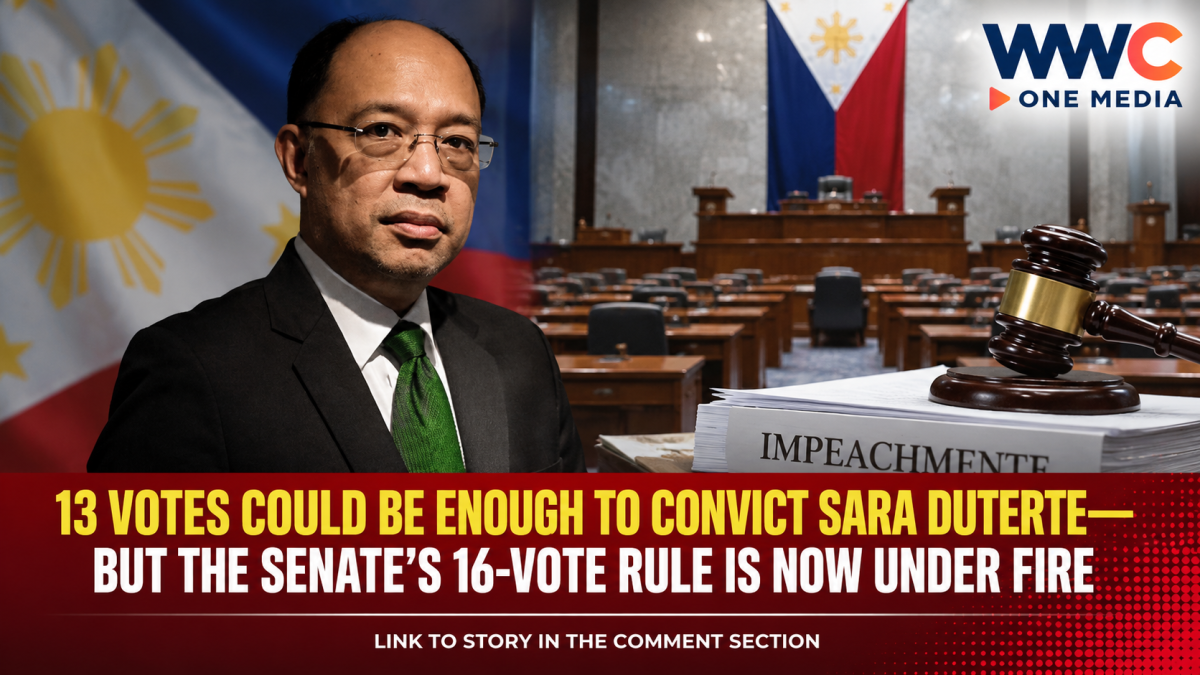
MANILA, Philippines — The battle over the number of votes needed to convict Vice President Sara Duterte has taken a potentially explosive turn, with a legal expert arguing that 13 votes could be enough if only 20 senators are ultimately considered active and eligible to participate in the impeachment proceedings.
Law professor and litigation lawyer Howard Calleja made the argument as the Senate impeachment court prepares to revisit the controversial voting threshold that currently stands at 16 votes.
Calleja said the Constitution does not expressly state that “16” or “24” must be used as fixed numbers when determining the two-thirds requirement. Instead, he argued that the calculation should reflect the senators who remain capable of performing their functions and participating in the proceedings.
That interpretation, however, is not yet the official rule of the impeachment court.
Why 13 votes are now being discussed
The 1987 Constitution provides that an impeached official cannot be convicted without the concurrence of two-thirds of all the members of the Senate.
Because the Philippine Senate has 24 members, the impeachment court initially interpreted that provision as requiring 16 votes for conviction.
Presiding officer Francis “Chiz” Escudero formally ruled at the beginning of Duterte’s trial that 16 affirmative votes would be required. The ruling remains in effect unless the impeachment court changes it or it is overturned through an appropriate legal process.
Calleja’s argument rests on a different interpretation.
If senators who are suspended, detained, in hiding or otherwise unable to perform their duties are excluded from the computation, the number of senators counted could fall.
Under his scenario, three senators — Jinggoy Estrada, Rodante Marcoleta and Ronald “Bato” dela Rosa — would initially be excluded. That would leave 21.
If Senator Loren Legarda, who has been on medical leave, also remains unavailable, Calleja said the number could effectively fall to 20.
Two-thirds of 20 is 13.33, making 13 votes the proposed threshold under his interpretation.
But 16 votes remain the official threshold—for now
The distinction is crucial.
The Senate impeachment court has not declared that 13 votes are sufficient to convict Duterte.
In fact, retired Supreme Court Associate Justice Adolfo Azcuna previously argued that the suspension or detention of senators may affect quorum but does not necessarily reduce the constitutional requirement for conviction, because the Constitution refers to “all” members of the Senate. Under that interpretation, the requirement remains 16 votes.
Senator Sherwin Gatchalian has likewise maintained that the threshold is 16, based on the Senate’s 24-member composition.
That leaves the Senate facing a fundamental constitutional question: Does “two-thirds of all members” mean two-thirds of the entire 24-member Senate, or two-thirds of those legally able to participate?
The issue is heading for a major showdown
The controversy intensified after several senator-judges became unavailable to participate in the trial.
Senators Jinggoy Estrada and Rodante Marcoleta are detained in connection with separate plunder cases, while Dela Rosa has remained absent amid an arrest warrant from the International Criminal Court. Legarda has also been away on medical leave.
Senator-judge Erwin Tulfo raised the issue before the impeachment court, asking whether senators who cannot participate in the proceedings should nevertheless remain part of the calculation when determining the number of votes required for a final decision.
The impeachment court subsequently scheduled proceedings to tackle the threshold issue.
The court is set to hear legal arguments concerning the voting requirement, with the prosecution and defense expected to present their positions later in September.
Even the number of votes needed to change the threshold is being debated
Adding another layer to the dispute, impeachment court spokesperson Reginald Tongol said the court could potentially revisit Escudero’s 16-vote ruling through a vote of the senator-judges.
Philstar reported that, with four senators unavailable and Escudero not voting on his own ruling, 10 votes could initially be enough to overturn the threshold ruling, although the calculation could change depending on attendance.
Later clarification reportedly put the figure at 11 votes under a different attendance calculation, illustrating just how fluid the procedural question has become.
That distinction matters because the court must first decide how many senators are eligible to vote on the threshold itself before it can determine whether the 16-vote requirement should remain.
Public opinion is also split
The controversy has moved beyond the Senate chamber.
A recent Tangere survey found that 54% of respondents favored excluding senators who are unavailable because they are detained, in hiding or outside the country from participating in and determining the required vote.
The survey also found that 53% favored adjusting the two-thirds requirement based on the 20 senators who are actively serving and available.
The findings suggest that the debate over the voting threshold is no longer merely a technical constitutional issue. It has become part of the broader political struggle surrounding Duterte’s impeachment.
What is at stake for Sara Duterte?
The stakes could hardly be higher.
Duterte is facing impeachment allegations involving culpable violation of the Constitution, graft and corruption, betrayal of public trust, bribery and other high crimes. The prosecution has also presented allegations involving the use of confidential funds and Duterte’s alleged threats against President Ferdinand Marcos Jr. and other officials.
Her defense has rejected the accusations and argued that the impeachment effort is politically motivated.
The outcome could also have major political consequences ahead of the 2028 presidential election, when Duterte has positioned herself as a potential presidential contender. Reuters previously noted that the impeachment result could affect the political landscape leading into that election.
The biggest question may no longer be simply “Will Sara Duterte be convicted?”
It may now be:
How many senators will actually be allowed to decide her fate?
For now, 16 votes remains the operative threshold.
But Calleja’s 13-vote interpretation has injected a new possibility into the proceedings: if the Senate ultimately accepts the argument that unavailable senators should not be counted, the number required for conviction could potentially fall.
Whether that interpretation survives constitutional scrutiny — and whether the senator-judges themselves agree — could become one of the most consequential decisions of Duterte’s impeachment trial.
And with the Senate preparing to formally revisit the issue, the fight over the numbers could become almost as important as the impeachment charges themselves.




Leave a Reply