
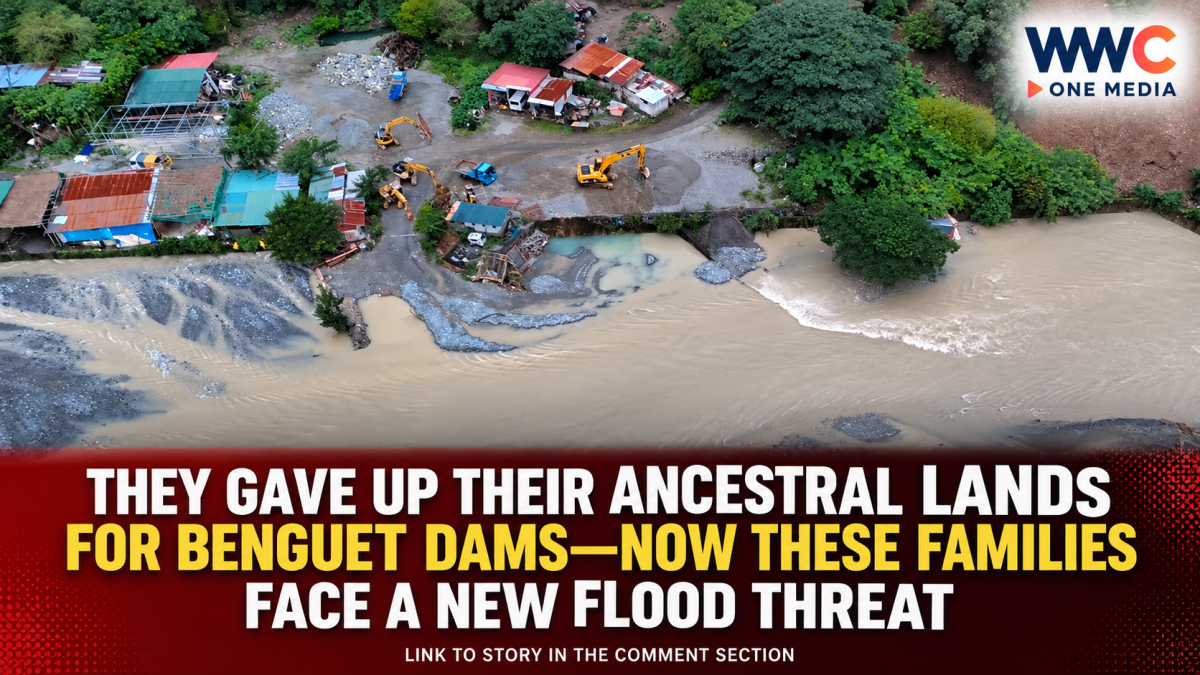
BOKOD, Benguet, Philippines — Decades after Indigenous families gave up ancestral lands to make way for major dams that now help power Luzon, some communities in Benguet are facing a painful new threat: flooding along the very riverbanks where displaced families rebuilt their lives.
Residents of communities along the Upper Agno River in Bokod are calling for urgent government intervention as worsening siltation has reduced the river’s capacity to safely carry floodwaters, increasing the danger to homes, farms and businesses during prolonged rains and typhoons.
The crisis has renewed questions about the long-term impact of the Ambuklao and Binga dam systems on communities that sacrificed land and livelihoods for infrastructure that has supplied electricity to the Luzon Grid for generations.
Riverbed Rising, Flood Risk Growing
Barangay officials in Ambuklao have warned that decades of accumulated sediment, sand, gravel and silt have raised portions of the Upper Agno River, leaving less space for floodwaters during intense rainfall.
According to Barangay Ambuklao officials, the buildup has significantly reduced the river’s capacity and placed nearby homes, agricultural lands and public infrastructure at increasing risk. Residents have appealed for immediate dredging, desilting and improvements to flood-control structures.
The situation became more alarming after prolonged monsoon rains caused the Upper Agno River to swell on Aug. 11, damaging portions of flood-control structures in Ekip and Karao villages and leaving homes and businesses vulnerable to flooding and erosion, according to Bokod Mayor Erik Donn Ignacio.
For residents, the danger is not simply about a single flood event. They fear that every major typhoon or prolonged period of heavy rain could bring the river closer to overflowing.
Displaced by the Dams, Then Drawn Back to the River
The current crisis carries a deeper historical burden for the Indigenous Ibaloi communities of Benguet.
Before Ambuklao Dam began operating in 1956, Ibaloi families lived in Old Ambuklao and depended on ancestral lands and the river for their homes and livelihoods. Families were displaced when land was surrendered for the construction of the dam.
Community leaders have said affected residents were promised relocation and livelihood assistance, but some commitments were allegedly not fully realized. Over time, some displaced families returned and settled along the Upper Agno River, rebuilding their homes and livelihoods near the water.
Today, those same communities are again living with uncertainty—this time because of the growing threat of flooding and erosion.
The issue also reflects a broader historical concern. International Finance Corporation project records related to the Ambuklao-Binga facilities noted possible outstanding land compensation claims connected to the original land acquisition, while recognizing Indigenous Peoples concerns associated with the project.
Benguet Communities Ask Marcos for Help
Barangay Ambuklao officials have formally appealed to President Ferdinand Marcos Jr. for national government intervention.
Their requests include:
- A comprehensive technical assessment of the Upper Agno River and surrounding areas
- Immediate dredging and desilting in high-risk sections
- River-channel improvements
- Construction or rehabilitation of flood-control structures
- A long-term river management plan
Barangay Captain Reynaldo Tello warned that strong typhoons and prolonged rainfall can cause water levels to rise rapidly, putting homes, farms, properties and residents at serious risk.
A Dam System Under Pressure During Heavy Rains
The flood concerns come after repeated spilling operations at Ambuklao and Binga dams during recent periods of heavy rainfall.
On Aug. 31, PAGASA reported that Ambuklao had eight sluice gates open while Binga had six gates open to manage reservoir pressure. PAGASA also placed the Agno River Basin and the Ambuklao-Binga-San Roque sub-basin under Flood Watch at the time.
Earlier in August, both dams also opened spillway gates as continued rains pushed reservoir levels close to critical thresholds.
NAPOCOR reported on Sept. 4 that Ambuklao and Binga were both conducting spillway operations, with water continuing downstream through the Agno River system toward San Roque Dam in Pangasinan.
The dams form part of a cascading system. Water released from Ambuklao flows toward Binga, while downstream flows are eventually managed through the San Roque Dam system in Pangasinan.
This means dam operations, heavy rainfall and the river’s reduced carrying capacity can create a complicated flood-risk situation for communities located near the Upper Agno River.
Benguet Already Reeling From Severe Weather
The warnings from Bokod come as Benguet continues to recover from destructive weather events.
In late August, Benguet was placed under a state of calamity after damages from successive tropical cyclones and the southwest monsoon exceeded P1 billion, according to the Philippine Information Agency.
The severe weather caused widespread flooding, landslides, soil erosion and damage to infrastructure and agricultural areas across the province.
For communities along the Upper Agno River, the disaster highlights why they are demanding preventive action before another major weather event strikes.
The Other Question: Why Do Dam Communities Still Face Power Problems?
Residents have also raised another issue that has added to their frustration.
Despite hosting major reservoirs and hydroelectric facilities that contribute to the Luzon Grid, some communities in Bokod continue to experience unreliable electricity service.
Community leaders have pointed out the irony of producing and hosting infrastructure essential to the region’s power supply while residents themselves remain vulnerable to outages, particularly when typhoons damage power lines and utility posts.
The Ambuklao facility itself is a major part of the country’s power infrastructure. PNA reported that Ambuklao Dam has a capacity of 327 million cubic meters and supports a hydroelectric facility with a generating capacity of 105 megawatts.
Communities Say Protection Cannot Wait
For the Ibaloi families and other residents living near the Upper Agno River, the issue is about more than sediment.
It is about families who lost ancestral lands for national development, rebuilt their lives near the river and now fear that the same landscape could once again take away their homes and livelihoods.
Local officials are pushing for dredging, stronger flood-control infrastructure and a comprehensive technical assessment before the next round of intense rains or typhoons tests the river system again.
The question now facing the government is whether action will come before another flood.
Because for communities that have already sacrificed their ancestral lands for the dams that help power Luzon, another displacement could be a tragedy they say they should never have to endure again.



Leave a Reply