
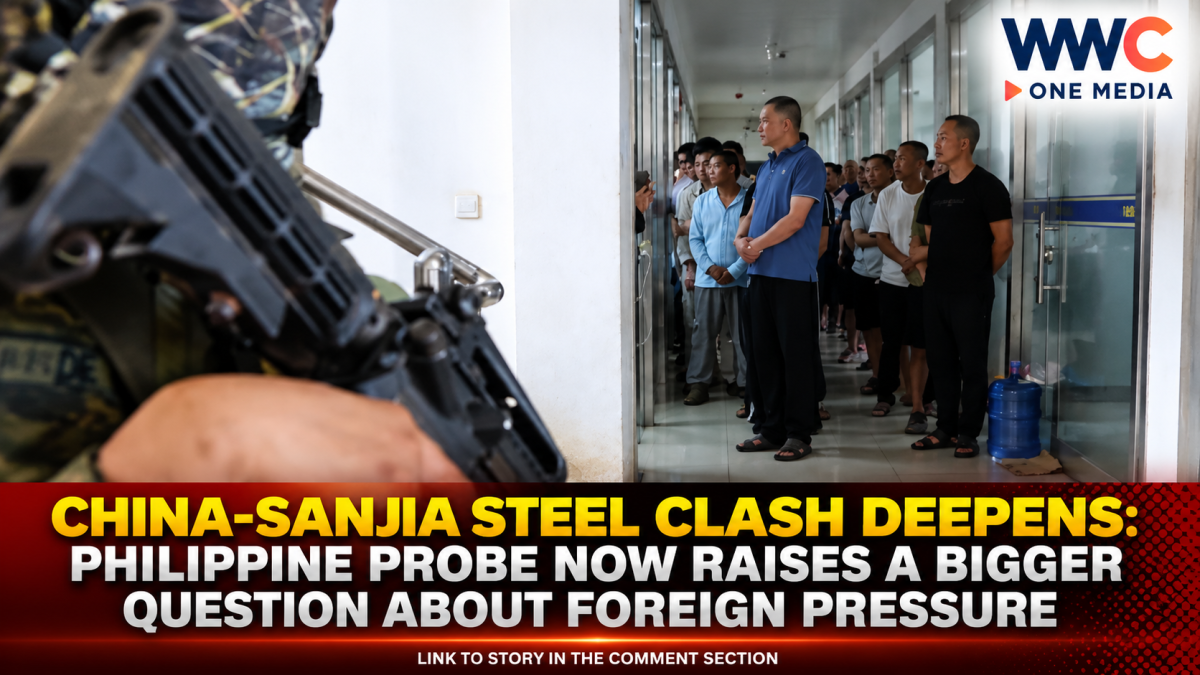
MANILA, Philippines — What began as a law-enforcement operation at a Chinese-linked steel plant in Misamis Oriental has evolved into a far bigger controversy, with Philippine authorities now confronting questions about foreign pressure, industrial regulation, national security and the treatment of Filipino workers abroad.
During a Senate inquiry on Friday, Sept. 11, Presidential Anti-Organized Crime Commission (PAOCC) Undersecretary Benjamin Acorda Jr. said the Chinese Embassy appeared to exert pressure following the May raid on Philippine Sanjia Steel Corp. in Tagoloan, Misamis Oriental.
Acorda told the Senate Committee on Economic Affairs that authorities initially viewed the operation as an enforcement action involving alleged violations of Philippine laws—not a geopolitical confrontation with China.
He said the embassy’s reaction appeared to shift the narrative toward geopolitics after the operation.
The Senate hearing was convened amid growing concerns over the country’s steel industry, compliance with Philippine laws inside special economic zones and the ability of government agencies to protect consumers, workers and the domestic market.
What triggered the Sanjia Steel controversy?
The controversy erupted in May when Philippine authorities conducted an inter-agency operation at the Sanjia Steel facility inside the PHIVIDEC Industrial Estate in Tagoloan.
Authorities arrested 69 Chinese nationals during the operation and investigated alleged violations involving immigration, labor, environmental and nuclear-safety regulations.
Earlier government statements also alleged that the facility had handled scrap materials containing radioactive elements and produced steel products that failed to meet required standards.
The government subsequently suspended operations at the facility.
PNA previously reported that authorities were investigating possible violations of the Philippine Nuclear Energy and Safety Act, the Consumer Act, the Labor Code and immigration laws. Investigators were also examining alleged links involving individuals connected to the company’s operations.
The allegations, however, have been disputed by Sanjia Steel.
The company has maintained that its Chinese technical personnel were properly documented and legally employed and has rejected allegations that it intentionally used radioactive materials or manufactured unsafe steel products.
Sanjia has also argued that the government operation amounted to harassment and said it would contest the allegations through the proper legal channels.
China pushes back
The Chinese Embassy strongly criticized the Philippine operation and questioned the treatment of Chinese workers.
The embassy accused Philippine authorities of selective enforcement and objected to the involvement of senior defense officials and military assets in the operation.
The dispute escalated further in August when the embassy accused Defense Secretary Gilberto Teodoro Jr. of distorting facts surrounding the arrests.
Philippine officials rejected those accusations.
The PAOCC emphasized that the operation was based on alleged violations of Philippine laws and insisted that nationality was not the basis for enforcement.
The Department of Foreign Affairs likewise stated earlier that Philippine law-enforcement operations are directed at specific acts and evidence rather than at any particular nationality.
Then came another layer: the Philippines-China dispute
The latest Senate hearing revealed why the government is now treating the controversy with heightened sensitivity.
Acorda told lawmakers that Chinese officials had questioned why a Cabinet secretary was present during the operation and why the Philippine government had involved the Department of National Defense.
He explained that the Sanjia facility is located within the PHIVIDEC Industrial Estate and that the government’s concerns therefore extended beyond a simple labor or immigration inspection.
The proximity of a port also attracted attention.
Acorda said investigators would examine shipments associated with the port, including how frequently deliveries were made and what materials were being unloaded.
That investigation could potentially broaden the Sanjia controversy beyond the company’s workers and manufacturing operations.
Filipino workers caught in the middle
One of the most sensitive developments came after the Sanjia raid, when reports emerged that Filipino workers in China had been arrested over alleged immigration violations.
During Friday’s Senate hearing, Senator Risa Hontiveros raised concerns that Filipino workers could become collateral damage if the dispute between Manila and Beijing escalates.
Acorda said some Filipinos in China had contacted him and urged Philippine authorities not to back down.
The issue adds a diplomatic dimension to an investigation that initially centered on alleged violations at a Philippine industrial facility.
The US-China angle
The Sanjia controversy has also acquired a strategic dimension because of the facility’s location and its potential relevance to Philippine-US military activities.
In August, the Armed Forces of the Philippines confirmed that Filipino and US personnel had visited the area as part of a routine site-scoping activity connected to future Balikatan exercises.
The US Embassy said its personnel were assessing the site’s potential use for bilateral military exercises, but the team left after being informed that written authorization was required to enter the premises.
The AFP stressed that the visit was not an attempt to take over or occupy the private facility.
The development nevertheless added another layer to an already sensitive dispute involving Manila and Beijing.
Why the steel issue matters
The controversy is not only about foreign nationals or diplomacy.
The Senate inquiry is also examining the broader condition of the Philippine steel industry.
Lawmakers are concerned about whether existing regulations are strong enough to prevent unsafe products from entering the domestic market, protect workers and consumers, and ensure that companies operating inside economic zones comply with Philippine law.
Hontiveros said the Senate inquiry had exposed regulatory and enforcement gaps and that the committee would consider measures to make steel regulations more effective and binding.
The stakes are significant.
Steel is a fundamental material for construction, infrastructure and manufacturing. Any questions involving the quality or safety of steel products can therefore have consequences extending well beyond one company.
The bigger question now
The Sanjia Steel case has become a test of how the Philippines handles a difficult balancing act.
Manila must enforce its laws and protect public safety while avoiding discrimination against foreign nationals.
At the same time, Philippine officials must manage diplomatic relations with China without allowing foreign pressure to dictate domestic law enforcement.
The controversy is also unfolding against a wider strategic environment in which Philippine-US security cooperation has expanded and Manila’s relationship with Beijing remains sensitive.
That is why the Sanjia case has attracted attention far beyond Misamis Oriental.
What started with a raid at a steel facility is now touching on industrial policy, worker protection, immigration enforcement, national security, Philippine sovereignty and Manila-Beijing relations.
For the Philippine government, the challenge is no longer simply determining what happened inside Sanjia Steel.
It is demonstrating that whatever the outcome of the investigation, Philippine laws are enforced consistently, transparently and without regard to nationality—while ensuring that legitimate diplomatic concerns do not derail an ongoing legal process.
And with the Senate investigation still open to further hearings and a possible technical working group, the Sanjia Steel story may be far from over.

Leave a Reply