
CARMONA, Cavite — What was once associated with waste and an abandoned landfill has been given a dramatically different purpose.
Executive Secretary Ralph Recto is urging local government units (LGUs) across the Philippines to look at the transformation of a former sanitary landfill in Carmona, Cavite as a possible model for turning underutilized public land into productive, environmentally friendly and disaster-ready community spaces.
The call came after Recto joined Metropolitan Manila Development Authority (MMDA) Chairman Romando Artes and other officials during the inauguration of the MMDA Nature Park and related development projects in Sitio Paligawan Matanda, Barangay Lantic, Carmona, on September 11.
A landfill gets a second life
The former sanitary landfill has been repurposed into a multi-use facility combining green space, disaster preparedness, agriculture, environmental activities and community-oriented facilities.
The project was originally conceptualized during the tenure of former MMDA chairman and now Cabinet Secretary Benhur Abalos, following the administration’s push for additional green and open spaces for recreation and environmental enhancement.
Recto described the transformation as an example of what can happen when government agencies and local governments work together to maximize public assets.
He particularly pointed to the convergence of programs at the site, including agricultural initiatives associated with Kadiwa ng Pangulo, as an example of how government facilities can serve several public purposes at once.
But the project’s significance goes beyond simply converting a former dumpsite into a park.
It is also being built for disasters
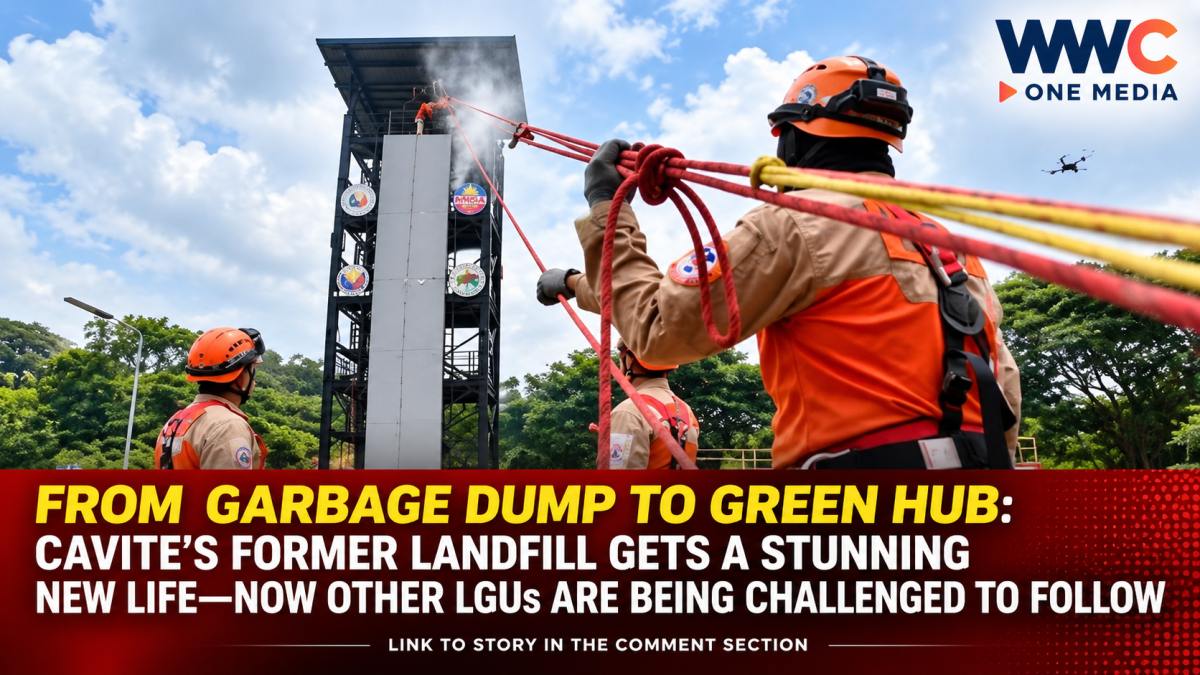
One of the major components of the development is a Disaster Preparedness Training Facility, designed to strengthen emergency-response capabilities in Metro Manila and nearby communities.
According to the MMDA, the facility is not intended solely for its own personnel. It can also be used by LGUs, volunteers, partner agencies and community organizations that want to improve their disaster-response skills.
The training complex includes facilities designed to simulate real emergency situations, including:
- a rappelling tower;
- confined-space structures;
- a simulated wrecked building and rubble pile;
- a pancake-collapse structure;
- a fire-suppression training area; and
- a vehicle simulator.
During the inauguration, disaster-response personnel from the MMDA and Metro Manila disaster risk-reduction offices demonstrated their capabilities at the facility.
More than just a park
The redevelopment also includes a Bamboo Pavilion, livestock farm and seedling nursery, expanding the site’s role beyond recreation and emergency training.
Other reports on the project have highlighted additional sustainability and resilience components associated with the development, including agricultural and environmental initiatives intended to make the property useful to surrounding communities.
The transformation is particularly notable because the property was previously used as a sanitary landfill before being rehabilitated.
Instead of leaving the former landfill as an unused or environmentally problematic property, authorities are attempting to turn it into an asset that can support public recreation, disaster preparedness and sustainable development.
Why the timing matters
The initiative comes as the Philippines continues to confront the overlapping challenges of solid-waste management, flooding, extreme weather and disaster preparedness.
Recent government discussions have placed renewed emphasis on improving waste-management systems and reducing the environmental consequences of improperly handled garbage.
The Philippine Information Agency recently reported that President Ferdinand R. Marcos Jr. had cited the former Carmona sanitary landfill’s conversion into the MMDA Nature Park as an example of how improved waste-management practices and the repurposing of former waste facilities can contribute to broader environmental and disaster-preparedness objectives.
The broader waste-management issue remains pressing. PIA reported this month that the Department of Environment and Natural Resources–Environmental Management Bureau in Calabarzon had intensified monitoring of landfill facilities following the redirection of some Metro Manila waste to disposal sites in Rizal.
That context makes the Carmona project more than a simple beautification effort.
It represents a different question for local governments: What can be done with land that can no longer serve its original purpose?
Recto wants other LGUs to take notice
Recto’s message was essentially a challenge to other local governments: the Carmona experience could be replicated elsewhere, particularly where LGUs have idle or underutilized properties that could be converted into productive public spaces.
The idea is to move beyond simply maintaining unused government land and instead develop properties that can simultaneously support environmental protection, public recreation, food production and disaster resilience.
For Carmona, the former landfill’s transformation also gives the community another potential destination for environmental and educational activities.
For Metro Manila and surrounding areas, meanwhile, the disaster-training component could provide another venue where responders and volunteers can practice before an actual emergency strikes.
A possible template for Philippine cities
The Carmona project arrives at a time when Philippine communities are increasingly being forced to think about resilience not as a single disaster-response activity but as part of everyday urban planning.
Earlier this month, Marcos also urged cities and municipalities to learn from Marikina’s integrated solid-waste management system, emphasizing that proper waste segregation, collection, recycling and recovery can contribute to efforts to address flooding.
The Carmona project adds another piece to that conversation: what happens to land after its original use is over?
The answer emerging from the former landfill in Cavite is striking.
A property once used to handle waste is now being positioned as a place for green space, disaster training, agriculture and community development.
And if Recto’s challenge gains traction, Carmona may not remain the only Philippine community turning yesterday’s landfill into tomorrow’s public asset.




Leave a Reply