
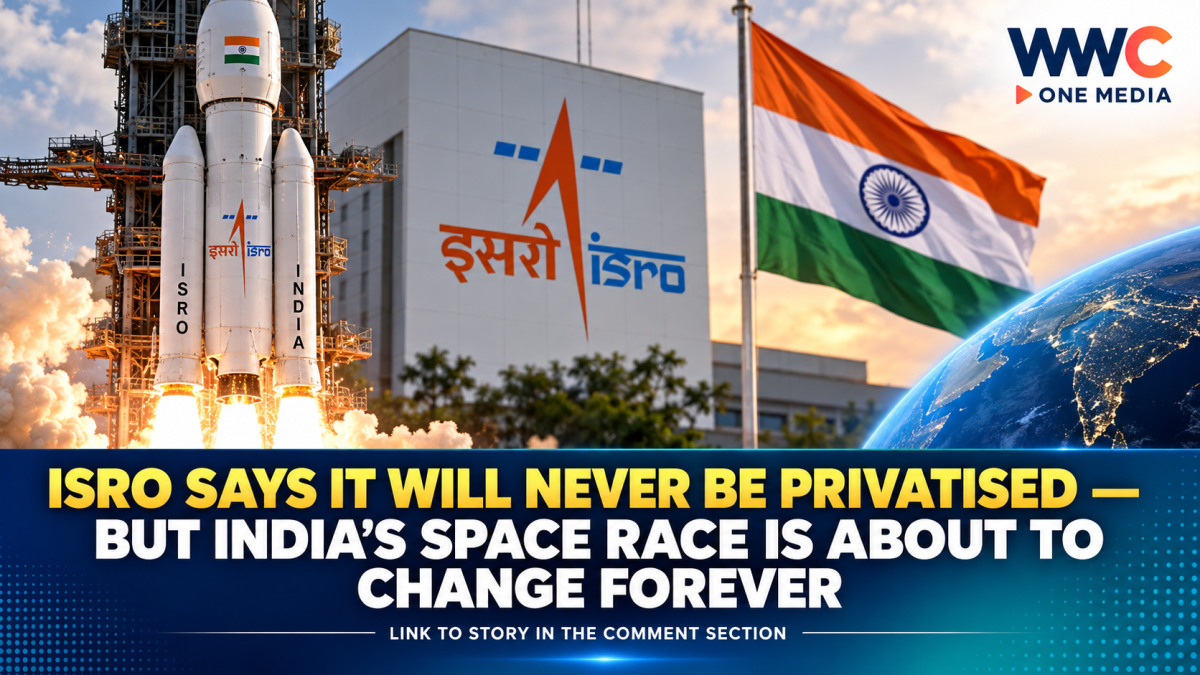
BENGALURU, India — India’s space agency has moved to calm growing concerns among its own workforce and the wider scientific community, declaring that the Indian Space Research Organisation, or ISRO, will not be privatised and will remain the country’s leading institution for advanced space research and national missions.
The reassurance comes as India accelerates one of the biggest transformations in its space programme in decades: shifting more manufacturing, commercial and operational activities to private companies while ISRO focuses on frontier technologies, deep-space exploration and strategically important missions.
ISRO said speculation that the government intends to privatise the agency or reduce its importance is “completely baseless and incorrect.” The agency stressed that its role would remain central to India’s future in space.
But the controversy reveals a much bigger question facing one of the world’s fastest-growing space powers:
Can India successfully turn ISRO from a government-dominated space operator into the scientific engine of a massive commercial space ecosystem — without weakening the institution that built the country’s space ambitions?
ISRO Draws a Clear Line: Private Sector Expansion Is Not Privatisation
In its September 6 clarification, ISRO said it would continue to serve as India’s principal organisation for:
- Advanced space research and technology development
- National and strategic missions
- Space science and exploration
- Critical and frontier space capabilities
The agency said greater private-sector participation is intended to allow industry to take mature technologies and capabilities to a larger commercial scale.
That, ISRO argued, would free its scientists and engineers to focus on the next generation of India’s space programme.
The message from ISRO is clear: industry will increasingly build and scale; ISRO will continue to innovate, explore and lead.
The distinction is crucial because India’s government has spent years trying to move the country’s space sector away from a model in which ISRO handled much of the research, development, manufacturing and operational work itself.
Why ISRO Employees Became Worried
The clarification followed concerns raised by ISRO staff associations, which sought answers from agency chairman V. Narayanan over reports and statements concerning the future transfer of manufacturing and operational responsibilities to private companies and other entities.
Employees reportedly wanted greater clarity on how the reforms could affect:
- ISRO’s long-term role
- Existing employees
- Manufacturing responsibilities
- Technology transfers
- Future recruitment
- The agency’s scientific capabilities
The concerns intensified after discussions surrounding the possibility of industry taking on a much larger role in producing launch vehicles and satellites — areas historically associated closely with ISRO’s capabilities.
ISRO’s response was designed to reassure employees that expanding the commercial space ecosystem does not mean abandoning the agency’s core mission.
India Is Rebuilding Its Space Industry
India formally opened its space sector to greater private participation in 2020, beginning a major shift in how the country approaches space development.
The government has since created a broader institutional framework involving several key organisations:
ISRO
Responsible primarily for advanced research, technology development, major national missions and frontier space capabilities.
IN-SPACe
The IN-SPACe facilitates and authorises non-government participation in India’s space sector.
NSIL
NewSpace India Limited focuses on commercialising mature ISRO technologies and capabilities.
ISRO says this new structure gives different parts of India’s space ecosystem distinct responsibilities rather than replacing the agency.
Private Investment Is Already Surging Into India’s Space Industry
India’s commercial space ambitions are no longer theoretical.
Government data released in July said private investment in India’s space sector had crossed US$618.5 million, while 105 authorisations had been issued to private entities as reforms accelerated.
The private ecosystem is also attracting increasingly large funding rounds.
On September 7, Indian space technology company Pixxel announced a US$100 million Series C funding round, according to Reuters — described as the largest funding round for an Indian space technology company.
The investment highlights the growing confidence surrounding India’s private space industry, which now includes companies developing:
- Satellite constellations
- Earth observation systems
- Launch vehicles
- Space data platforms
- Advanced sensors
- Commercial space services
The transformation could eventually make India a much bigger competitor in the global commercial space economy.
ISRO’s Future Focus: Moon, Space Station and Deep Space
The government’s Space Vision 2047 places enormous new demands on ISRO.
According to the agency, India’s ambitions include:
🛰 Bharatiya Antariksh Station by 2035
India plans to establish its own space station, significantly expanding its long-term human spaceflight capabilities.
Indian Crewed Moon Mission by 2040
India aims to eventually send Indian astronauts on a crewed mission to the Moon.
Next-Generation Launch Systems
ISRO is also expected to develop more advanced and reusable launch technologies.
Sustained Planetary Exploration
India plans to expand exploration beyond Earth orbit and continue lunar and planetary science missions.
ISRO says these goals require the agency to concentrate its scientific workforce on technologies that cannot simply be replaced by commercial manufacturing.
This is the central argument behind India’s space reforms:
Let companies manufacture mature technologies at scale while ISRO builds the technologies of the future.
From Chandrayaan to Commercial Space Power
ISRO enters this transformation with one of the strongest reputations in the global space community.
India has already:
- Sent the Mangalyaan mission to Mars
- Successfully landed Chandrayaan-3 near the Moon’s south polar region
- Developed indigenous launch vehicles
- Built a major satellite programme
- Advanced its human spaceflight programme
The agency’s ability to deliver relatively cost-efficient missions has become a major source of India’s technological prestige.
But India’s next challenge is fundamentally different.
Success will no longer be measured only by whether ISRO can launch a spacecraft or land on the Moon.
It will also depend on whether India can create a self-sustaining space economy involving private companies, investors, manufacturers, universities and international customers.
Technology Transfers Are at the Heart of the Debate
One reason the reforms have generated anxiety is the increasing transfer of mature ISRO technologies and capabilities to industry.
ISRO’s latest framework argues that technology transfer should be seen as capability multiplication, not institutional retreat.
The agency says India’s growing industrial base is increasingly capable of handling mature and scalable activities.
That could allow private companies to manage large-scale production and commercialisation while ISRO develops more advanced technologies.
However, critics and concerned employees fear that too rapid a transfer of responsibilities could eventually erode the expertise and capabilities that made ISRO successful in the first place.
That tension is now emerging as one of the biggest challenges in India’s space transformation.
The Big Question: Can India Protect ISRO While Expanding Business?
ISRO insists there is no contradiction between a stronger private space industry and a powerful government space agency.
In fact, its leadership argues that one depends on the other.
Private companies need access to:
- Mature technologies
- Infrastructure
- Testing capabilities
- Technical expertise
- Regulatory support
- Commercial opportunities
Meanwhile, ISRO needs industry to provide:
- Manufacturing capacity
- Investment
- Commercial scale
- Faster production
- Access to global markets
The challenge will be finding the right balance.
Countries with successful commercial space sectors typically rely on a combination of government-funded research, national security programmes and private innovation.
India is now attempting to build that model at extraordinary speed.
What Happens Next for ISRO?
For now, ISRO has delivered its strongest reassurance yet:
It will not be privatised. Its importance will not be reduced.
But the agency is also making something else equally clear.
The old model — in which ISRO did almost everything — is changing.
Private companies will increasingly take responsibility for scaling technologies that have already matured. New institutions will manage commercialisation and private-sector participation. ISRO, meanwhile, wants to push deeper into advanced research, human spaceflight, reusable rockets, lunar exploration and planetary missions.
The strategy could make India’s space ecosystem dramatically larger.
But it also means ISRO is entering one of the most consequential transitions in its history.
The agency that helped put India on the Moon is now preparing for a future where it may build fewer of the systems it pioneered — while aiming to develop technologies that could take India much farther into space.
And that raises the question that will define India’s next space decade:
If private companies take over the business of building India’s space industry, can ISRO successfully focus on building India’s future beyond Earth?
WWC ONE MEDIA J.M.S




Leave a Reply